

Stone Fireplace Ideas That Work in Any Home

The strongest fireplace stone ideas right now are full-height bookmatched quartzite slabs, stacked ledgestone in warm honey tones, honed marble surrounds, rough-cut limestone with a timber mantel, smooth granite hearths, and soapstone panels. Design perspectives for 2026 confirm the shift away from cool gray and stark white toward warm, grounded palettes and organic textures. The single deciding factor is usually heat exposure: wood-burning fireplaces demand granite, quartzite, or soapstone near the firebox; gas and electric inserts open the door to marble and limestone surrounds.
Quick-pick guide:
- Full-height bookmatched quartzite slab — best for modern or transitional rooms with high ceilings; creates a seamless architectural wall
- Stacked ledgestone in warm amber or cream — best for rustic, farmhouse, or casual living rooms; works at any scale
- Honed marble surround — best for classic or transitional interiors; keep it away from direct firebox heat
- Rough-cut limestone with timber mantel — best for farmhouse or cottage styles; pairs with wide-plank floors
- Smooth granite hearth and surround — best for high-heat wood-burning fireplaces; nearly indestructible
- Soapstone panels — best for a matte, tactile look in contemporary or Scandinavian-inspired rooms; no sealing required
- Warm-tone quartzite (Taj Mahal, White Macaubas) — best for buyers who want marble’s elegance with better heat tolerance
- Manufactured stone veneer — best for budget-conscious renovations or lighter-load framed walls
Immediate next steps:
- Measure the firebox opening and the full wall height
- Note your insert brand and model to confirm clearance requirements
- Pull three to five stone samples and hold them against your wall color in natural and artificial light
- Consult a licensed mason or tile installer before ordering full quantities
Key Takeaways
Granite, quartzite, and soapstone are the only safe choices for direct firebox surrounds in wood-burning fireplaces; marble and limestone belong on the mantel and overmantel, away from sustained heat.
| Point | Details |
|---|---|
| Match stone to heat zone | Use granite, quartzite, or soapstone at the firebox; marble and limestone suit the surround and mantel only. |
| Veneer vs. full stone | Veneer works well for gas and electric fireplaces on reinforced substrates; full masonry is preferred for high-use wood-burning applications. |
| Seal porous stones regularly | Marble and travertine need sealing roughly every 2–3 years; granite rarely; soapstone not at all. |
| 2026 trend direction | Warm neutrals and organic textures (honey quartzite, rough limestone, soapstone) are replacing cool gray palettes. |
| Surfacesgalore for sourcing | Direct-import natural stone with sample ordering and nationwide shipping supports fireplace projects from design to installation. |
Table of Contents
- What are the best fireplace stone ideas by style?
- How do you choose the right stone, finish, and layout?
- What you need to know about stone types, veneer, and installation
- How do you clean and maintain a stone fireplace?
- Design and installation mistakes that cost you later
- Why stone sourcing and installer experience matter
- Natural stone samples and collections at Surfacesgalore
- Sources
- FAQ
What are the best fireplace stone ideas by style?
Stone fireplace design is most satisfying when the material and the room’s architecture speak the same language. Below are five style directions, each with specific stone choices, finishes, and one practical styling note.
Modern minimalist: full-height slabs and bookmatched stone
The defining move here is running stone floor to ceiling with no interruption. Full-height slab and bookmatched installations create a continuous veining pattern that reads as a single architectural element rather than applied cladding. Taj Mahal quartzite is a standout choice: its warm ivory ground and soft gold veining give the marble look without the heat sensitivity. White Macaubas quartzite works similarly. Finish these in a honed or leathered surface rather than polished; polished stone on a fireplace wall catches glare and shows every fingerprint.
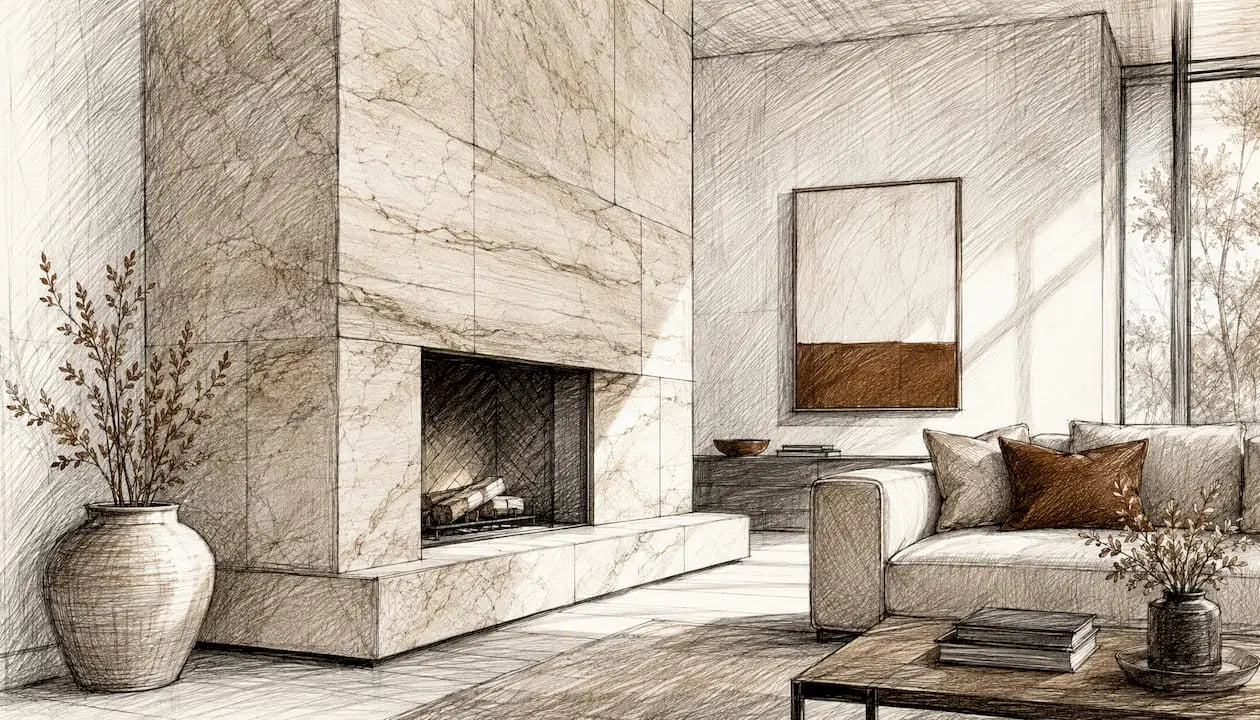
Pro Tip: For a bookmatched slab wall, ask your stone supplier to pull consecutive slabs from the same block. The mirror-image veining only works when the slabs are matched at the quarry level, not assembled from random inventory.
Scale guidance: full-height stone suits ceilings above nine feet. Below that, a slab that stops at the mantel line reads better proportionally.
Transitional: marble surrounds with clean mantels
A marble surround framed by a simple, low-profile mantel is the workhorse of transitional design. Calacatta or Carrara marble in a honed finish softens the formality without losing elegance. Mantel trends in 2026 favor clean architectural profiles, fluted or reeded details, and floating mantels that feel substantial rather than decorative. Pair a marble surround with a floating shelf mantel in white oak or painted MDF for a look that ages well.
One styling note: keep the marble to the surround and hearth only. Extending it up the full wall in a transitional room can feel cold. A band of painted drywall above the mantel, or a simple plaster finish, gives the marble room to breathe.
Rustic and farmhouse: fieldstone and rough-cut limestone
Nothing grounds a room like a full fieldstone fireplace built from locally sourced river rock or quarried limestone. The texture is the point: split-face limestone with visible tool marks, irregular coursing, and deep mortar joints creates warmth that no smooth slab can replicate. Pair with a rough-hewn timber mantel and the combination reads as genuinely old rather than styled.
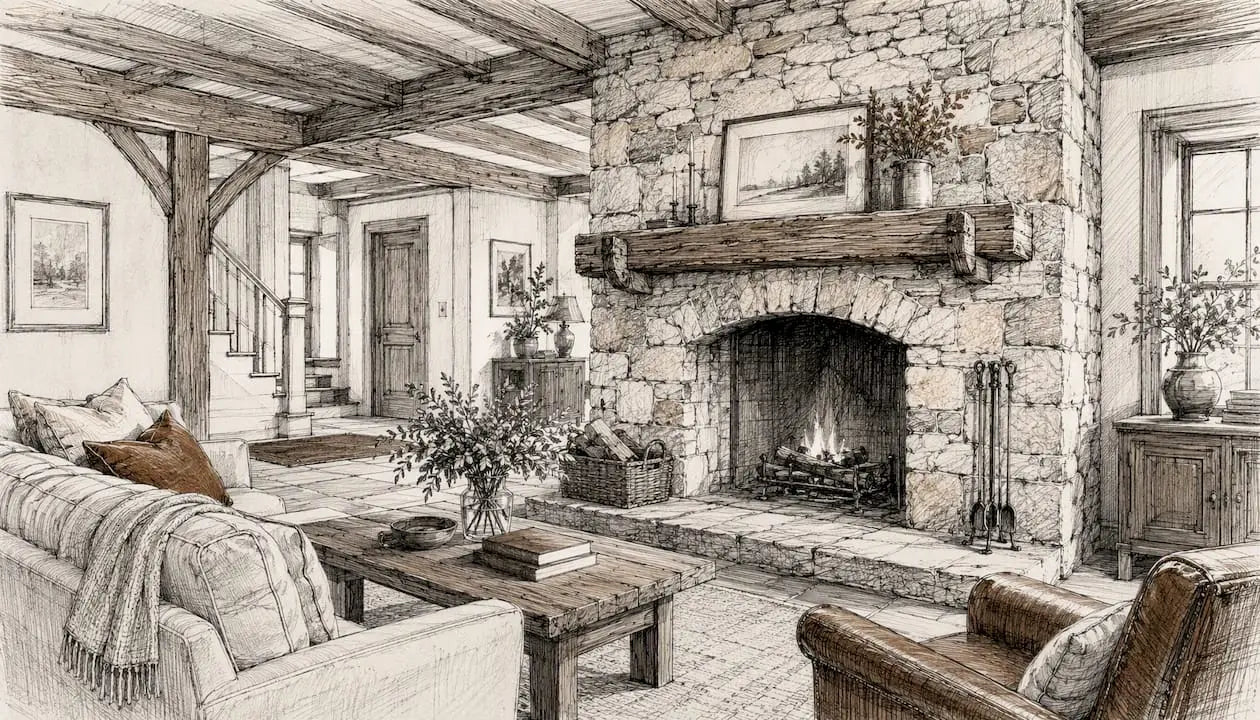
Pro Tip: Fieldstone fireplaces look best when the stone courses vary in height. Avoid uniform brick-like rows; ask your mason to mix large anchor stones with smaller fill pieces for a natural, gathered look.
For a lighter version of this style, stacked ledgestone panels in cream, buff, or warm brown give a similar texture at a fraction of the weight and cost. These work particularly well on framed walls where full-thickness stone is not structurally feasible.
Contemporary veneer: stacked ledgestone with linear inserts
Stacked ledgestone paired with a linear gas insert is the most popular contemporary fireplace look in new construction right now. The horizontal lines of the ledgestone echo the wide, low proportions of a linear firebox. Choose a warm-toned ledgestone in honey, sandstone, or charcoal rather than the cool gray that dominated the last decade. The 2026 trend direction is explicitly warmer: terracotta undertones, sandy creams, and muted golds are replacing the slate grays.
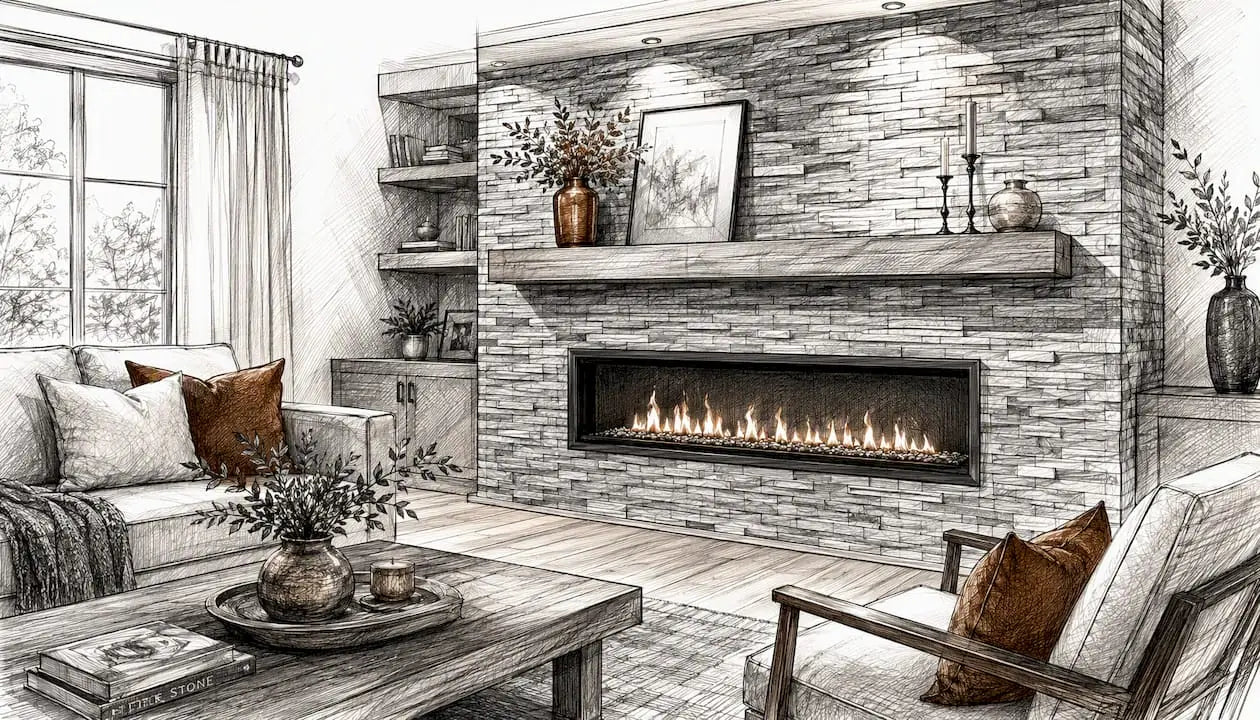
Scale guidance: ledgestone works at any height, but a floor-to-ceiling application on a wide wall needs a strong horizontal anchor, usually a floating shelf or a recessed media niche, to keep the eye from drifting upward without purpose.
Classic: granite hearths and carved stone mantels
Granite is the most heat-resistant common fireplace stone, and a polished or flamed granite hearth is a practical choice for wood-burning fireplaces. Black Absolute, Giallo Ornamental, and Baltic Brown are perennial choices. For a carved stone mantel, limestone and marble are traditional materials; just keep carved limestone away from direct firebox heat, as calcite stones can spall under repeated thermal cycling.
Pro Tip: A flamed granite finish, created by applying a high-heat torch to the surface, produces a slightly rough, non-slip texture that is ideal for hearth slabs. It also hides soot and minor scuffs far better than a polished finish.
How do you choose the right stone, finish, and layout?
Start with the fireplace type. A wood-burning fireplace generates sustained radiant heat; the firebox surround and hearth must be granite, quartzite, or soapstone. Gas inserts run cooler and allow marble or limestone on the surround, though keeping calcite stones at least six inches from the firebox opening is still good practice. Electric inserts generate almost no radiant heat and are compatible with any stone.
Decision checklist:
- Confirm insert type (wood, gas, electric) and pull the manufacturer’s clearance spec sheet
- Measure the firebox opening width and height, the full wall width, and ceiling height
- Photograph the room in natural light to assess undertones in flooring, trim, and walls
- Request physical samples (minimum 6 × 6 inches) and hold them against the wall for 48 hours across different lighting conditions
- Ask your installer for a substrate plan before ordering stone
Scale rules of thumb:
- Ceilings above nine feet: full-height stone reads as intentional architecture
- Ceilings eight feet or below: stop stone at the mantel line or use a framed surround
- Narrow rooms: avoid busy veining patterns; choose a quieter stone and let the form do the work
- Open-plan rooms: the fireplace wall can carry bolder stone because it competes with more visual noise
Natural stone has color variation between lots, and a repair or extension six months later from a different lot will never match.*
Finish and texture:
- Honed: matte, velvety, hides scratches; best for marble and limestone surrounds
- Polished: reflective, formal; best for granite hearths and classic marble surrounds
- Leathered: slightly textured, low-sheen; excellent for quartzite and granite in contemporary rooms
- Split-face: rough, dimensional; best for ledgestone and fieldstone in rustic applications
Budget and timeline buckets:
- Entry-level: manufactured stone veneer panels, installed; fastest timeline, lightest weight
- Midrange: natural stone veneer or slab surround with a standard mantel; two to four weeks from demo to completion
- Premium: bookmatched full-height natural slab with custom mantel; four to eight weeks including fabrication
What you need to know about stone types, veneer, and installation
Material primer: which stone goes where
Granite, quartzite, slate, marble, limestone, and stone veneer are the most common fireplace surround materials. Each has a different heat tolerance, maintenance profile, and visual character.
| Zone | Recommended stones | Avoid |
|---|---|---|
| Firebox surround (high heat) | Granite, quartzite, soapstone, slate | Marble, limestone, travertine |
| Hearth slab | Granite, quartzite, soapstone, slate | Polished marble (slippery) |
| Mantel shelf | Marble, limestone, granite, quartzite | None if away from direct heat |
| Overmantel / full wall | Any stone; veneer appropriate | Calcite stones near heat source |
Professional masons note that calcite-based stones (marble, limestone, travertine) can crack or spall when exposed to repeated high heat cycles. Granite and quartzite are the safe choices for the firebox surround. Soapstone is a lesser-known option worth considering: it absorbs and radiates heat evenly, develops a natural patina over time, and requires no sealing.
Pro Tip: Soapstone darkens with age and oil exposure. If you want a consistent dark finish from day one, rub the surface with mineral oil at installation. If you prefer the natural progression, leave it untreated and let it develop character.
Stone veneer vs. full-thickness stone
Veneer (typically 3/4 inch to 1.5 inches thick) is the practical choice for most renovations. It weighs far less than full-thickness stone (which runs 3–4 inches), so it can be applied over framed walls without structural reinforcement in most cases. Veneer offers a cost-effective, lighter-weight way to achieve many stone looks, but installation quality and substrate anchoring are the critical variables.
For veneer over framed walls, the substrate must be reinforced with corrosion-resistant anchors and a continuous thermal movement joint to prevent cracking as the wall heats and cools. Full-thickness stone on a masonry substrate is the traditional approach for wood-burning fireplaces and is still preferred when the authentic look and long-term durability outweigh the higher cost.
Installation essentials:
- Substrate: cement board or masonry for veneer; existing masonry for full stone
- Mortar: use a heat-rated mortar for firebox zones; standard thinset is not appropriate near direct heat
- Anchoring: corrosion-resistant mechanical anchors for veneer on framed walls
- Thermal joints: leave expansion gaps at corners and transitions to accommodate heat cycling
- Dry lay: always dry-lay natural stone before setting to control color distribution
Cost and timeline estimates:
- Manufactured veneer panel install: lower end of the range; typically one to two weeks from demo to finish
- Natural stone veneer reface: midrange; two to three weeks including substrate prep and mortar cure
- Custom full-height slab surround: highest cost; four to eight weeks including slab fabrication, delivery, and cure
Pro Tip: Request slab photos from your supplier before fabrication begins. Natural stone slabs vary significantly within the same material name. Seeing the actual slab, not a catalog photo, is the only way to confirm the veining and color match your design.
How do you clean and maintain a stone fireplace?
Stone fireplaces are low-maintenance compared to painted or wood surrounds, but they are not maintenance-free. The key variables are stone type, finish, and how often the fireplace is used.
General cleaning rules:
- Use a pH-neutral stone cleaner for all natural stone; avoid vinegar, bleach, or ammonia-based products on calcite stones (marble, limestone, travertine)
- For honed and leathered finishes, a damp microfiber cloth removes most soot and dust without chemical cleaners
- For textured split-face stone, a soft-bristle brush loosens debris from the crevices before wiping
- Never use abrasive scrubbers on polished or honed surfaces
Pro Tip: For light soot on a marble or limestone surround, mix a small amount of dish soap with warm water and apply with a soft cloth. Rinse thoroughly and dry immediately. Standing water on calcite stone can etch the surface over time.
Sealing frequency by stone type:
- Marble and travertine: seal at installation, then roughly every 2–3 years depending on use and finish
- Granite: sealing is rarely required; test by placing a few drops of water on the surface and watching for absorption
- Soapstone: no sealing required; mineral oil is optional for appearance only
- Quartzite: seal at installation; retest annually and reseal when water no longer beads
Soot removal:
- Light soot: pH-neutral cleaner and a soft cloth
- Heavy soot or smoke staining: a poultice paste (baking soda and water, or a commercial stone poultice) applied and left for 24 hours, then rinsed
- Chimney smoke damage or deep staining: call a professional stone restoration company; DIY abrasives can permanently damage the surface
Seasonal inspection checklist:
- Check mortar joints for hairline cracks or crumbling; regrout as needed before the heating season
- Look for hearth settlement or lippage (one tile higher than adjacent)
- Inspect the firebox throat and damper for soot buildup before first use each season
- Check the chimney cap and flashing if you use a wood-burning fireplace
Design and installation mistakes that cost you later
The most common errors
The Natural Stone Institute and experienced masons consistently flag the same cluster of mistakes in residential fireplace projects.
Top mistakes to avoid:
- Wrong stone for the heat zone: placing marble or limestone directly on the firebox surround of a wood-burning fireplace; calcite stones crack under repeated thermal cycling
- Ignoring insert clearances: every gas and wood insert has a manufacturer-specified clearance to combustibles; stone is non-combustible, but the framing behind it is not
- Oversized mantel: a mantel shelf that projects more than the insert clearance spec allows is a fire code violation in most jurisdictions
- Skipping the dry lay: setting natural stone without a dry lay first leads to color clustering, where all the dark pieces end up on one side
- Underestimating substrate needs: veneer on an unprepared drywall substrate will crack within one to two heating seasons
- Mismatching veining direction: running quartzite or marble veins horizontally on one section and vertically on another creates visual chaos
Red flags when vetting installers:
- No substrate plan provided before quoting
- Cannot show photos of previous stone fireplace installations
- Proposes standard thinset for firebox-zone work
- No mention of thermal expansion joints
- No references from homeowners with similar projects
Finishing details that separate good from great
Grout color is a design decision, not an afterthought. A grout that matches the stone’s mid-tone makes joints disappear and the surface reads as continuous. A contrasting grout highlights the coursing pattern, which works for ledgestone but can look busy on a large-format slab.
Edge profiles on hearth slabs matter for safety and aesthetics. A bullnose or eased edge on a hearth slab is safer than a sharp 90-degree corner, particularly in homes with children. A mitered edge on a slab surround creates a seamless corner that reads as a single piece of stone rather than two pieces meeting.
When planning a TV above a fireplace, confirm the insert’s heat output and flue direction before mounting. Many gas inserts vent forward and upward, which can push heat directly into the display. A recessed niche with a heat shield, or a side-venting insert, solves the problem without sacrificing the design. Thermal clearance is not a suggestion; it is a code requirement.
Pro Tip: During the dry lay, have your mason photograph the full layout from the room’s natural viewing distance, not up close. Color patches that look minor at arm’s length can read as jarring from across the room. Adjust before setting.
Why stone sourcing and installer experience matter
What provenance and slab selection actually affect
Natural stone color variation is not a defect; it is the material’s character. But unmanaged variation, where one corner of a fireplace wall runs noticeably darker than the other, is an installation failure, not a stone failure. The seller and installer share responsibility for managing it. A reputable stone supplier pulls slabs from the same lot, photographs them together, and flags significant variation before shipment. A skilled mason sorts the pieces during dry lay to distribute color evenly.
Natural Stone Institute best practices emphasize that material selection and installation technique are inseparable. The most beautiful slab, poorly installed on an unprepared substrate, will crack. A modest stone, carefully sorted and set on a properly reinforced substrate, will outlast the house.
Installer checklist:
- Request a written substrate plan that specifies backer type, anchor method, and mortar specification
- Confirm heat-clearance compliance for your specific insert model
- Ask for photos or a portfolio of similar stone fireplace installations
- Verify insurance and licensing for your state
- Get a project schedule that includes mortar cure time before grouting and finishing
The difference between a fireplace that looks great on installation day and one that still looks great in fifteen years comes down to two things: the right stone in the right zone, and a substrate that was prepared as if the installer expected the wall to move. Because it will.
Pro Tip: Before the final set, request a small dry-laid mockup on-site and photograph it from the room’s main seating position. Confirm the joint layout and color distribution in writing before the mason begins setting. Changes after mortar cures are expensive.
How Surfacesgalore supports your project
Surfacesgalore is a direct importer of premium natural stone, which means the slabs and tiles come from the quarry with fewer intermediaries and more consistent documentation of origin. For fireplace projects, that matters: you can request slab photos, order samples before committing to full quantities, and get natural stone for living rooms shipped nationwide from Anaheim, California. The inventory spans marble, limestone, travertine, and specialty stones suited to the full range of fireplace stone ideas covered here.
A note on where stone fireplace design is actually heading
The pull toward warm, organic stone in 2026 is not a trend cycle; it is a correction. A decade of cool gray and white minimalism left a lot of fireplaces looking like they belonged in a hotel lobby rather than a home. The shift back to honey-toned quartzite, rough limestone, and soapstone is really a shift back to materials that feel like they have been somewhere. Full-height slabs read as confident and architectural, but they work best when the stone itself has enough movement and warmth to carry the scale. A large, flat, cold-gray slab is just a wall. A large, warm quartzite slab with gold veining is a room’s anchor.
Veneer gets a bad reputation it does not fully deserve. When the substrate is right and the installer knows what they are doing, a natural stone veneer fireplace is indistinguishable from full-thickness stone at normal viewing distances. The honest tradeoff is not appearance; it is longevity under extreme heat cycling. For gas and electric fireplaces, veneer is a smart choice. For a high-use wood-burning fireplace, full masonry is still the safer long-term bet.
Natural stone samples and collections at Surfacesgalore
Surfacesgalore ships premium natural stone nationwide, direct from import, so you get authentic marble, limestone, and travertine at prices that reflect the source rather than a retail markup. For a fireplace project, the practical starting point is a sample order: pick three to five stones that fit your style direction, hold them against your wall, and confirm the color in your actual lighting before committing to full quantities.
The collections include honed and leathered marble tiles suited to transitional surrounds, warm-toned limestone for farmhouse and rustic applications, and travertine options that work beautifully on overmantel walls. Browse the marble and natural stone collections and use the sample ordering process to get physical pieces in hand before your installer begins substrate prep. The team supports projects from design through delivery, with slab photos available on request and nationwide shipping from Anaheim, California.
Sources
The following sources informed the material, installation, and trend guidance in this article:
- Top design trends in fireplace mantle surrounds for 2026 — Fireside
- Stone Fireplace Surrounds: Materials, Design & Care – Dynamic Stone Tools
- Natural Stone Institute
- 36 Stone Fireplace Ideas From Natural to Modern - The Spruce
- Top 2026 Fireplace Ideas & Surround Trends You Need to Know — DPD360
- Designing With Fire in 2026: What Top Designers Prioritize - DreamCast Design and Production
FAQ
What stone is best for a fireplace surround?
Granite, quartzite, and soapstone are the safest choices for the firebox surround of a wood-burning fireplace because they withstand sustained high heat without cracking. Marble and limestone work well on the mantel and overmantel but should stay at least six inches from the firebox opening.
What is the trend in fireplace surrounds in 2025 and 2026?
The dominant direction is warm, organic palettes replacing cool gray minimalism: honey-toned quartzite, rough limestone, and soapstone are gaining ground, and full-height bookmatched slab installations are increasingly popular for a seamless architectural look.
How often does a stone fireplace need to be sealed?
Sealing frequency depends on the stone: marble and travertine typically need resealing every 2–3 years; granite rarely needs it; soapstone requires no sealing at all. Test granite by placing a few drops of water on the surface and watching whether it absorbs.
Can I use stone veneer on a wood-burning fireplace?
Stone veneer can be used on the overmantel and surrounding wall of a wood-burning fireplace, but the firebox surround and hearth should use full-thickness, heat-rated stone on a masonry substrate. Veneer on framed walls requires corrosion-resistant anchors and thermal movement joints to survive repeated heating cycles.
How do I choose between a full-height slab and a framed surround?
Ceiling height is the primary guide: rooms with ceilings above nine feet can carry a full-height stone wall without feeling heavy, while rooms with eight-foot ceilings read better with stone stopped at the mantel line. Budget and structural load capacity are the secondary factors, since full-height slabs require more material, fabrication, and often substrate reinforcement.
Leave a comment