

Limestone tile: The complete guide for stylish renovations

TL;DR:
- Limestone tile offers natural variation, warmth, and versatility in various home design styles.
- Proper sealing, maintenance, and professional installation are essential for long-term durability.
- It is ideal for low-to-moderate traffic areas like foyers, bathrooms, and fireplaces, less so for high-traffic kitchens.
Not all stone tiles behave the same way underfoot, and choosing the wrong one can cost you both money and peace of mind. Limestone tile has quietly become one of the most sought-after natural stone options for American homeowners who want warmth, character, and a look that feels genuinely timeless rather than trendy. But because it shares shelf space with marble, travertine, and ceramic lookalikes, it’s easy to misunderstand what limestone tile actually is, how it performs long-term, and whether it’s the right fit for your renovation. This guide covers everything you need to know.
Table of Contents
- What is limestone tile? Origins and defining features
- Pros and cons of limestone tile for your home
- Where limestone tile works best in home renovations
- How limestone tile compares to marble and travertine
- Limestone tile care: Cleaning, sealing, and lasting beauty
- The truth about limestone tile: What most guides won’t tell you
- Ready to explore limestone tile for your home?
- Frequently asked questions
Key Takeaways
| Point | Details |
|---|---|
| Natural stone composition | Limestone tile is a sedimentary rock cut into tiles, offering unique and natural appeal. |
| Pros and cons balance | It combines beautiful aesthetics with care requirements like sealing and proper cleaning. |
| Best applications | Limestone tile excels in foyers, bathrooms, and accent walls, but requires thoughtful placement. |
| Maintenance commitment | Regular sealing and gentle cleaning are essential to keeping limestone tile in top shape. |
| Informed comparison | Limestone stands out from marble and travertine for its texture and maintenance needs. |
What is limestone tile? Origins and defining features
Now that you know there’s more than meets the eye to stone tiles, let’s dig into exactly what makes limestone tile unique.
Limestone tile is a natural-stone product made by quarrying limestone from the earth and cutting it into uniform tiles sized for floors and walls. Limestone tile is natural-stone tile made from a sedimentary rock composed primarily of calcium carbonate, formed over millions of years as marine organisms, shells, and mineral deposits compressed under enormous pressure beneath ancient seas. This geological process is what gives limestone its signature layered look and subtle texture. It’s not manufactured in a factory. It comes directly from the earth.
Once quarried, limestone blocks are cut into slabs and then into individual tiles using precision saws. The tiles go through various finishing processes depending on the intended use. A honed finish produces a smooth, matte surface that’s popular for floors and walls alike. A brushed or tumbled finish adds a more rustic, aged appearance with soft edges. Polished limestone is less common than polished marble because limestone’s softer composition makes high-gloss finishes harder to maintain over time.
“Limestone offers homeowners something synthetic materials simply cannot replicate: the natural record of millions of years of geological history, visible in every unique vein, fossil impression, and mineral variation across the surface.”
What really sets limestone apart visually is its color palette and natural variation. You’ll find limestone tiles in creamy whites, warm beiges, soft golds, cool grays, and even blush tones. Many limestone tiles contain visible fossils, shell imprints, and organic markings that make each tile one of a kind. This natural variation is part of the charm, but it also means you’ll need to dry-lay tiles before installation to check for pattern balance.
| Feature | Details |
|---|---|
| Stone type | Sedimentary natural stone |
| Primary mineral | Calcium carbonate |
| Common finishes | Honed, brushed, tumbled, polished |
| Typical colors | Cream, beige, gold, gray, blush |
| Origin regions | France, Turkey, Israel, United States |
| Primary uses | Floors, walls, accents, fireplaces |
The natural stone design benefits extend well beyond aesthetics. Because limestone is quarried directly from the earth, it doesn’t off-gas chemicals or rely on synthetic binders, making it a genuinely clean material for indoor living spaces.
Pros and cons of limestone tile for your home
Understanding how limestone tile is crafted naturally leads to the question: Should you actually consider it for your home? Let’s weigh the pros and cons honestly.
The biggest draw of limestone tile is its beauty. No two tiles are exactly alike, which means your floor or accent wall will never look mass-produced. Limestone’s muted, earthy tones complement a wide range of design styles, from Mediterranean and Tuscan to modern farmhouse and minimalist contemporary. It pairs easily with wood, metal, and natural fiber furnishings, making it a flexible choice for homeowners who like to evolve their interior style over time.
Limestone’s pros include natural, unique character and style versatility, while its cons include the need for ongoing sealing, heavier weight compared to ceramic or porcelain, and higher susceptibility to staining without consistent care. This honest summary matters because some homeowners choose limestone based on photos alone and are surprised by the upkeep reality.
Key advantages of limestone tile:
- Genuinely unique appearance with natural variation in every tile
- Warm, comfortable feel underfoot, especially compared to colder stones like polished marble
- Works well in both traditional and contemporary design schemes
- Scratch-resistant surface holds up well against everyday furniture movement
- Naturally cool in summer, which makes it comfortable in warm climates
- Long lifespan when properly maintained, often lasting decades
Key drawbacks to consider:
- Porous surface absorbs stains quickly without proper sealing
- Heavier than ceramic or porcelain, which may require structural reinforcement in some installations
- More prone to etching from acidic substances like citrus juice, wine, or vinegar-based cleaners
- Higher installation cost due to weight, tile fragility during cutting, and the expertise required
- Requires periodic resealing, typically every one to two years depending on traffic and use
| Factor | Limestone | Ceramic | Porcelain |
|---|---|---|---|
| Natural appearance | Excellent | Poor | Moderate |
| Maintenance level | High | Low | Low |
| Scratch resistance | Good | Moderate | Excellent |
| Stain resistance (sealed) | Good | Excellent | Excellent |
| Durability | Good | Good | Excellent |
| Cost per sq. ft. | Moderate to high | Low | Low to moderate |
Pro Tip: Seal limestone tile before grouting during installation, and then again immediately after grouting is complete. This two-stage sealing process creates a stronger moisture barrier and dramatically reduces the risk of grout residue staining the tile surface permanently.
For homeowners comparing options, reading a detailed travertine vs limestone guide can help clarify which natural stone fits your maintenance lifestyle and design goals before you commit to purchasing.
Where limestone tile works best in home renovations
Knowing the benefits and limitations, it’s crucial to understand where limestone tile truly excels in residential spaces.
Limestone tile genuinely shines in specific areas of the home. Foyers and entryways are a classic choice because they benefit from limestone’s natural elegance while experiencing relatively moderate foot traffic compared to a kitchen or hallway. A honed limestone floor in a foyer creates an immediate first impression of quality and sophistication without the sterile feel of polished marble.
Bathrooms are another strong application, particularly for walls and shower surrounds. Because you control moisture exposure in a bathroom setting (through good ventilation and consistent sealing), limestone can perform beautifully there for years. Many designers use limestone tiles on bathroom floors with radiant heating beneath, which enhances that warm, comfortable feel underfoot. Before starting a bathroom project, reviewing a detailed bathroom wall tile workflow helps you plan for proper waterproofing, which is essential with any natural stone in wet areas.
Living rooms and dining rooms offer lower moisture risk, making them ideal for limestone floors. The natural texture provides subtle grip underfoot, and the earthy tones anchor large furniture arrangements without competing with them visually. Limestone also performs very well as a fireplace surround, where its heat tolerance and natural look create a striking focal point. For help planning a living room tile installation, layout and tile orientation make a significant difference in how the finished space feels.
Best rooms and applications for limestone tile:
- Foyers and grand entryways with moderate foot traffic
- Bathroom floors and walls with proper waterproofing and sealing
- Shower surrounds and wet room walls (with epoxy grout and penetrating sealant)
- Living room and dining room floors in low-to-moderate traffic areas
- Fireplace surrounds and hearth tiles
- Accent walls in hallways or feature rooms
- Outdoor patios in mild, dry climates (with weather-rated stone)
Areas where limestone may not be the best choice:
- High-traffic kitchens where daily spills, grease, and acidic foods are common
- Busy commercial spaces or rental properties where consistent sealing is hard to guarantee
- Outdoor installations in climates with heavy freeze-thaw cycles, as moisture expansion can damage the stone
Because limestone requires sealing and can chip or crack during installation, professional installation is strongly recommended. This isn’t a DIY-friendly tile for beginners. The weight requires proper substrate preparation, and cutting limestone cleanly requires diamond-blade wet saws and experienced hands.
Pro Tip: Use limestone primarily as an accent or feature tile in higher-risk areas like kitchens rather than covering the entire floor. A limestone island base, backsplash section, or feature wall brings all the visual appeal without exposing the entire floor to constant stain risk.
How limestone tile compares to marble and travertine
Homeowners often debate between limestone, marble, and travertine. Let’s see how limestone stacks up against these alternatives.
All three are natural stone, and all three develop from calcium carbonate. But the similarities largely end there. Limestone is a sedimentary rock formed by compression and time, while marble is limestone that has been transformed by extreme heat and pressure underground, a process called metamorphism. That transformation is what gives marble its distinctive crystalline structure and brilliant polish. Travertine, by contrast, forms when mineral-rich spring water deposits calcium carbonate in layers, creating the signature pitted and banded structure that makes travertine so recognizable.
These geological differences create very real practical differences in how each stone looks and performs in a home renovation.
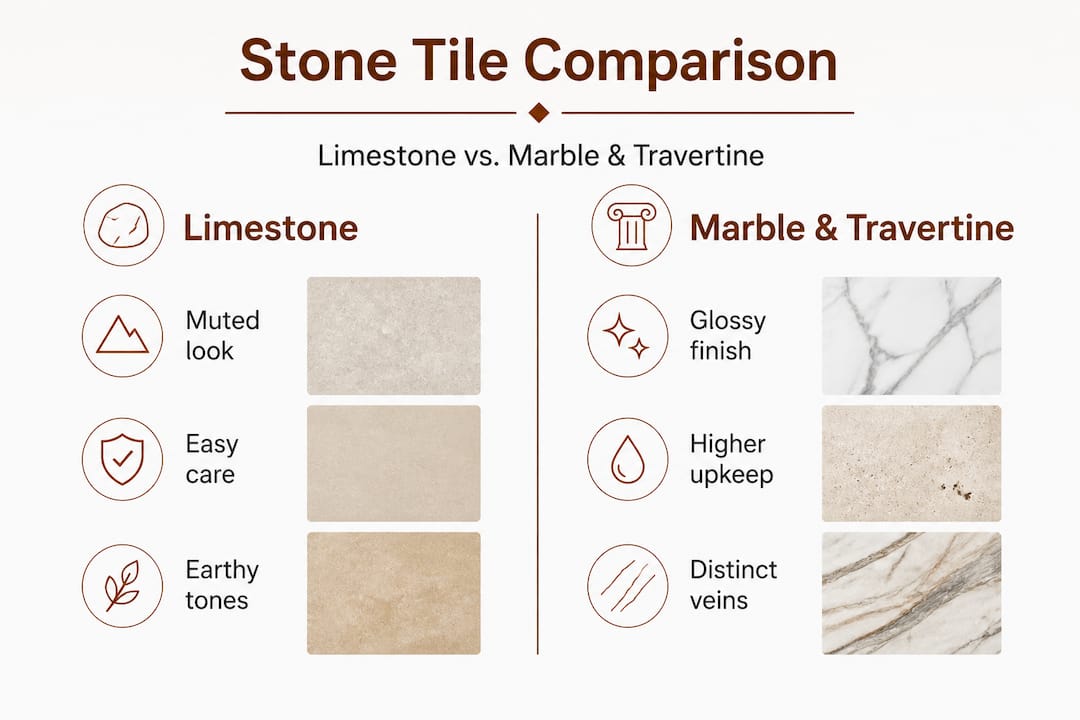
- Appearance and character. Limestone delivers soft, muted tones with subtle organic variation. Marble has dramatic veining and a high-polish sheen that commands attention. Travertine sits in between, with its earthy warmth and distinctive pores that give it a more rustic appeal.
- Hardness and scratch resistance. Marble is harder than limestone, which makes polished marble more durable against scratches in high-traffic areas. Travertine is similar in hardness to limestone. For everyday residential use, all three perform well with proper care.
- Maintenance demands. All three require sealing, but marble is more prone to etching from acids due to its high polish reflecting imperfections. Limestone’s honed surface hides minor etching better. Travertine has its pores to deal with, which need to be filled and sealed consistently.
- Design versatility. Limestone works across the widest range of design styles precisely because it doesn’t dominate a room. Marble makes a bold statement but can feel imposing in smaller spaces. Travertine reads as warm and casual, which is perfect for Mediterranean or Southwest-inspired designs.
- Cost comparison. Entry-level limestone and travertine tiles are often more affordable than high-end marble, making them accessible for homeowners on a renovation budget without sacrificing the natural stone look.
| Stone | Formation | Surface | Maintenance | Best for |
|---|---|---|---|---|
| Limestone | Sedimentary | Muted, organic | Seal 1-2x yearly | Warm, casual, versatile spaces |
| Marble | Metamorphic | Dramatic, polished | Seal 1-2x yearly | Formal, luxurious spaces |
| Travertine | Mineral deposits | Warm, pitted | Seal and fill pores | Mediterranean and rustic styles |
For a deeper comparison between marble and non-stone alternatives, the marble vs ceramic comparison offers useful insight into what drives the cost and performance difference. If you’re still deciding between natural stone options, exploring the full limestone vs travertine differences breakdown can help you narrow down which stone fits your project.
Limestone tile care: Cleaning, sealing, and lasting beauty
Once you’ve selected limestone tile, proper care is essential to protect your investment and preserve its natural beauty.
The good news is that caring for limestone tile isn’t complicated. It just requires consistency. The core routine involves three things: gentle daily cleaning, periodic deep cleaning with the right products, and a sealing schedule that keeps the stone protected from moisture and stains.
Here’s a practical step-by-step care routine to follow from day one:
- Sweep or dust-mop daily. Fine grit and dust act like sandpaper underfoot over time, slowly abrading the surface. A dry microfiber mop picks up debris without scratching. This simple daily habit protects your investment more than any product.
- Clean with a neutral-pH cleaner. Avoid vinegar, lemon-based products, bleach, and multi-surface bathroom sprays. All of these are acidic or chemically aggressive and will etch the calcium carbonate in limestone, leaving dull spots. Use a stone-safe, pH-neutral cleaner diluted in warm water.
- Wipe up spills immediately. Don’t let coffee, wine, oil, or citrus juice sit on limestone even for a few minutes. Blot, don’t rub, to prevent spreading the stain deeper into the pores.
- Apply penetrating sealant every one to two years. Because limestone requires sealing and is susceptible to chipping or cracking without proper preparation and ongoing care, using a high-quality impregnating sealant that soaks into the stone rather than sitting on top is essential. Apply it with a clean cloth, let it penetrate for the manufacturer’s recommended time, and buff off any excess.
- Use floor mats and area rugs in high-traffic zones. Place mats inside entry doors and in front of kitchen sinks to catch the grit and moisture that cause the most wear. Make sure the backing of any rug or mat is non-slip and breathable so it doesn’t trap moisture against the tile.
- Inspect grout lines annually. Cracked or deteriorating grout can allow moisture to get underneath the tile, which causes problems over time. Regrout damaged areas promptly to maintain a watertight installation.
Pro Tip: Test your sealant by placing a few drops of water on the tile surface. If the water beads up and doesn’t absorb within a few minutes, your sealant is still working. If the water soaks in and darkens the stone, it’s time to reseal. This quick test takes 30 seconds and removes all guesswork from your maintenance schedule.
The truth about limestone tile: What most guides won’t tell you
Beyond the how-to details, let’s get real about what it’s like to live with limestone tile. Here’s what most guides overlook.
We’ve seen hundreds of limestone tile installations across all types of homes, from modern California bungalows to traditional East Coast colonials, and the pattern that emerges is clear: the homeowners who are most satisfied with limestone are the ones who chose it with eyes open, not just eyes wide at how gorgeous it looked in a showroom.
Limestone’s natural variation is simultaneously its greatest asset and its most common source of frustration. Some homeowners fall in love with a sample tile, place their order, and are surprised when the installed floor looks different from what they imagined. That’s not a defect. That’s the nature of natural stone. Within a single quarry batch, tones can shift from pale cream to warm gold depending on the depth of extraction. This variation is what gives limestone its soul, but it requires you to order more tiles than you think you need (typically 10 to 15 percent extra), dry-lay them before installation, and work with an installer who understands how to blend tiles from multiple boxes for visual cohesion.
The maintenance commitment is also something many buyers underestimate until they’re living with it. When you choose limestone, you’re signing up for a long-term relationship that includes thoughtful cleaning product choices, annual sealant checks, and the discipline to wipe spills quickly. For some households, particularly those with young children or heavy kitchen activity, this level of care becomes genuinely burdensome. There’s no shame in recognizing that and choosing a lower-maintenance stone or even a high-quality porcelain tile that mimics limestone’s look. Choosing the wrong material for your lifestyle will cost you far more in frustration and repair than choosing the right material from the start.
That said, for homeowners who are willing to maintain limestone properly, following sound tiling process tips from the start and committing to consistent care, the reward is a floor or wall that genuinely improves with age. Unlike porcelain, which looks the same on day one as it does a decade later, limestone develops a subtle patina over time that deepens its warmth and character. Homeowners who embrace that process tend to love their limestone even more at year ten than they did at installation. That’s a rare quality in any building material.
The last thing most guides skip: source quality matters enormously. Limestone from reputable importers who quarry from consistent, well-documented sources will behave more predictably during installation and wear more evenly over time. Bargain limestone from unknown origins can include inconsistent density, hidden pitting, or surface treatments that mask flaws. It’s worth the extra effort to buy from a supplier who can tell you exactly where their stone comes from and what to expect from it.
Ready to explore limestone tile for your home?
Armed with a genuine understanding of limestone tile, you’re in a much stronger position to make a renovation decision that you’ll love for years to come.
At Surfaces Galore, we import premium limestone tile directly from the world’s finest quarries, cutting out the middlemen so you get better quality at a price that makes sense for real renovation budgets. Our team works directly with homeowners, designers, architects, and contractors across the country, and we’re here to help you find the right stone for your specific project, whether that’s a bathroom refresh, a living room transformation, or a dramatic foyer installation. Browse our limestone tile selection online, or reach out to our team for personalized guidance. We ship nationwide from our Anaheim, California warehouse, and we’re happy to send samples so you can see the real stone in your own space before committing.
Frequently asked questions
Is limestone tile suitable for kitchens and bathrooms?
Yes, limestone tile works well in both kitchens and bathrooms, but it requires sealing regularly to protect against moisture and stains given its porous nature. Bathrooms with good ventilation are an especially popular and practical application.
How often does limestone tile need to be sealed?
Limestone tile typically needs resealing every one to two years, though high-traffic floors or wet areas like showers may benefit from annual sealing. The water-drop test described in this guide is the simplest way to check when it’s time.
Will limestone tile scratch or stain easily?
Limestone is fairly scratch-resistant against everyday use like furniture movement, but it will stain quickly if left unsealed or exposed to acidic spills without prompt cleanup. A quality penetrating sealant is your best defense against both staining and surface etching.
Is limestone tile eco-friendly?
Limestone tile is a naturally occurring material that requires no synthetic binders or chemical manufacturing, making it one of the more sustainable tile choices when sourced responsibly from well-managed quarries. Its long lifespan also reduces the need for replacement, which adds to its overall environmental value.
Recommended
- Home Tile Renovation Guide 2026: 30% Less Edge Chipping– SurfacesGalore
- Step-by-step travertine tiling: A DIY guide for homeowners– SurfacesGalore
- Tile finishes explained: choose right for any room– SurfacesGalore
- Step-by-step living room tile workflow for lasting results– SurfacesGalore
- Transforming Your Space: Essential Tips for New Jersey Bathroom Renovations
Leave a comment