
Marble Quality Explained: Impact on Luxury Design

Every high-end renovation in Southern California relies on decisions that set spaces apart, and few materials embody sophistication like marble. Yet, distinguishing true quality goes deeper than surface shine. Understanding the unique mineral composition and crystal structure of marble helps reveal which varieties offer both enduring beauty and performance. This guide provides essential criteria to evaluate premium marble, so your next luxury kitchen or bathroom features stone with lasting elegance and integrity.
Table of Contents
- Core Definition of Marble Quality
- Marble Types and Notable Distinctions
- Features That Indicate Premium Quality
- How Marble Grading Works for U.S. Market
- Common Quality Mistakes to Avoid
- Comparing Marble to Alternative Surfaces
Key Takeaways
| Point | Details |
|---|---|
| Marble Quality Factors | Key attributes affecting marble quality include mineral composition, crystal structure, porosity, and impurities. These elements influence durability, aesthetic appeal, and performance. |
| Types of Marble | The two main types are Calcitic and Dolomitic marble, with Dolomitic offering better chemical resistance. Understanding these distinctions is crucial for appropriate application. |
| Grading Importance | Proper grading assessments evaluate a marble’s mineral composition, structural integrity, and environmental performance. This ensures selection of high-quality stone for luxury applications. |
| Avoiding Mistakes | Common selection mistakes include overlooking porosity and hidden structural defects. Conduct thorough testing and obtain geological reports to mitigate these risks. |
Core Definition of Marble Quality
Marble represents a sophisticated natural stone with complex geological origins, formed through intense metamorphic processes involving limestone transformation. Metamorphic rock characteristics reveal marble’s unique composition of carbonate minerals like calcite and dolomite that undergo remarkable recrystallization under extreme heat and pressure.
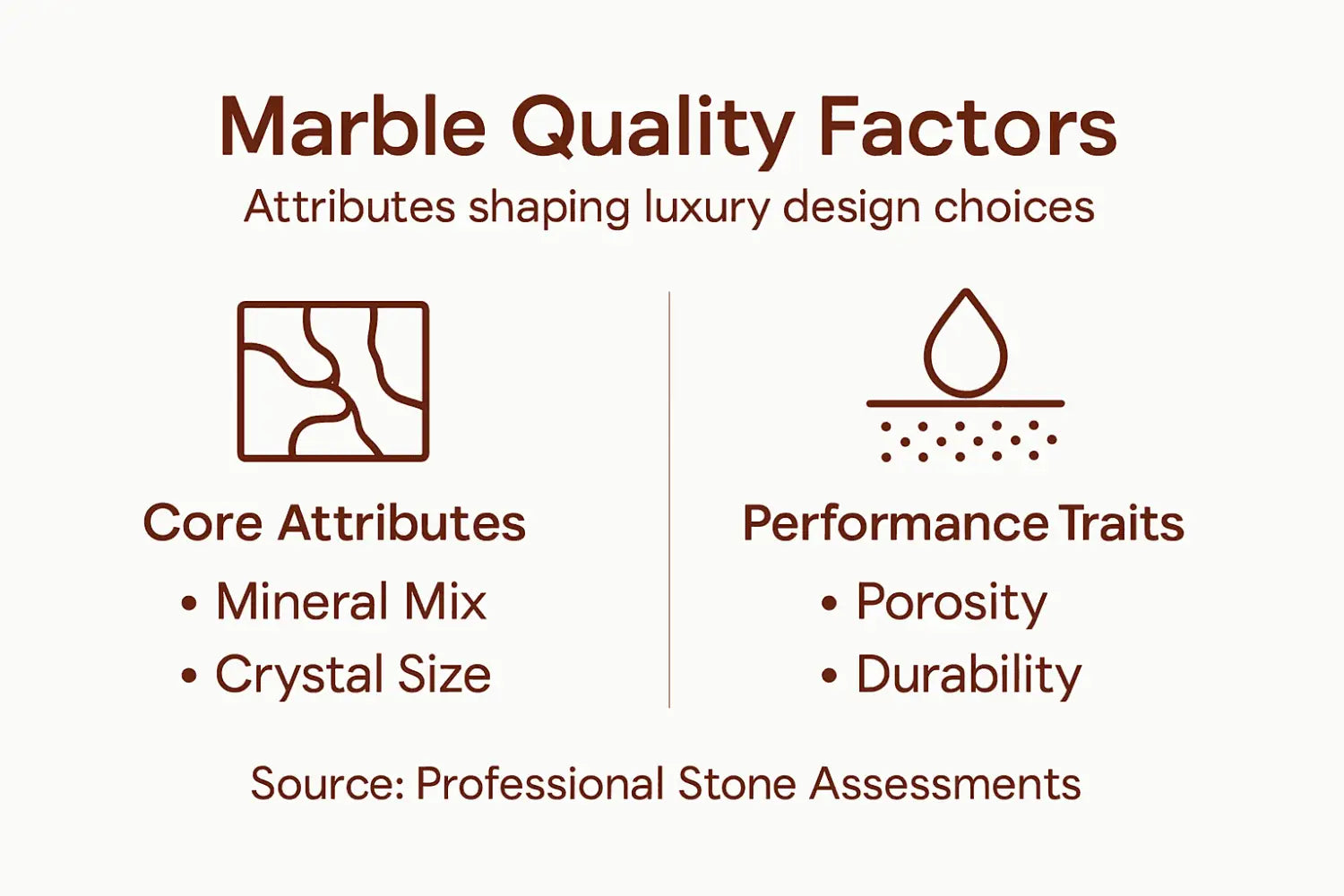
The fundamental quality of marble depends on several critical attributes that distinguish superior stone from average material:
- Mineral Composition: Determines color, durability, and visual complexity
- Crystal Structure: Impacts polish potential and aesthetic refinement
- Porosity: Influences resistance to staining and environmental degradation
- Mineral Impurities: Creates distinctive veining and color variations
Marble’s geological formation creates remarkable diversity, with colors ranging from pristine white to deep black, depending on trace mineral content. Calcite marble tends to be more vulnerable to acidic agents, while dolomitic marble offers enhanced chemical resistance, making it preferred for environments with potential chemical exposure.
Marble quality is not just about appearance, but about the stone’s inherent geological characteristics that determine its long-term performance and aesthetic potential.
Professional stone experts evaluate marble through comprehensive assessments that examine mineral density, crystalline tightness, and potential environmental vulnerabilities. These evaluations help designers and architects select marble that will maintain its elegance and structural integrity across decades of use.
Here’s a summary of how marble’s geological attributes affect its suitability for design applications:
| Attribute | Influence on Performance | Best Use Cases |
|---|---|---|
| Crystal Structure | Higher polish, structural integrity | Luxury interiors, sculptures |
| Mineral Composition | Chemical resistance and color | Kitchen surfaces, facades |
| Porosity | Stain resistance, durability | Bathrooms, flooring |
| Impurities | Unique veining and coloration | Feature walls, decorative pieces |
Pro tip: Always request a detailed geological report and professional assessment before selecting marble for high-end design projects to ensure optimal stone quality and performance.
Marble Types and Notable Distinctions
Marble classification is a complex science that reveals the intricate geological processes behind this luxurious natural stone. Marble mineral compositions demonstrate remarkable variations that significantly impact their aesthetic and functional properties, creating unique characteristics for designers and architects.
The primary marble types are distinguished by their fundamental mineral structures:
-
Calcitic Marble:
- Predominantly composed of calcium carbonate
- More common in younger geological formations
- Typically lighter in color
- More susceptible to chemical interactions
-
Dolomitic Marble:
- Rich in dolomite mineral content
- Predominant in older Precambrian geological terranes
- Enhanced chemical resistance
- Often darker and more structurally complex
Geological impurities play a crucial role in marble’s visual complexity. Trace minerals like clay, iron oxides, and serpentine create distinctive veining patterns and color variations during the metamorphic recrystallization process. These impurities transform ordinary stone into extraordinary design elements, making each marble slab a unique geological artwork.
Marble’s beauty lies not just in its surface, but in the intricate geological story embedded within its crystalline structure.
Professional stone selectors evaluate marble beyond simple visual assessment, examining microscopic crystal arrangements, mineral density, and potential environmental interactions. This comprehensive approach ensures that selected marble meets both aesthetic expectations and long-term performance requirements for luxury design applications.

Pro tip: Request detailed geological reports that document mineral composition, crystal structure, and potential environmental vulnerabilities before selecting marble for high-end design projects.
Features That Indicate Premium Quality
Identifying premium marble requires a sophisticated understanding of its intrinsic geological characteristics. Marble crystalline structure reveals critical indicators that distinguish exceptional stone from ordinary materials.
Key features of premium marble include:
-
Crystal Structure:
- Uniform, fine-grained crystals
- Interlocking mosaic texture
- Grain boundaries meeting at approximately 120° angles
- Minimal sedimentary textures
-
Mineralogical Composition:
- Low impurity content
- Balanced mineral distribution
- Consistent color and veining patterns
- Enhanced chemical resistance
Durability indicators are paramount in evaluating marble quality. Premium marble demonstrates exceptional resilience through tight crystalline formations that resist environmental degradation. Dolomitic varieties typically exhibit superior acid and weathering resistance compared to standard calcite-based stones.
Premium marble is not just a surface, but a complex geological narrative embedded in crystalline perfection.
Professional stone selectors employ microscopic and geological analysis to assess marble’s long-term performance potential. They examine crystal uniformity, secondary mineral interactions, and potential environmental vulnerabilities to ensure the stone meets stringent luxury design requirements.
Pro tip: Conduct comprehensive geological testing and request detailed microscopic analysis reports to validate the true quality of marble before making significant design investments.
How Marble Grading Works for U.S. Market
The U.S. marble grading system represents a sophisticated approach to evaluating natural stone quality, balancing geological precision with architectural performance standards. Marble grading considerations involve comprehensive assessments that determine a stone’s suitability for various design applications.
Key evaluation criteria for marble grading include:
-
Mineralogical Assessment:
- Calcite or dolomite mineral composition
- Percentage of primary and secondary minerals
- Crystal structure uniformity
- Mineral purity levels
-
Structural Integrity Factors:
- Absence of structural defects
- Crack and fissure evaluation
- Porosity measurement
- Crystalline density analysis
Environmental Performance plays a crucial role in determining marble grade. Professional assessments examine the stone’s capacity to withstand temperature variations, chemical interactions, and potential degradation factors. High-grade marble demonstrates exceptional resilience across diverse architectural environments.
Marble grading transcends visual aesthetics, representing a complex scientific evaluation of geological potential and performance characteristics.
Professional stone selectors in the U.S. market employ rigorous multi-stage grading protocols that consider not just immediate visual appeal, but long-term durability and functional performance. These comprehensive evaluations ensure that only superior marble meets the stringent requirements of luxury design and architectural applications.
Pro tip: Request a comprehensive geological performance report that details microscopic analysis, environmental resistance, and potential long-term degradation factors when selecting high-end marble for critical design projects.
Common Quality Mistakes to Avoid
Navigating marble selection demands sophisticated understanding to prevent costly errors that compromise design integrity. Marble material vulnerabilities reveal critical pitfalls that professional designers must carefully evaluate.
Common quality mistakes include:
-
Selection Errors:
- Overlooking porosity levels
- Ignoring mineral impurity content
- Failing to assess environmental exposure risks
- Neglecting long-term performance indicators
-
Structural Vulnerabilities:
- Accepting marble with hidden microfractures
- Disregarding crystal structure inconsistencies
- Underestimating chemical interaction potential
- Ignoring temperature sensitivity factors
Environmental Degradation represents a significant risk in marble quality assessment. Certain marble types demonstrate extreme sensitivity to atmospheric conditions, particularly acidic environments that can rapidly deteriorate stone structures. Professional designers must comprehensively evaluate potential exposure scenarios before making final selections.
Quality mistakes in marble selection are not merely aesthetic failures, but potential long-term architectural compromises.
Professional stone specialists emphasize the importance of comprehensive material testing, which goes far beyond surface-level visual assessments. Microscopic analysis, environmental stress testing, and detailed geological reports provide the most reliable indicators of true marble quality and potential performance limitations.
Pro tip: Invest in professional geological testing and request comprehensive material performance reports to identify potential marble vulnerabilities before finalizing design selections.
Comparing Marble to Alternative Surfaces
Understanding the nuanced landscape of surface materials requires a sophisticated approach to comparative analysis. Natural stone surface alternatives reveal complex trade-offs between aesthetic elegance, durability, and practical performance across different architectural applications.
Key comparative characteristics include:
-
Granite:
- Superior scratch resistance
- More uniform appearance
- Less translucent than marble
- Enhanced durability in high-traffic areas
-
Engineered Stone:
- Consistent color and pattern
- Lower maintenance requirements
- Higher stain resistance
- Manufactured uniformity
-
Quartz:
- Engineered mineral composition
- Extreme durability
- Non-porous surface
- Limited natural variation
Performance Dynamics distinguish marble from alternative surfaces through its unparalleled aesthetic complexity. While alternatives offer practical advantages, marble remains the pinnacle of luxury design, delivering unique translucency and historic visual depth that engineered materials cannot replicate.
This comparison highlights key differences between marble and other popular surface materials:
| Characteristic | Marble | Granite | Quartz |
|---|---|---|---|
| Visual Diversity | High, unique veining | Moderate, more uniform | Limited, manufactured patterns |
| Acid Sensitivity | Sensitive, especially calcitic | Highly resistant | Not affected |
| Maintenance Need | Regular sealing required | Periodic sealing | Minimal maintenance |
| Longevity | Decades with proper care | Extremely long-lasting | Exceptionally durable |
Marble’s true value lies not in its immediate performance, but in its capacity to transform spaces through geological artistry.
Professional designers must carefully balance aesthetic aspirations with practical requirements, recognizing that each surface material represents a complex compromise between visual elegance, maintenance demands, and environmental resilience.
Pro tip: Conduct comprehensive performance testing and request material samples to understand the precise trade-offs between marble and alternative surfaces before making final design selections.
Elevate Your Luxury Designs with Authentic Premium Marble
Selecting the right marble goes beyond surface beauty. This article highlights how understanding mineral composition, crystal structure, and porosity can make the difference between timeless elegance and costly mistakes. If you are a designer, architect, or homeowner striving for durable, chemically resistant, and uniquely veined marble, you face the challenge of finding authentic stone that truly performs over time.
At Surfaces Galore, we specialize in delivering premium natural stone that meets these exacting standards. Our direct-import approach guarantees access to superior quality marble with documented geological integrity. We help you transform spaces confidently by providing detailed material care insights and a diverse selection of travertine tiles, mosaics, and decorative pieces nationwide.
Discover unparalleled marble quality and expert support to avoid common pitfalls.
Browse our curated collection and bring your luxury vision to life.
Explore premium marble and travertine today at Surfaces Galore. Don’t settle for less when your design deserves lasting beauty supported by geological excellence. Visit https://surfacesgalore.com now to see our available options and get personalized assistance for your project. Your masterpiece starts with choosing the right stone.
Frequently Asked Questions
What are the key attributes that determine marble quality?
The quality of marble is determined by several key attributes, including mineral composition, crystal structure, porosity, and the presence of mineral impurities. These elements impact durability, visual complexity, and resistance to stains and environmental degradation.
How can I assess the quality of marble before purchasing it?
To assess marble quality, request a detailed geological report and conduct a professional assessment evaluating mineral density, crystalline tightness, and environmental vulnerabilities. This ensures that the selected marble meets both aesthetic expectations and long-term performance requirements.
What is the difference between calcitic and dolomitic marble?
Calcitic marble is predominantly composed of calcium carbonate, is typically lighter in color, and is more susceptible to chemical interactions. Dolomitic marble, rich in dolomite, offers enhanced chemical resistance, is often darker, and is found in older geological formations, making it more structurally complex.
What common mistakes should I avoid when selecting marble?
Common mistakes when selecting marble include overlooking porosity levels, ignoring mineral impurity content, failing to assess environmental exposure risks, and neglecting long-term performance indicators. It’s crucial to conduct thorough evaluations to prevent costly errors in design integrity.

Leave a comment