
Marble vs Granite Pros: What Homeowners Need to Know

Granite is the practical default for busy kitchens. Marble is the statement piece for homeowners who want timeless beauty and are willing to maintain it. That single trade-off drives almost every decision in this comparison.
- Granite’s primary advantage: Harder, more scratch-resistant, and far easier to maintain under daily cooking use.
- Marble’s primary advantage: Unmatched visual elegance, naturally cool surface ideal for baking, and a look that ages into character rather than just wear.
- Hybrid option: Use marble on a low-traffic island or pastry station and granite on perimeter prep counters. You get both aesthetics and durability where each matters most.
Surfacesgalore supplies authentic natural stone slabs, including marble, limestone, and travertine, and ships nationwide from Anaheim, California. Their team can help you evaluate slab options before you commit.
Table of Contents
- What are the real pros of marble vs granite countertops?
- How does hardness actually affect your countertop in daily use?
- How much maintenance do granite and marble actually require?
- Where does each stone look best in your home?
- What does each stone actually cost, installed?
- How do you decide which stone fits your lifestyle?
- Sourcing authentic stone: what Surfacesgalore recommends
- Key Takeaways
- The trade-off most homeowners underestimate
- Natural stone for your next project, direct from the source
- Useful sources
- FAQ
What are the real pros of marble vs granite countertops?
Granite wins on durability and low maintenance. Marble wins on beauty and baking performance. Here is how they stack up across the dimensions that actually affect your daily life.
| Dimension | Granite | Marble |
|---|---|---|
| Best for | High-traffic kitchens, family homes | Islands, vanities, baking stations, bathrooms |
| Durability (Mohs) | high hardness, very durable | softer than granite, scratches more easily |
| Heat resistance | Excellent — formed under extreme heat | Moderate — use a trivet for hot pans |
| Stain vs. etch risk | Stains if unsealed; does not etch | Stains and etches from acids (lemon, wine) |
| Sealing frequency | Periodic resealing every few years | More frequent resealing required, typically multiple times per year |
| Aesthetics | Crystalline, speckled, broad color range | Dramatic veining, classic white/gray tones |
| Installed cost | Varies widely depending on type and complexity | Generally higher than granite, especially for premium varieties |
| Lifespan | Decades with basic upkeep | Decades with consistent, careful maintenance |
- Granite’s strongest pro: Near-indestructible surface for everyday cooking, cutting, and heat exposure.
- Marble’s strongest pro: No other natural stone replicates its veining and luminosity, especially in Calacatta or Carrara varieties.
- For bathrooms and vanities, marble is often the better fit since acid exposure is minimal and the visual payoff is high.
How does hardness actually affect your countertop in daily use?
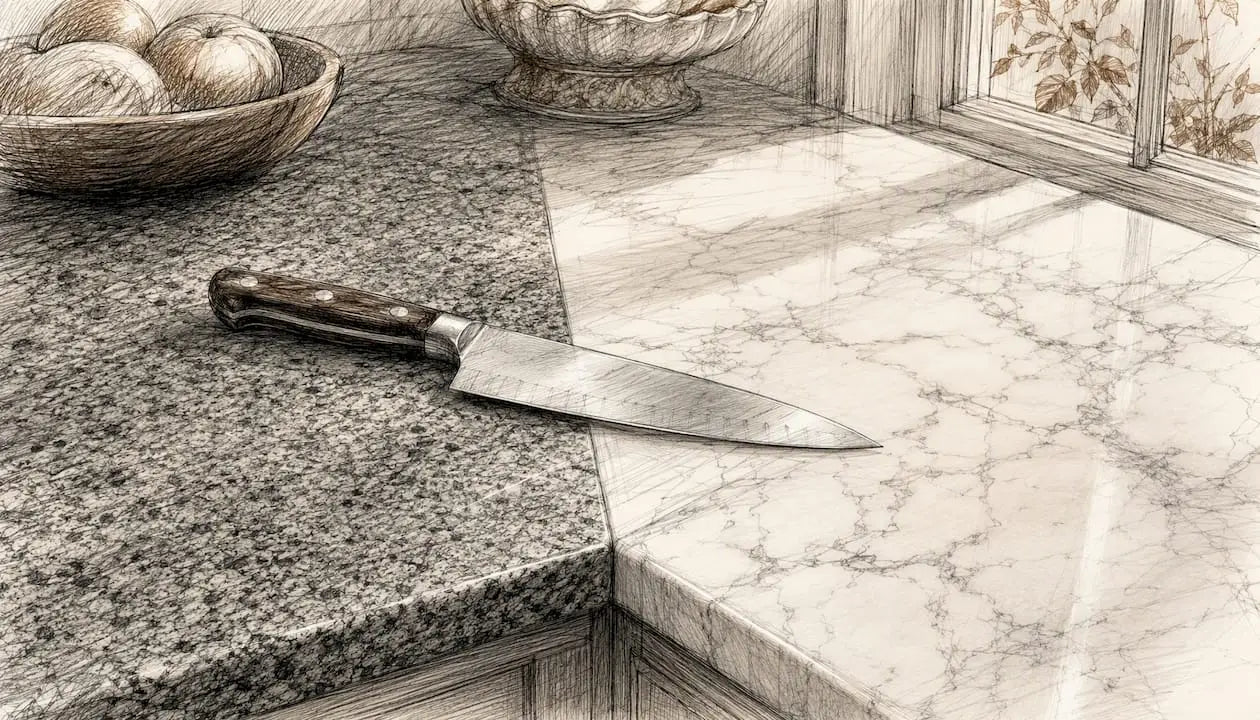
The Mohs hardness gap between these two stones is not a minor technical detail. Granite scores 6–7 on the Mohs scale; marble scores 3–5. A kitchen knife blade sits around 5.5 Mohs, which means marble can scratch from a misplaced knife. Granite generally will not.
Scratch and chip behavior
In practical terms, granite shrugs off the kind of abuse most kitchens dish out: dragged cast-iron pans, abrasive scrubbing pads, dropped utensils. Marble is more forgiving than people expect on chips (it tends to dent rather than shatter), but surface scratches accumulate faster, especially on polished finishes where every mark catches the light.
Heat and thermal shock
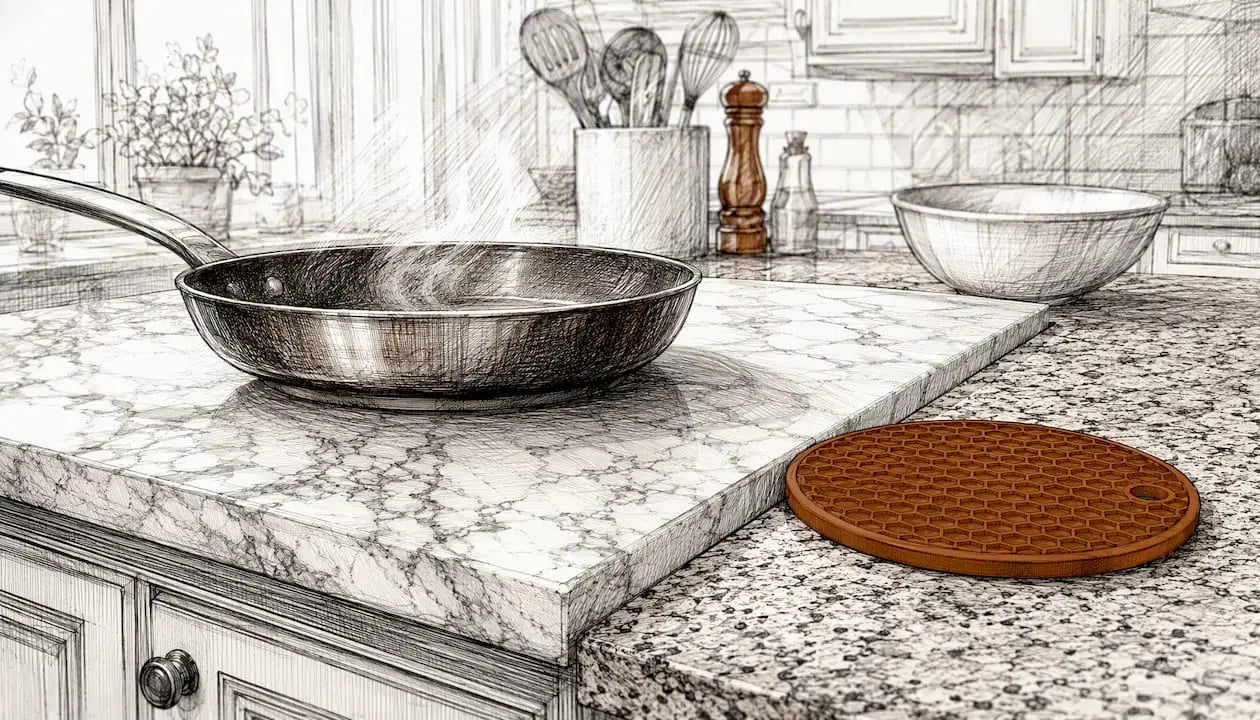
Granite formed under extreme geological heat, so a hot pan from the stove is not a threat to it. Marble handles moderate heat but is vulnerable to thermal shock from very hot cookware placed directly on a cold surface. Use a trivet on marble, always. This is not optional advice.
What the hardness gap means for longevity
Both stones can last the lifetime of a house. The difference is how much effort that takes. A granite countertop in a busy family kitchen can go years with nothing more than wiping and occasional resealing. Marble in the same kitchen will show its history, which some homeowners love and others regret.
Pro Tip: If you want marble’s look in a high-use kitchen, place it on the island only. Use granite on the perimeter prep runs where knives, pots, and daily prep happen. You get the visual impact without the maintenance burden where it would hurt most.
How much maintenance do granite and marble actually require?
Granite is genuinely low-maintenance. Marble requires a real commitment. Understanding the difference before you buy prevents the most common homeowner regret in natural stone.
Sealing frequency
Granite typically needs resealing every 1–3 years; denser varieties can go 2–3 years between applications. Marble in a kitchen needs sealing every 6–12 months because its more porous calcite structure absorbs liquids faster. A simple water-drop test tells you when it is time: if water soaks in rather than beading, reseal.
Use a penetrating impregnating sealer rated for calcite-based stones on marble. Standard granite sealers are not always appropriate. Surfacesgalore’s guide on sealing natural stone covers the differences in detail.
Cleaning products: what works and what damages
Diluted mild dish soap like Dawn is generally safe for granite if you rinse thoroughly. On marble, even dish soap used repeatedly can leave a dull film and should be avoided in favor of pH-neutral stone cleaners. The Natural Stone Institute recommends stone-specific, non-acidic products for all calcareous stones, which includes marble, limestone, and travertine.
Never use vinegar, lemon juice, or citrus-based sprays on marble. These are acids, and they cause etching, a chemical reaction that dissolves a microscopic layer of calcite and leaves a dull mark. Sealing does not prevent etching. Sealing reduces staining. Etching is a different problem entirely, and fixing a polished marble surface after significant etching usually requires professional repolishing.
Daily, monthly, and annual maintenance checklist
Daily:
- Wipe spills immediately, especially anything acidic (wine, citrus, coffee).
- Use a soft cloth or microfiber with warm water and a pH-neutral stone cleaner.
- Avoid leaving wet items sitting on marble surfaces.
Monthly:
- Inspect the surface for early etch marks or dull spots.
- Apply a marble-safe polish if the finish looks flat.
- Check grout lines in tiled applications for staining.
Annual:
- Perform the water-drop porosity test on both granite and marble.
- Reseal marble if water absorbs within a few minutes. Follow Surfacesgalore’s step-by-step sealing guide for application technique.
- For larger etch marks or deep stains, call a professional stone restoration specialist rather than attempting DIY repairs.
Pro Tip: Avoid using dish soap on marble as a daily cleaner. Over time it leaves a residue that dulls the finish. A dedicated pH-neutral stone cleaner like those recommended by the Natural Stone Institute costs about the same and protects the surface properly.
Where does each stone look best in your home?
Granite and marble do not just perform differently. They look different in ways that affect which rooms and applications each suits.
Visual character
Granite has a crystalline, speckled pattern formed from interlocking mineral grains. The color range is broad: black, white, gray, gold, blue, green, and everything between. It reads as grounded and natural rather than dramatic.
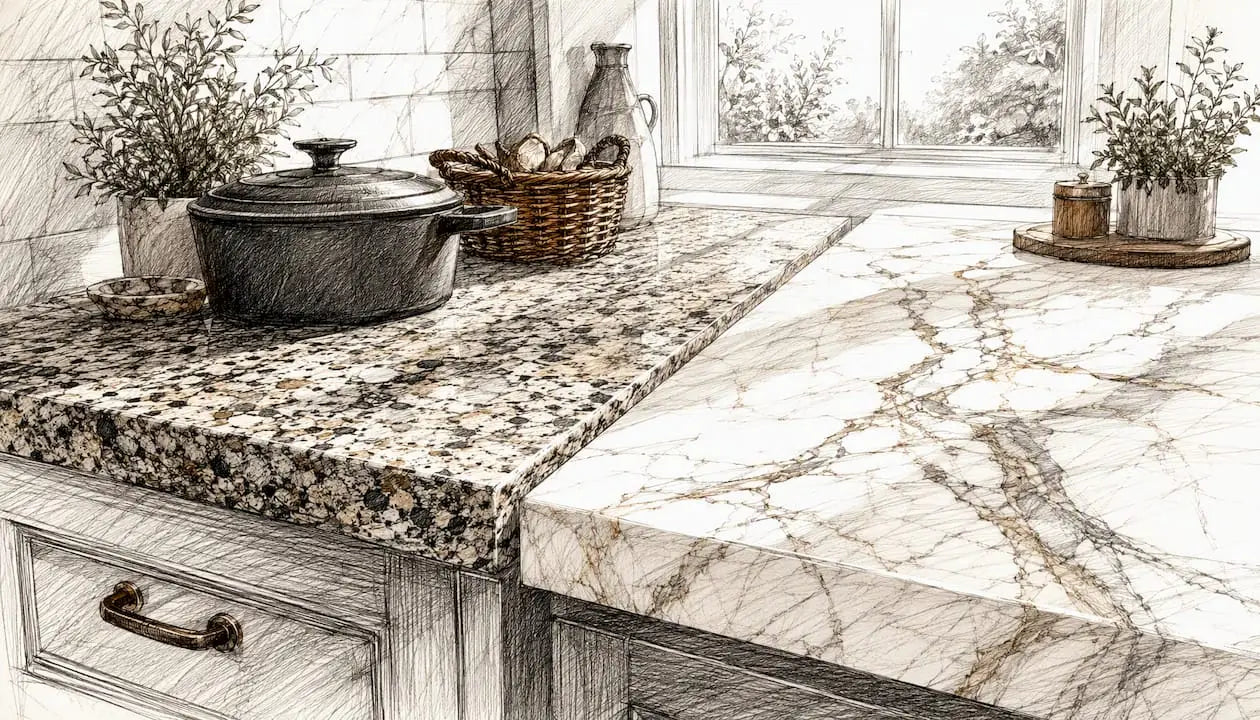
Marble is defined by its veining, the result of mineral impurities moving through calcite under heat and pressure. Calacatta marble has bold, sweeping veins on a bright white background. Carrara is softer, with fine gray veining. No two slabs are identical, and that uniqueness is a large part of the appeal.
Finish choices and visible wear
Polished marble shows etching immediately because the contrast between a glossy surface and a dull etch mark is obvious. Honed marble (a matte finish) hides etch marks far better and is a smarter choice for kitchens. Polished granite hides scratches better than polished marble but still shows grease smears more than a honed or leathered finish.
Where marble performs best
Marble’s naturally cool surface temperature makes it the preferred choice for baking and pastry work. Butter and dough stay cold longer on marble than on granite or any engineered surface. For bathroom vanities, marble is nearly ideal: acid exposure is rare, traffic is light, and the visual elegance is hard to match. For choosing marble colors and finishes that suit your space, Surfacesgalore’s design guidance covers the full palette.
Pro Tip: Always view full slabs in natural light before purchasing, not just small samples. Veining patterns on marble vary dramatically across a single slab, and what looks subtle on a 4-inch sample can be overwhelming at full countertop scale. Book-matching two slabs on an island creates a mirror-image vein pattern that is genuinely striking, but you need to see the actual slabs together to judge it.
What does each stone actually cost, installed?
Cost is where the difference between granite and marble becomes concrete. Granite typically runs $40–$175 per square foot installed, depending on slab rarity and fabrication complexity. Marble starts around $65 per square foot and climbs to $250 or more for premium varieties like Calacatta.
| Stone | Installed cost range | Typical sealing cost (DIY) | Pro restoration (if needed) |
|---|---|---|---|
| Granite | $40–$175/sq ft | — | — |
| Marble | $65–$250+/sq ft | — | — |
The cost gap widens when you factor in maintenance. Marble’s 6–12 month sealing cycle means more product and more labor over time. Professional repolishing for etch damage is an additional cost that granite owners rarely face.
- Fabrication complexity adds cost for both stones: thick slabs, unusual edge profiles, and complex cutouts for sinks all increase labor.
- Marble’s relative softness makes it more susceptible to cracking during transport and installation, which can raise handling costs.
- Weight is similar for both: plan for reinforced cabinetry on long runs.
How do you decide which stone fits your lifestyle?
The right stone depends on how you actually use your kitchen, not how you imagine using it.
Step-by-step decision checklist
- Assess your kitchen traffic. Do you cook daily with multiple people in the kitchen? Granite. Do you use the kitchen lightly and prioritize aesthetics? Marble is viable.
- Evaluate acid exposure. Do you regularly cook with citrus, wine, or vinegar? Marble will etch. Granite will not.
- Consider kids and pets. Busy households with children or pets benefit from granite’s forgiveness on scratches and stains.
- Set your maintenance threshold honestly. Are you willing to reseal every 6–12 months and use only approved cleaners? If the answer is uncertain, choose granite.
- Define your visual priority. If the countertop is the design centerpiece of the room, marble’s veining is hard to replace. If the countertop is a working surface first, granite’s appearance is more than adequate.
- Budget for the full lifecycle. Include sealing, cleaning products, and potential professional restoration in your cost estimate, not just the installed price.
Questions to ask your fabricator
- Where will seams fall, and can they be minimized or book-matched?
- What sealer do you apply at installation, and how long before I can use the surface?
- What finish do you recommend for my use case (polished, honed, leathered)?
- How do you handle edge profiles on marble to reduce chipping risk at corners?
Red flags that should steer you away from marble
- You cook with acidic ingredients daily.
- You have young children who will use the countertop as a surface for homework, crafts, or snacks.
- You are not prepared to reseal twice a year.
- Your budget does not include professional restoration if etching occurs.
For hybrid layouts, the most practical configuration is marble on the island (lower traffic, visual centerpiece) and granite on the perimeter runs (prep, cooking, and sink areas). For tips on selecting marble slabs for specific project types, Surfacesgalore’s guidance covers finish, veining, and sizing decisions.
Sourcing authentic stone: what Surfacesgalore recommends
Surfacesgalore is a direct importer of authentic natural stone, focused on marble, limestone, and travertine. Buying direct from an importer rather than a big-box retailer means you are working with real stone, not engineered alternatives, and you can often view full slabs before committing.
Maintenance checklist for Surfacesgalore buyers
- At installation: Confirm the fabricator applied a penetrating impregnating sealer rated for your specific stone. Ask for the product name so you can match it on future applications.
- First 30 days: Avoid harsh cleaners and let the sealer fully cure. Use only warm water and a pH-neutral stone cleaner.
- Every 6 months (marble) or annually (granite): Run the water-drop test. If water absorbs within 3–4 minutes, reseal. Follow the step-by-step sealing process for best results.
- Annually: Inspect for etch marks, chips, or grout deterioration. Small surface etches on honed marble can sometimes be buffed with a marble polishing powder. Larger damage warrants a professional.
- When in doubt: Contact Surfacesgalore for product recommendations before using any new cleaner on your stone.
Pro Tip: Order your slabs and view them in person or request high-resolution photos in natural light before purchase. Slab variation in marble is significant, and what looks like a match in a showroom can look mismatched once installed under your kitchen lighting. Surfacesgalore ships nationwide, so request samples first if an in-person visit is not possible.
Key Takeaways
Granite is the lower-maintenance, higher-durability choice for active kitchens, while marble delivers unmatched aesthetics and baking performance for homeowners willing to commit to consistent upkeep.
| Point | Details |
|---|---|
| Hardness gap is real | Granite scores 6–7 Mohs; marble scores 3–5, making granite far more scratch-resistant in daily use. |
| Marble etches, sealing won’t stop it | Acids like lemon and vinegar cause chemical etching on marble; sealing only reduces staining, not etching. |
| Sealing cadence differs significantly | Marble needs sealing every 6–12 months in kitchens; granite typically needs it every 1–3 years. |
| Hybrid layouts solve the trade-off | Use marble on islands or baking stations and granite on perimeter prep areas for both beauty and durability. |
| Surfacesgalore for authentic stone | Surfacesgalore is a direct importer shipping authentic marble, limestone, and travertine nationwide from Anaheim, CA. |
The trade-off most homeowners underestimate
The granite-versus-marble debate gets framed as durability versus beauty, and that framing is mostly right. What it misses is the emotional dimension of maintenance. Homeowners who choose marble for a busy kitchen often do so knowing the risks, then find that the reality of twice-yearly sealing and careful cleaner selection feels different at month eight than it did at the showroom.
The homeowners who are happiest with marble are the ones who chose it for a specific reason: a baking station, a bathroom vanity, a low-traffic island that functions more as a display surface than a prep zone. They matched the material to the use case rather than falling for the look and hoping the behavior would follow.
Granite, on the other hand, gets underestimated aesthetically. The range of granite available today, from deep blacks to translucent whites with dramatic movement, is wider than most homeowners realize until they actually visit a slab yard. Some granite slabs are visually indistinguishable from marble to a non-specialist eye, with none of the maintenance burden.
The honest recommendation: if you are not sure, choose granite for the kitchen and save marble for the bathroom. You can always add marble later in a lower-stakes application. Reversing a regretted marble installation is expensive.
Natural stone for your next project, direct from the source
Surfacesgalore brings authentic marble, limestone, and travertine directly from the source to homeowners and designers across the United States. As a direct importer based in Anaheim, California, Surfacesgalore cuts out the middleman, which means you get genuine natural stone at prices that reflect the actual material, not a retail markup.
Whether you are planning a marble island, a granite kitchen countertop, or a full bathroom renovation in travertine, Surfacesgalore’s collections cover the full range of natural stone options. Every piece is authentic, every slab is available for review, and the team can help you match material to application before you order. Surfacesgalore ships nationwide, so your project location is not a barrier.
Browse the natural stone tile collections at Surfacesgalore today, or reach out directly to request samples and a quote for your project.
Useful sources
- Natural Stone Institute — Care and Cleaning Guidance: The industry authority on stone classification, cleaning product safety, and pH-neutral cleaner recommendations for calcareous stones.
- Dynamic Stone Tools — Stone Countertop Annual Maintenance: DIY vs. professional maintenance guidance, water-drop porosity test, and sealing interval recommendations.
- Consumer Reports — Dish Soap Cleaning Guidance: Guidance on when dish soap is safe for granite and why it should be avoided on marble.
FAQ
What are the pros and cons of granite vs marble?
Granite’s pros are hardness (6–7 Mohs), low maintenance, heat resistance, and a wide color range. Its main con is a less dramatic visual character than marble. Marble’s pros are unmatched veining and elegance, a cool surface ideal for baking, and timeless appeal. Its cons are lower hardness (3–5 Mohs), susceptibility to etching from acids, and a more demanding sealing schedule of every 6–12 months in kitchen use.
Why don’t people use granite as much anymore?
Granite remains widely used, especially in higher-end projects favoring authentic natural stone. Its broad color range and durability make it a strong choice for busy kitchens today.
Is Dawn dish soap okay for granite?
Dawn diluted in water is generally safe for granite if you rinse the surface thoroughly afterward. On marble, repeated use of dish soap is not recommended because it can leave a dull film and does not provide the pH-neutral protection that calcite-based stone requires. Use a dedicated pH-neutral stone cleaner on marble instead.

Leave a comment