
Homeowners and Designers: How Marble's Color, Veining, Finish Look

Marble reads as a stone with movement: soft background colors in white, gray, black, cream, or green, threaded through with veins and cloud-like patterns that range from barely-there to dramatic. Its surface has a faint crystalline sparkle, and light seems to sink slightly beneath the polish before bouncing back, giving it a gentle glow rather than a flat shine.
TL;DR:
- Marble’s veins, colors, and patterns are created by mineral impurities and fluid movement during recrystallization, making each slab unique.
- The appearance of marble varies with finish, with polished surfaces enhancing color depth and honed finishes softening contrast for a more matte look.
- Light and room placement dramatically affect marble’s visual depth, transparency, and contrast, so viewing full slabs in your space is crucial before buying.
- Marble features a natural surface that can etch or stain over time due to its calcite composition, but routine sealing and maintenance can preserve its beauty.
- Buying directly from a supplier like Surfaces Galore ensures authentic samples and accurate color matching, minimizing surprises after installation.
Table of Contents
- What Does Marble Look Like Once You Understand How It Forms?
- Color Range: What Causes Marble’s Different Hues?
- How to Read Veining, Pattern Types, and Texture
- How Finishing and Cutting Change the Way Marble Looks
- Signature Looks: Carrara, Calacatta, Crema Marfil, Nero Marquina, and Bardiglio
- How Lighting, Scale, and Room Placement Change the Way Marble Looks
- Will Marble’s Appearance Change Over Time?
- Why Surfaces Galore Is a Reliable Source for Seeing Real Marble
- Ready to See Marble in Person? Here’s Where to Start
- A Note on Choosing Marble by Eye
- Sources
- FAQ
What Does Marble Look Like Once You Understand How It Forms?
Marble starts as limestone or dolomite, then gets cooked and compressed deep in the earth until the original calcite or dolomite crystals melt into a new, interlocking mosaic. That process is called recrystallization, and it’s the entire reason marble looks the way it does. The heat and pressure erase the original fossils and sediment layers, replacing them with a denser, more crystalline structure that takes a polish beautifully.
While the rock is transforming, mineral impurities and mineral-rich fluids move through it, pooling and streaking as they go. That movement is what leaves behind veins, swirls, and color zones instead of a uniform block.
- Recrystallization creates the granular texture that lets marble polish to a soft, glassy finish.
- Impurities present in the original limestone (clay, sand, iron oxides, chert) become the pigment source for veining and color.
- Fluid movement during metamorphism explains why veins often look like they’re flowing in one direction rather than scattered randomly.
- The same geologic process that erases the stone’s fossil history is what gives it optical depth once cut and polished.
Every slab is a record of a specific, one-time geologic event, which is exactly why no two pieces of natural marble ever look quite identical.
Color Range: What Causes Marble’s Different Hues?
Marble’s color comes down to chemistry, not decoration. The purer the original limestone, the whiter the marble. Once other minerals get mixed in during formation, you start seeing color families that fall into recognizable patterns.
- White: Very low impurity content, close to pure calcite, produces the classic white marbles designers reach for first.
- Gray and black: Carbon or graphite trapped in the stone darkens the background, sometimes to a near-black like Nero Marquina.
- Green: Serpentine and other magnesium silicates create the mossy, sometimes swirled green tones seen in serpentine marbles.
- Pink, red, and yellow: Iron oxides and hematite tint the stone in warmer, earthier ranges.
- Warm cream and gold: Sedimentary inclusions combined with iron staining give beige marbles their honeyed cast.
These color groupings hold up across the major named varieties that show up in kitchens and bathrooms worldwide, from stark white Carrara to deep black Nero Marquina.
Statistic Callout: Marble’s visual depth isn’t just about color. Its low index of refraction lets light penetrate a few millimeters below the surface before scattering back out, which is what gives polished marble that faint inner glow rather than a hard, mirror-like shine.
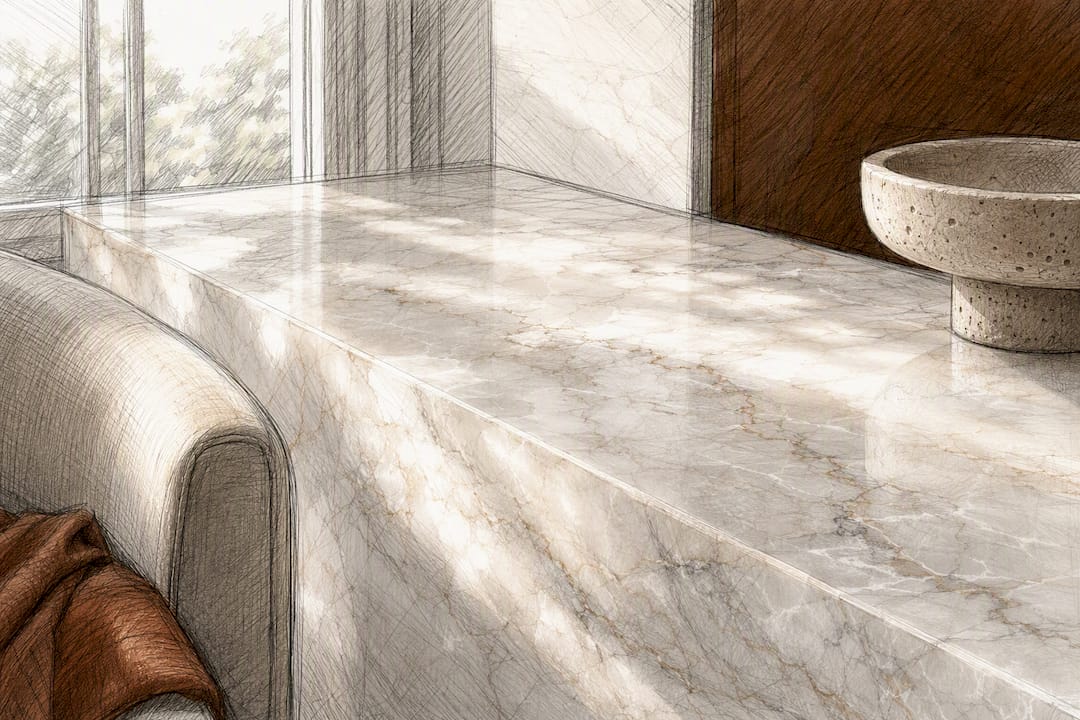
That subsurface scattering is also why two slabs with the same base color can look completely different in person. Crystal size, density, and how much light they let in before bouncing it back all shift the effect slightly, which is one reason photos alone rarely capture marble the way it actually looks in a room.
How to Read Veining, Pattern Types, and Texture
Once you know what to look for, marble veining stops looking random and starts telling you something about the slab. Vein type, scale, and direction all shift the overall visual weight of the stone.
- Hairline veins run thin and delicate across the background, common in subtler marbles where impurities were minimal and evenly distributed.
- Bold ribbon veins cut wide, saturated paths through the stone, often in a contrasting gray, gold, or brown against a lighter field.
- Clouded or “bianco” patterns look softer and more diffuse, like smoke suspended in the stone rather than sharp lines.
- Fossil inclusions occasionally survive in less-metamorphosed marbles, showing up as small shell or organism outlines.
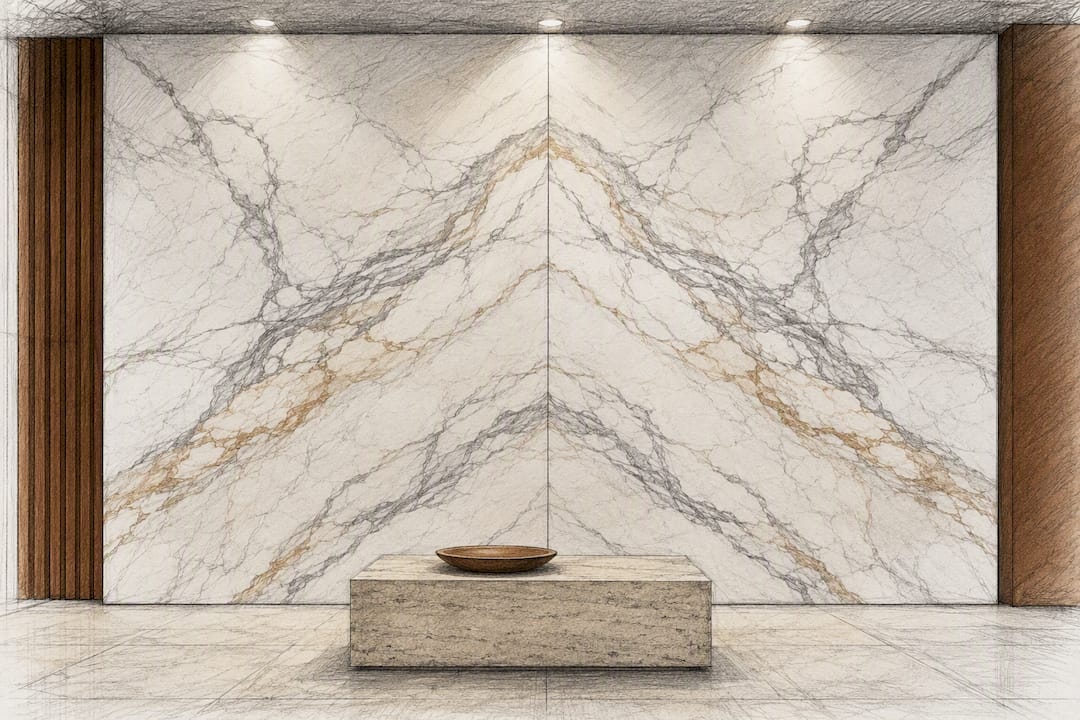
Pattern scale matters as much as vein type. A slab with widely spaced, dramatic veining reads as bold and architectural, while tight, repetitive veining feels quieter and more textural. Cutting technique amplifies this further: bookmatched slabs mirror the pattern across two adjoining pieces, doubling the vein’s visual flow across a large surface like a shower wall or island.
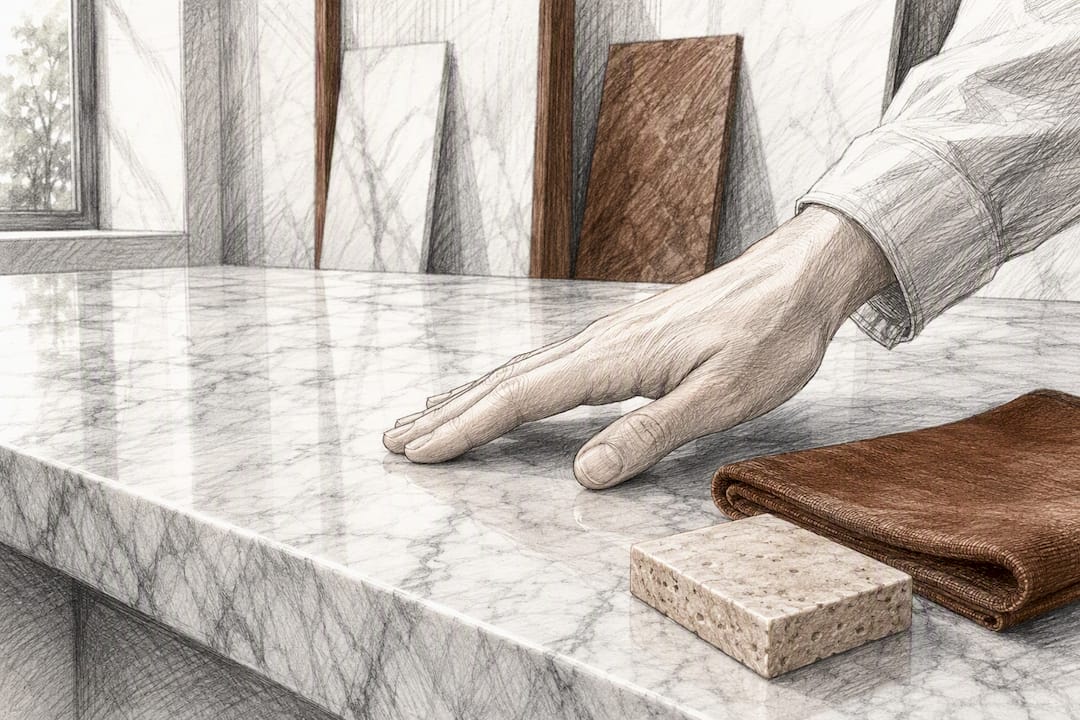
Texture adds a second layer of identification you can’t get from a photo. Run your hand across a polished marble surface and you’ll feel a faint, slightly granular quality from those interlocking crystals, plus a coolness to the touch that engineered stone rarely replicates.
How Finishing and Cutting Change the Way Marble Looks
The same slab can look like two different stones depending on how it’s finished. Fabrication decisions control gloss, contrast, and how saturated the veining appears.
- Polished finishes amplify color depth and sharpen vein contrast, giving marble its most reflective, formal look.
- Honed finishes mute the sheen entirely, softening contrast and giving the stone a flatter, more matte appearance that some designers prefer for floors.
- Leathered or satin textures add a subtle tactile ripple while still preserving most of the color’s natural depth, landing somewhere between polished and honed visually.
- Vein cut vs. cross cut changes whether veining reads as linear stripes or looser, cloud-like patterns, since the slicing direction relative to the stone’s natural layering determines the pattern you see.
- Edge profiles and grout choices either continue a pattern’s flow across a countertop or interrupt it, depending on how they’re selected.
Choosing a finish is really a design decision, not just a technical one. A polished-versus-honed comparison is worth reviewing before you commit to a slab, since the same Calacatta can look dramatically different in each finish.
Signature Looks: Carrara, Calacatta, Crema Marfil, Nero Marquina, and Bardiglio
Certain marbles have become visual shorthand in design because their patterns are so consistent and recognizable. Knowing these five will get you through most kitchen and bathroom conversations.
- Carrara: Soft white to blue-gray background with thin, fairly subtle linear veins that feel understated rather than dramatic. This is the marble most people picture first when someone says the word “marble.”
- Calacatta: A brighter, whiter background than Carrara, with bold, wide veins that often carry gold or gray undertones. Calacatta reads as more luxurious and higher-contrast, which is why it’s a favorite for statement islands.
- Crema Marfil: A warm beige to cream background with gentler, less contrasty veining. It leans traditional and works well in spaces that want warmth over drama.
- Nero Marquina: Deep black background with crisp, often jagged white veins. The contrast is the whole point here, and it’s one of the boldest choices in the marble family.
- Bardiglio: Mid-gray background with soft, swirling gray-on-gray veining, sitting between the quiet neutrality of Carrara and the boldness of Nero Marquina.
Pro Tip: Take a photo of any slab you’re considering under both warm indoor lighting and natural daylight before you buy. Calacatta’s gold veining, in particular, can look almost silver under cool LED light and noticeably warmer under incandescent bulbs.
For a fuller breakdown of veining styles across these and other varieties, the types of veined marble guide walks through more examples with visual context.
How Lighting, Scale, and Room Placement Change the Way Marble Looks
The exact same slab looks different depending on where you put it and how it’s lit. This trips up a lot of buyers who fall in love with a showroom sample and get a surprise once it’s installed.
- Natural daylight enhances marble’s translucency, letting that subsurface scattering do its job and giving veining more visible depth.
- Warm artificial light shifts cream and gold-toned marbles even warmer, which can be a benefit in a cozy kitchen or a problem if you wanted a cooler, neutral look.
- Large bookmatched slabs create sweeping, uninterrupted drama, especially on a shower wall or waterfall island edge.
- Smaller tiles repeat the pattern across grout lines, which mutes large-scale drama but emphasizes texture and grain up close.
- Placement against other materials changes perceived contrast; marble against dark cabinetry looks brighter and more saturated than the same slab against white walls.
Because scale and lighting shift the visual outcome so much, small samples and photos only tell part of the story compared to seeing a full slab in the room it’s headed for.
Will Marble’s Appearance Change Over Time?
Yes, and knowing how helps you set realistic expectations before installation. Marble is calcite-based, which makes it reactive to acids in a way granite and quartz simply aren’t.
- Etching happens when something acidic (lemon juice, vinegar, wine) sits on the surface and dulls the polish, often leaving a light, matte spot where the shine used to be.
- Staining occurs when a liquid soaks into the stone’s naturally porous surface and changes its color from within, rather than sitting on top.
- Sealing reduces the risk of staining by slowing liquid absorption, but it does nothing to prevent etching, since that’s a chemical reaction with the calcite itself, not a surface penetration issue.
- Routine cleaning with pH-neutral products, instead of anything acidic or abrasive, keeps the polish intact far longer.
- Professional honing and repolishing can restore a dulled or etched surface almost entirely, which is one advantage marble has over some engineered alternatives that can’t be refinished the same way.
None of this means marble is fragile. It means its look is a living surface that develops a bit of patina with age, and a well-maintained slab decades old often still reads as elegant rather than worn.
Why Surfaces Galore Is a Reliable Source for Seeing Real Marble
Photos and swatches only go so far, which is exactly why Surfacesgalore, as a direct importer of premium natural stone, focuses on giving designers, architects, and homeowners access to full slab galleries and physical samples rather than just catalog images. Buying direct from an importer, rather than through several layers of distribution, tends to mean more authentic variety and more accurate color representation from lot to lot.
Reviewing real slabs, or at minimum a large sample, matters more with marble than almost any other material because pattern and bookmatching only reveal themselves at scale. A two-inch swatch cannot show you how a vein will flow across a six-foot island.
Ready to See Marble in Person? Here’s Where to Start
Reading about marble only gets you so far. The color families, vein types, and finish differences covered above are consistent starting points, but the fastest way to know what a specific slab will look like in your space is to see it, and ideally touch it, yourself.
That’s the gap Surfacesgalore is built to close. As a direct importer shipping nationwide, Surfacesgalore gives homeowners, designers, and contractors access to slab galleries and sample requests without the markup that comes from buying through multiple middlemen, so you can compare a Calacatta’s gold veining against a Bardiglio’s gray swirl side by side before committing to either. If you’re weighing finishes, the honed versus polished breakdown is worth a look before you order, and the full marble types and origins guide covers varieties beyond the five named here. Ready to move from research to a real decision? Discover marble collections at Surfaces Galore, request a sample, or reach out directly for help matching a slab’s color and veining to your project’s lighting and finish plans.
A Note on Choosing Marble by Eye
Most people default to whichever slab has the boldest veining, but the quieter marbles usually age better in a whole-house design. Bold Calacatta patterns are stunning as a single feature, an island or a fireplace surround, but they can overwhelm a room if repeated across every surface. Subtlety, like Carrara’s soft gray threading or Bardiglio’s gentle swirl, tends to hold up longer against changing trends.
Always view a physical sample under your own lighting before deciding, and think about finish as seriously as you think about color. A honed Crema Marfil and a polished Crema Marfil are almost different materials visually. When in doubt, ask Surfacesgalore to walk through slab options directly. That conversation usually saves a costly reorder later.
— cihan
Sources
FAQ
What does marble look like compared to granite?
Marble typically shows smoother, flowing veins in a single dominant background color, while granite tends to display a speckled, uniform grain pattern without the same directional vein flow.
What is marble used for in home design?
Marble is most commonly used for countertops, flooring, shower walls, backsplashes, and decorative accents like moldings and mosaics, largely because its veining and translucency read as high-end in both large slabs and smaller tile formats.
How is marble formed, and why does that affect its look?
Marble forms when limestone or dolomite recrystallizes under heat and pressure, and that process both erases the original rock’s texture and creates the crystalline structure responsible for its polish and glow.
Why do two pieces of the same marble type look different?
Because veining and color come from mineral impurities distributed unevenly during formation, no two slabs, even from the same quarry block, carry identical patterns.
Does the finish change how marble looks, or just how it feels?
Finish changes both. Polished marble looks glossier with more saturated color and sharper vein contrast, while honed marble looks softer and more matte, and Surfacesgalore can help you compare both finishes on the same stone before you order.

Leave a comment