

What Is a Stone Quarry? Processes, Types, and Uses

TL;DR:
- A stone quarry is a site where natural stone and aggregates are extracted for construction and decorative purposes. Most modern quarries use low-vibration methods like diamond wire sawing and hydraulic splitting to preserve stone quality, while aggregate quarries rely on blasting and crushing. Proper extraction techniques significantly influence the stone’s durability, appearance, and long-term performance in projects.
A stone quarry is a designated site where natural stone and aggregate materials are extracted from the earth for use in construction, architecture, and decorative applications. Quarries supply materials including granite, marble, limestone, sandstone, sand, and gravel, making them the foundational supply chain for road construction and high-end building projects worldwide. Understanding how quarries work, what types exist, and how modern regulations shape operations gives architects, designers, contractors, and researchers a clearer picture of where natural stone actually comes from before it reaches a project site.
What is a stone quarry and what materials does it produce?
A stone quarry is defined as an open-pit, surface, or underground excavation site specifically designed for extracting hard rock and aggregate materials from geological formations. The industry term used by geologists and construction professionals is “quarrying,” which refers to the full process of site preparation, extraction, and processing of raw stone. Both terms appear throughout this article because each serves a different audience: “stone quarry” answers the search question directly, while “quarrying” reflects the recognized industry vocabulary.
The materials extracted from quarries fall into two broad categories. Dimension stone includes granite, marble, limestone, travertine, and sandstone, all cut into specific sizes for architectural and decorative use. Aggregates include crushed stone, sand, and gravel, which are used in bulk for road base, concrete, and infrastructure. These materials supply the raw inputs for virtually every construction project, from highway foundations to luxury hotel lobbies.
The distinction between dimension stone and aggregate matters enormously for quality. Dimension stone requires precise extraction to preserve block integrity and natural aesthetics. Aggregate production prioritizes volume and speed. A single quarry site may produce both, but the extraction methods, equipment, and quality controls differ significantly between the two product lines.
How does a stone quarry work?
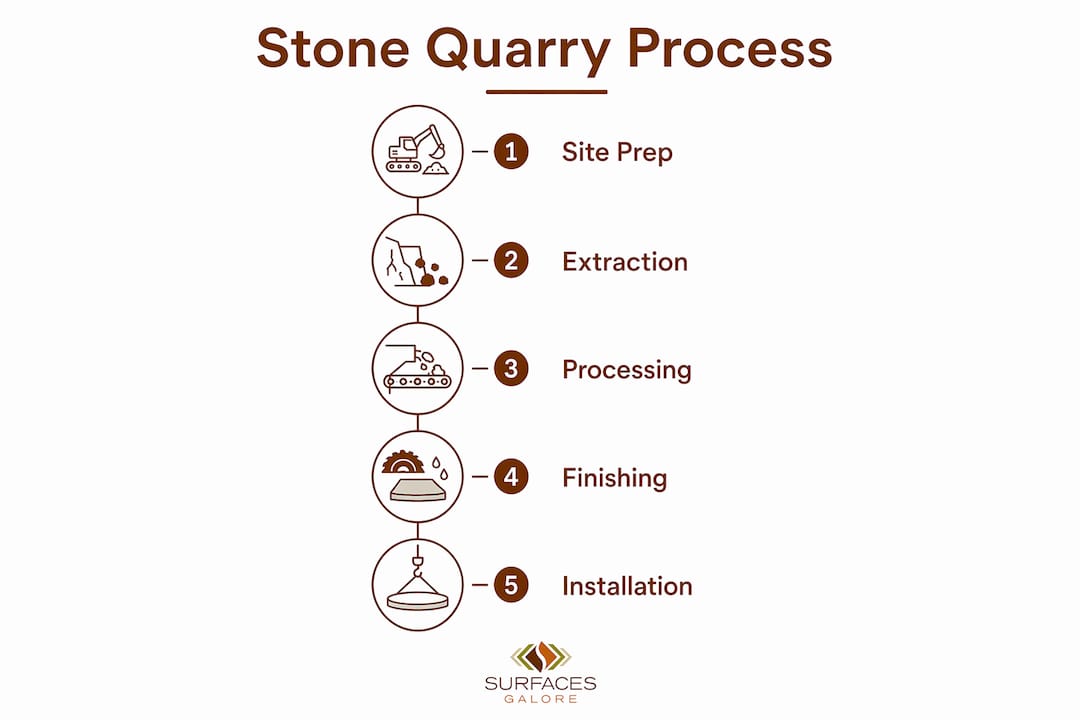
Quarry operations follow three sequential phases: site preparation, primary extraction, and processing. Each phase requires different equipment, expertise, and regulatory compliance. Skipping or rushing any phase directly reduces the quality of the final stone product.
Phase 1: Site preparation
Site preparation begins with removing the overburden, commonly called the “cap,” which is the layer of soil, vegetation, and non-usable rock sitting above the target stone deposit. Removing the cap can take months and directly influences extraction complexity and final stone cost. A high waste-to-yield ratio during this phase raises the price of every block that eventually leaves the quarry. Layered or fractured geology makes this phase even more costly and time-consuming.

Phase 2: Primary extraction
Primary extraction is where the actual quarrying process happens. The choice of extraction method depends on the rock’s joint systems, the quality goals for the stone, and the environmental vibration sensitivity of the surrounding area. Four main techniques are used in modern quarrying:
- Diamond wire sawing cuts through stone using a steel cable embedded with industrial diamonds. It produces clean, straight cuts with minimal vibration and is the preferred method for premium marble and limestone blocks.
- Hydraulic splitting uses pressurized wedges inserted into pre-drilled holes to split stone along natural fracture lines. It generates almost no vibration, which protects the internal structure of the block.
- Drilling and channeling involves drilling a series of closely spaced holes along a planned cut line, then removing the stone in sections. This method works well in medium-hardness stone like sandstone.
- Controlled blasting uses precisely calculated explosive charges to fracture large volumes of rock quickly. It is standard in aggregate quarries but avoided in dimension stone operations because the vibration creates micro-fractures inside the block.
Pro Tip: When sourcing natural stone for a high-end project, ask your supplier which extraction method was used at the quarry of origin. Diamond wire sawing and hydraulic splitting are the clearest indicators of premium block quality.
Phase 3: Processing
After extraction, raw blocks move to an on-site or nearby processing facility. Workers and machines sort blocks by size, color, and structural integrity. Blocks are then cut into slabs or tiles, surfaced with finishes ranging from polished to honed, and inspected for cracks, veining consistency, and dimensional accuracy. Processing is where raw geology becomes a finished architectural product.

What types of stone quarries exist?
Stone quarries are not all built the same way. The quarry type determines the stone quality, extraction cost, environmental footprint, and the range of products that can be produced.
Open-pit, underground, and hybrid quarries
Open-pit quarries are the most common type worldwide. They operate by removing stone from the surface downward in a series of stepped benches. Open-pit operations offer good access for heavy equipment and natural lighting, which helps workers assess stone color and quality in real time. Most marble, limestone, and travertine quarries operate as open-pit sites.
Underground quarries extract stone from tunnels and chambers carved beneath the surface. This method is used when the highest-quality stone lies deep below a layer of inferior rock, or when surface disruption must be minimized. Underground quarrying is more expensive but can yield exceptional blocks with consistent color and minimal weathering.
Hybrid quarries combine both approaches, starting with open-pit extraction and transitioning underground as the surface deposit is exhausted. This method extends the productive life of a quarry site significantly.
Dimension stone quarries vs. aggregate quarries
The table below summarizes the key differences between the two primary quarry categories:
| Feature | Dimension stone quarry | Aggregate quarry |
|---|---|---|
| Primary product | Marble, granite, limestone, travertine blocks | Crushed stone, sand, gravel |
| Extraction method | Diamond wire sawing, hydraulic splitting | Controlled blasting, heavy crushing |
| Quality priority | Block integrity, aesthetics, minimal fractures | Volume, particle size consistency |
| End use | Architecture, flooring, countertops, facades | Road base, concrete, fill material |
| Price per ton | Significantly higher | Lower |
Dimension stone quarries operate more like surgical labs, focusing on high block yield and pristine separation. Aggregate quarries prioritize volume and efficiency using high-impact methods. The extraction method choice dramatically affects stone quality and price, which is why a marble tile and a bag of gravel can both originate from limestone geology but carry completely different market values.
Key characteristics that define a dimension stone quarry include:
- Careful geological mapping before any extraction begins
- Low-vibration extraction techniques to protect block integrity
- Strict block grading systems based on color, veining, and structural soundness
- Higher labor intensity per ton of usable stone produced
- Longer site preparation timelines due to selective overburden removal
Why modern quarrying emphasizes sustainability and strict regulations
Modern quarrying operates under a framework of environmental, safety, and community standards that did not exist a generation ago. Regulatory requirements in 2026 cover noise levels, ground vibration limits, dust suppression, water management, and ecological documentation. Compliance with these standards is not optional. Quarries that fail to meet them face fines, operational shutdowns, and permanent loss of extraction licenses.
Progressive site rehabilitation is now a continuous legal requirement, not a post-closure activity. Rehabilitation costs must be factored into quarry planning from day one, and ecological restoration work runs concurrently with active extraction. This means that as one section of a quarry is being worked, a previously exhausted section is being replanted, graded, and returned to a functional ecosystem.
The practical requirements for a compliant modern quarry include:
- Continuous noise and vibration monitoring at site boundaries
- Dust suppression systems on all active extraction faces and haul roads
- Stormwater management plans to prevent sediment runoff into waterways
- Biodiversity assessments before and during operation
- Community consultation processes for new extraction zones
- Detailed environmental impact documentation updated annually
Pro Tip: When evaluating a natural stone supplier, ask whether their quarry sources hold current environmental certifications. Suppliers who can provide this documentation are sourcing from operations that meet 2026 regulatory standards, which directly correlates with responsible stone quality.
Modern quarrying is transitioning toward automation and sustainability, balancing extraction speed with environmental permits and community safety. This shift is vital for operational success and industry reputation. Quarries that invest in automation also tend to produce more consistent stone quality, because machine-controlled extraction reduces the variability that comes with manual methods.
The consequences of noncompliance extend beyond fines. A quarry that loses its operating license removes a supply source from the market, which can affect stone availability and pricing for architects and designers months or years later. Understanding the regulatory environment helps buyers appreciate why responsibly sourced natural stone carries a premium.
How does extraction precision affect natural stone quality?
Extraction precision is the single most important factor in determining whether a natural stone block will perform well over decades of use. Low-vibration extraction methods like hydraulic splitting preserve stone integrity by reducing micro-fractures, which are a key cause of later stone durability failures. A block extracted with controlled blasting may look identical to one extracted with diamond wire sawing, but the internal damage from vibration will show up as cracking, spalling, or surface degradation years after installation.
“The luxury perception of natural stone underestimates the complexity behind quarrying techniques that ensure longevity and aesthetics.” The quality of a finished marble floor or limestone facade begins not at the fabrication plant, but at the quarry face where the first cut is made.
The practical implications for architects, designers, and contractors are significant:
- Blocks with micro-fractures are more likely to crack during fabrication, increasing material waste
- Vibration damage is invisible to the naked eye but detectable under polarized light microscopy
- Premium stone suppliers request quarry extraction reports to verify method compliance
- Extraction method choice serves as a foundational quality assurance step, influencing the stone’s long-term performance
- Travertine and marble are particularly sensitive to vibration damage due to their crystalline structure
The difference between surgical extraction for dimension stone and bulk extraction for aggregates is not just a matter of technique. It reflects a fundamentally different relationship with the material. Dimension stone quarrying treats each block as a finished product in waiting. Aggregate quarrying treats rock as raw tonnage. Buyers who understand this distinction make better sourcing decisions and specify stone with greater confidence.
Natural stone sourcing practices directly connect quarry extraction quality to the durability and aesthetics of finished surfaces. Selecting stone from suppliers who document their quarry sources is the most reliable way to verify that precision extraction standards were followed from the first cut to the finished tile.
Key Takeaways
A stone quarry is the origin point of every natural stone surface, and the extraction method used there determines the quality, durability, and price of the finished product.
| Point | Details |
|---|---|
| Stone quarry definition | A quarry is a designated site for extracting dimension stone or aggregates from geological formations. |
| Three operational phases | Site preparation, primary extraction, and processing each directly affect final stone quality and cost. |
| Quarry type determines quality | Dimension stone quarries use low-vibration methods; aggregate quarries prioritize volume with blasting. |
| Precision extraction matters | Hydraulic splitting and diamond wire sawing reduce micro-fractures that cause long-term stone failures. |
| Sustainability is now mandatory | Progressive rehabilitation and environmental compliance are legal requirements in 2026, not optional practices. |
Why I think most buyers underestimate what happens before the tile arrives
Most people who select natural stone for a project focus entirely on the finished surface. They look at color, veining, finish, and price. Almost nobody asks where the block came from or how it was extracted. That gap in awareness costs buyers money and performance over time.
I have seen firsthand how two slabs of nominally identical marble can behave completely differently after installation. One stays solid and beautiful for decades. The other develops hairline cracks within a few years. The difference almost always traces back to the quarry. Specifically, it traces back to whether the block was extracted with a diamond wire saw or with a method that introduced vibration damage into the crystal structure.
Sustainable stone sourcing is not just an environmental talking point. It is a quality indicator. Quarries that invest in low-vibration extraction, environmental compliance, and progressive rehabilitation are also the quarries that produce the most consistent, durable blocks. The two things are connected because both require discipline, investment, and long-term thinking.
The public perception that quarrying is a blunt, destructive industry is outdated. Modern quarry operations use GPS-guided diamond wire saws, real-time vibration monitoring, and automated block grading systems. The gap between that reality and the popular image is enormous. Buyers who close that gap make better decisions, specify better materials, and end up with projects that hold up the way natural stone is supposed to.
My advice is simple. Ask your supplier for quarry documentation. Ask which extraction method was used. Ask whether the quarry holds current environmental certifications. Those three questions will tell you more about the long-term performance of your stone than any visual inspection of the finished slab.
— cihan
Natural stone from quarry to your project, with Surfacesgalore
Surfacesgalore sources premium marble, limestone, and travertine directly from quarries that meet rigorous extraction and environmental standards. Every product in the collection reflects the precision and care that begins at the quarry face, not just at the fabrication plant.

Based in Anaheim, California, Surfacesgalore ships nationwide to designers, architects, contractors, and homeowners who want natural stone that performs as well as it looks. The catalog includes marble and limestone tiles, mosaics, moldings, and custom cuts sourced with full transparency about origin and extraction quality. Explore the full collection at Surfacesgalore and find natural stone that carries its quarry credentials all the way to your finished space.
FAQ
What is the stone quarry definition in simple terms?
A stone quarry is an open-pit, surface, or underground site where natural stone and aggregate materials are extracted from the earth for construction and architectural use.
What materials are typically found in a quarry?
Quarries produce dimension stone such as granite, marble, limestone, travertine, and sandstone, as well as aggregates including crushed stone, sand, and gravel used in road and concrete construction.
How does a stone quarry work step by step?
Quarry operations follow three phases: removing the overburden cap during site preparation, extracting stone using methods like diamond wire sawing or hydraulic splitting, and processing blocks into slabs or tiles at a finishing facility.
What is the difference between a dimension stone quarry and an aggregate quarry?
Dimension stone quarries use low-vibration extraction to preserve block integrity for architectural products, while aggregate quarries use blasting and crushing to produce high volumes of crushed stone and gravel for infrastructure.
Why does extraction method affect natural stone quality?
Low-vibration methods like hydraulic splitting prevent micro-fractures inside the stone block. Those micro-fractures, caused by blasting or high-impact extraction, are a primary cause of cracking and surface failure in installed stone years after completion.
Leave a comment