
Designers & Fabricators: 4 Fabrication Checks for Arabescato Marble

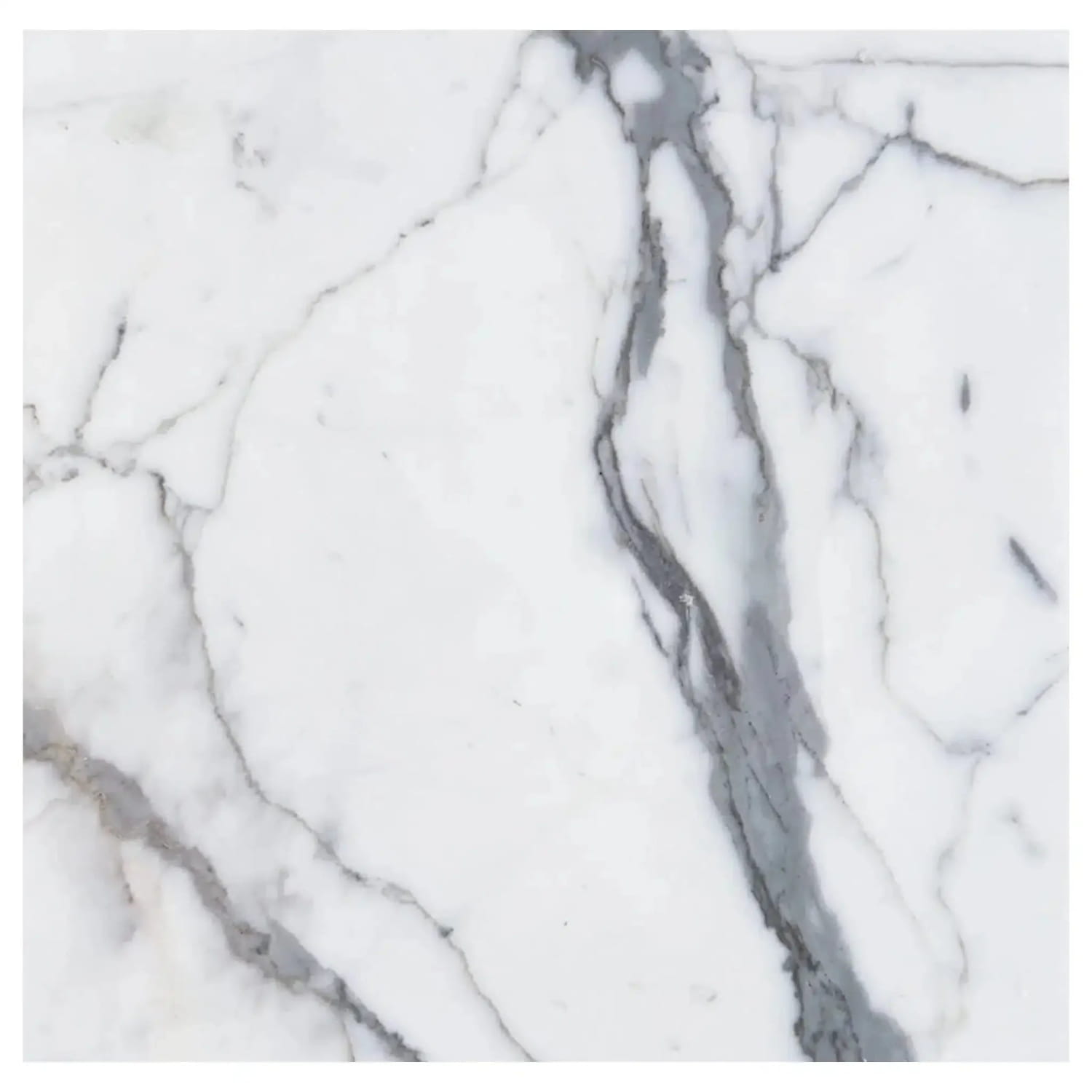
Arabescato marble is a calcitic natural stone from Italy’s Apuan Alps, prized for its ivory ground and dramatic, arching grey veins unlike any other white marble. It works best as a statement countertop, feature wall, or vanity top, but its acid sensitivity means it needs sealing and careful fabrication. With a density near 2,710 kg/m³ and true bookmatched slabs available through direct importers like Surfaces Galore, it rewards buyers who plan ahead rather than treat it like a standard kitchen stone.
TL;DR:
- Arabescato marble’s veining varies significantly by quarry, with Corchia producing the classic bold grey arcs, Vagli offering softer contrast, and Arni displaying a busier pattern.
- Its calcitic composition means it is highly acid-sensitive, requiring sealing and careful fabrication to prevent etching and structural damage from daily use.
- The stone performs best in low-traffic, indoor spaces like vanities, accent walls, and fireplace surrounds, while outdoor and high-abuse applications are not recommended.
- Pricing depends on quarry, slab size, finish, and fabrication complexity, generally falling between Carrara and Calacatta in cost, with detailed quotes needed for accurate budgeting.
- Proper maintenance includes gentle cleaning with pH-neutral products, regular resealing, and professional repairs for etching or minor damage, especially in high-traffic or moisture-prone areas.
Table of Contents
- What Is Arabescato Marble and Where Does It Come From?
- What Are the Technical Specs Designers and Fabricators Need?
- Where Should You Actually Use Arabescato Marble?
- How Does Arabescato Compare to Carrara and Calacatta?
- What Should You Know Before Fabricating Arabescato Marble?
- How Do You Clean, Seal, and Repair Arabescato Marble?
- What’s Involved in Buying Arabescato: Checklist and Price Drivers
- Is Arabescato Marble a Sustainable Choice for Your Project?
- How Do You Fix Etching, Chips, and Stains in Arabescato Marble?
- Which Applications Give Arabescato the Best Long-Term Performance?
- How Should You Care for Arabescato in High-Traffic or Outdoor Settings?
- What Design Styles Pair Best With Arabescato Marble?
- When Does Surfaces Galore Recommend Arabescato Marble?
- Order Arabescato Corchia Tile Samples From Surfaces Galore
- Where Can You Verify These Arabescato Marble Facts?
- Sources
- FAQ
What Is Arabescato Marble and Where Does It Come From?
Arabescato marble comes from quarries scattered across the Apuan Alps in Tuscany, the same mountain range that produces Carrara. The name itself is a clue: “arabesco” is Italian for arabesque, describing the looping, calligraphic veins that move across the stone almost like brushstrokes rather than the tight, linear streaks you see in other white marbles.
Three quarry names come up constantly when you’re sourcing this stone, and they’re not interchangeable:
- Corchia produces the material most associated with the classic Arabescato look. Expect a bright ivory ground with heavy, dark grey veining that reads almost black in some lots.
- Vagli tends to run a bit softer in contrast, with grey veins that sometimes carry a warmer, taupe undertone.
- Arni often shows a denser network of fine secondary veins alongside the bold primary ones, giving slabs a busier, more textured field.
When you’re evaluating slabs in person, view them under raking light. That angle exposes the depth and direction of the veining far better than overhead showroom lighting. Pull at least three slabs from the same lot before committing, since natural variation between blocks can be significant even within a single quarry name. If the design calls for bookmatched panels, ask specifically which slabs were cut sequentially. Sequential slabs are what make bookmatching possible.
What Are the Technical Specs Designers and Fabricators Need?
Arabescato is a calcitic marble, meaning it’s built primarily from calcium carbonate. That composition is exactly why it looks the way it does under polish, and exactly why it reacts to citrus, vinegar, and other acids. Calcite is soft relative to quartz-based stones, and it dissolves slightly on contact with acidic liquids, leaving the dull etch marks that are the single most common complaint about marble countertops.
Statistic Callout: Arabescato’s density runs approximately 2,700 to 2,724 kg/m³, with water absorption between roughly 0.17% and 0.4%. That absorption range is low enough for good performance indoors but still high enough to justify a quality impregnating sealer before the stone goes into service.
Key specs at a glance:
- Composition: Calcitic marble (calcium carbonate base)
- Density: Approximately 2,700–2,724 kg/m³
- Water absorption: Approximately 0.17%–0.4%
- Mohs hardness: Around 3, classified as medium hardness with high acid sensitivity
- Finish options: Polished, honed, and leathered
That Mohs rating of roughly 3 tells you everything about daily use. It scratches more easily than granite or quartz, and it etches on contact with wine, lemon juice, or tomato sauce. None of that disqualifies it from kitchens, but it does mean sealing, finish choice, and homeowner expectations all need to line up before installation day.
Where Should You Actually Use Arabescato Marble?
Arabescato earns its price tag in spaces where the stone itself is the design statement, not just a work surface.
Strong fits:
- Island countertops, especially when bookmatched across a run or waterfall edge
- Bathroom vanity tops paired with brass or matte black fixtures
- Kitchen and bar backsplashes as a single dramatic slab
- Accent walls, fireplace surrounds, and shower feature panels
- Covered or enclosed shower walls, where the material stays protected from direct weather
Weaker fits:
- Exposed exterior edges or uncovered patios, where freeze/thaw cycles and UV exposure accelerate wear
- Pool coping, where constant water exposure and acidic pool chemicals compound the etching risk
- High-abuse kitchen counters for households that cook with a lot of citrus and wine and won’t commit to sealing
Match the finish to the job. A honed surface hides etching and fingerprints far better on a busy kitchen island, while a polished finish shows off the veining at full intensity on a vanity or accent wall that sees lighter use. Either way, plan on resealing every one to two years depending on traffic.
How Does Arabescato Compare to Carrara and Calacatta?
If you’ve shopped white marble for more than an hour, you’ve probably had someone tell you Arabescato, Carrara, and Calacatta are basically the same stone with different names. They’re not, and the differences show up in your final invoice as much as your finished kitchen.
Visually, Carrara runs the quietest of the three, with fine, feathery grey veins scattered fairly evenly across a soft grey white ground. Calacatta sits at the opposite extreme, with a brighter, whiter background and bolder, more dramatic veining that often runs in thick, distinct bands. Arabescato lands in between on brightness but stands apart in vein character. Its grey markings curl and arc across the surface in a way neither Carrara nor Calacatta quite replicates.
Pricing tends to follow that same order. Arabescato usually costs more than Carrara and less than Calacatta, with exact prices varying by quarry and finish, though the exact numbers shift depending on the quarry, lot, and finish you choose. Our guide to Italian Carrara marble breaks down that stone’s grading system if you’re weighing both options side by side.
- Vein style: Arabescato arches and loops; Carrara feathers finely; Calacatta bands boldly.
- Price tier: Carrara lowest, Arabescato mid-range, Calacatta highest.
- Maintenance: All three are calcitic and acid sensitive; Arabescato’s busier veining tends to camouflage minor etching better than Carrara’s subtler pattern.
What Should You Know Before Fabricating Arabescato Marble?
Arabescato is sold on pattern as much as color, and that pattern is exactly what makes fabrication trickier than a standard white stone. Heavy veins aren’t just cosmetic. They’re often the weakest structural planes in the slab.
- Inspect before you cut. Request photographed slabs or an in-person slab walk, and look closely along the thickest veins for hairline cracks. Hidden micro-fractures frequently run along heavy vein lines and may not show up until the saw or polishing head hits them.
- Open slabs in sequence for bookmatching. Lay sequential slabs side by side, mark the mirrored seam, then step back several feet to confirm the pattern reads correctly at viewing distance, not just up close. Our slab matching guide covers this process in more detail.
- Flag structural risk zones early. Interior corners of sink cutouts, mitered waterfall folds, and any seam that crosses a heavy vein are the spots most likely to crack under stress. Plan relief cuts, extra support, or back-mesh reinforcement before the piece goes on the truck.
- Use the right blade and speed. Marble-rated continuous-rim blades and slower feed rates on final passes reduce chip-out, especially where dense veining meets softer ivory ground.
Pro Tip: Ask your fabricator to dry-lay bookmatched pairs on sawhorses under the same lighting your kitchen or bath will actually have, not the shop’s overhead fluorescents. Vein continuity that looks perfect under bright white light can shift noticeably under warm LED task lighting.
How Do You Clean, Seal, and Repair Arabescato Marble?
Day-to-day care for Arabescato comes down to one rule: treat it like the sensitive, calcitic stone it is, not like granite or quartz.
Cleaning: Stick to pH-neutral, non-abrasive stone cleaners. Skip vinegar-based sprays, bleach, and anything marketed as an all-purpose degreaser. Even brief contact with acidic cleaners can etch the polished surface within minutes.
Sealing: A penetrating impregnating sealer applied before installation gives the stone its first line of defense against staining. Statistic Callout: Regular resealing is generally recommended to maintain stone countertops’ condition, though busier areas may need more frequent resealing, while lower-traffic surfaces can go longer between treatments.
Finish choice matters here too. Busier veining and honed surfaces both hide etching and wear better than stark, minimally veined polished stone, which is one more reason Arabescato performs better under daily use than a plainer white marble might. Read more in our comparison of polished versus honed finishes.
Repair: Light etching often responds to professional re-honing, which removes a thin layer of the surface and restores the sheen. Deeper stains typically call for a poultice treatment that draws the contaminant out over 24 to 48 hours. Sealing cut edges before adhesive application also prevents seam darkening from resin bleed-through, a small step that saves a lot of frustration later.
What’s Involved in Buying Arabescato: Checklist and Price Drivers
Before you sign off on a slab order, run through this checklist with your supplier or fabricator:
- Request slab photos of the actual lot, not stock catalog images, so you can judge vein intensity and background tone firsthand.
- Confirm bookmatched pairs are available if your design calls for a mirrored seam, and get the specific slab numbers reserved.
- Ask about finish options (polished, honed) and whether the fabricator can deliver leathered on request.
- Review edge details available for your project, since heavy ogee or bullnose edges show more veining loss than a simple eased edge.
- Check the sample policy so you can view a physical piece under your own lighting before committing to full slabs.
- Get shipping and crating terms in writing, especially lead times for imported material.
Price on Arabescato is driven by more than square footage. Quarry and named variety matter, slab yield on heavily veined blocks matters, and fabrication difficulty around bookmatching or waterfall edges adds labor hours a plainer stone wouldn’t require. A quote that runs higher than expected because a fabricator is preserving vein continuity across a bookmatched pair is usually money well spent. Cutting corners there is where finished kitchens start looking mismatched.
Is Arabescato Marble a Sustainable Choice for Your Project?
Natural stone quarrying carries a genuine environmental footprint, and Arabescato is no exception. Extracting marble from the Apuan Alps involves heavy machinery, water use for cutting and cooling, and energy-intensive transport from Tuscany to ports and eventually to job sites across the United States.
That said, marble has some real sustainability advantages over synthetic alternatives once you factor in lifespan. A properly sealed and maintained Arabescato surface can last decades, even generations, without needing replacement. Engineered surfaces and laminates typically get swapped out on a much shorter cycle, which means more material heading to landfills over the same time span. Marble is also fully recyclable at end of life, ground down for aggregate, terrazzo, or agricultural lime rather than discarded as waste.
Quarry operators in the region have faced increasing scrutiny over dust control, water runoff, and habitat disruption in the Apuan Alps, and responsible operators now invest in water recycling systems for cutting slurry and dust suppression measures at the quarry face. When you’re sourcing Arabescato, ask your supplier whether the quarry follows recognized environmental management practices. Direct importers who maintain long-term quarry relationships are generally in a better position to vouch for those practices than resellers working through multiple middlemen. For broader context on how material choice affects a project’s environmental profile, sustainable materials guidance for structural design offers useful benchmarks worth applying to interior finishes as well.
How Do You Fix Etching, Chips, and Stains in Arabescato Marble?
Etch marks are the most common form of damage, and the fix depends on severity. A light etch, the kind that leaves a dull ring where a wine glass sat overnight, often buffs out with a marble polishing powder and a soft cloth applied in small circular motions. Deeper etching that’s actually removed a layer of the polish usually needs professional wet-honing, where a technician works through a sequence of diamond abrasive pads to level the surface and restore sheen.
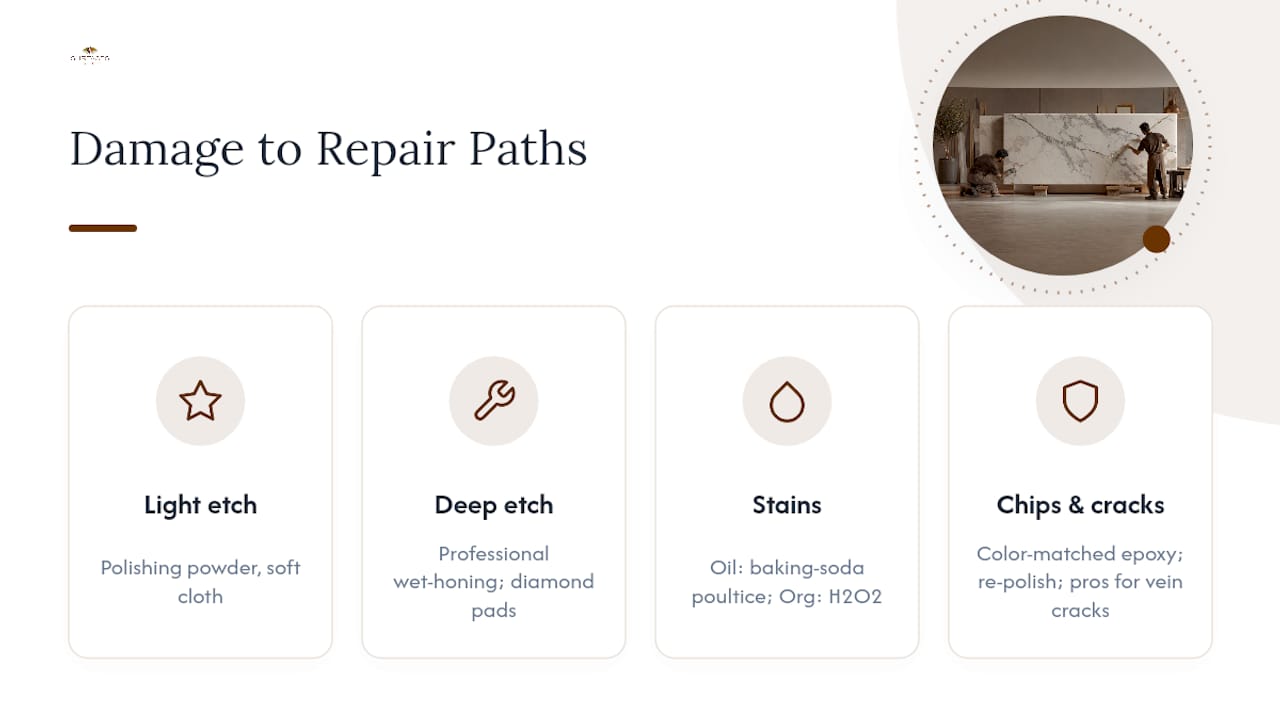
Stains behave differently than etches because they involve something soaking into the stone rather than reacting with it. Oil-based stains, from cooking grease or hand lotion, typically respond to a poultice: a paste of baking soda or a commercial poulticing powder mixed with water, applied thickly, covered with plastic wrap, and left for 24 to 48 hours to draw the contaminant back out. Organic stains from coffee, tea, or fruit juice sometimes need a mild hydrogen peroxide poultice instead, though this should be tested on an inconspicuous area first given the stone’s acid sensitivity.
Chips and small cracks along an edge or corner are usually repaired with a color-matched epoxy resin, then re-honed or re-polished to blend with the surrounding surface. For a crack that runs along one of Arabescato’s characteristic heavy veins, a fabricator may recommend a resin injection followed by reinforcement on the underside before deciding whether the piece is salvageable or needs replacement. Most etching and light staining is fixable. Structural cracks along vein planes are the damage worth calling in a professional for immediately, rather than attempting a DIY fix.
Which Applications Give Arabescato the Best Long-Term Performance?
Longevity with Arabescato comes down almost entirely to where you put it and how it’s finished, not some inherent weakness in the stone itself.
Vanity tops and low-traffic accent surfaces perform the best over time, often looking essentially unchanged after a decade or more of normal use. These areas see minimal acid exposure and light foot traffic, so the sealing schedule can stretch longer and small etches rarely appear at all.
Kitchen islands and counters sit at the other end of the spectrum. Even with diligent sealing, a busy kitchen that handles citrus, wine, and tomato-based cooking daily will show some etching within the first year or two, particularly on a polished finish. That’s not a defect. It’s the expected behavior of a calcitic stone under acid exposure, and many designers now present it to clients as a form of patina rather than damage. A honed finish substantially reduces how visible that wear becomes.
Backsplashes and accent walls perform closer to vanity tops than counters, since they see splashes rather than direct food contact and abrasion. Shower walls in covered, indoor bathrooms also hold up well, provided grout lines and seams are properly sealed against moisture intrusion.
The application that ages worst is anything with sustained water and chemical exposure outdoors, like pool decking. Freeze/thaw cycling in colder climates can accelerate surface degradation on any calcitic stone left uncovered, which is part of why Arabescato works so much better as an interior statement piece than an all-weather exterior material.
How Should You Care for Arabescato in High-Traffic or Outdoor Settings?
If Arabescato is going into a busy kitchen, a commercial lobby, or any high-traffic zone, the maintenance routine needs to be tighter than what a quiet powder room vanity requires.
Wipe up spills immediately, especially anything acidic, rather than letting them sit even for a few minutes. In a household that cooks often, that means keeping a soft cloth and pH-neutral cleaner within reach of the island at all times, not tucked away under the sink. Use cutting boards and trivets religiously. Direct knife contact and hot pans both damage the polished surface, the first through scratching and the second through thermal shock that can cause micro-cracking.
For high-traffic commercial installations, a maintenance agreement with scheduled professional resealing, typically every six to twelve months depending on foot traffic, keeps the stone performing as intended rather than reacting to a problem after it’s already visible.
Outdoor use requires the most caution of all. Covered patios with no direct rain or freeze exposure can work for accent applications, but fully exposed installations aren’t recommended given the stone’s water absorption rate and sensitivity to freeze/thaw cycling. If a client insists on an exterior application, a honed finish, aggressive sealing schedule, and clear expectations about accelerated weathering are non-negotiable parts of that conversation.
What Design Styles Pair Best With Arabescato Marble?
Arabescato’s bold veining does most of the design work on its own, which means the styles that pair with it best tend to keep everything else relatively restrained.
Modern luxury interiors lean into the contrast between Arabescato’s dramatic pattern and clean, minimal cabinetry, usually in matte black, deep navy, or warm walnut tones that let the stone read as the room’s focal point. Brass and unlacquered bronze fixtures have become the default pairing in this style because the warm metal tone plays well against the stone’s cool grey veining.
Transitional and classic interiors use Arabescato differently, often as a countertop or fireplace surround paired with painted cabinetry in soft whites, sage green, or dusty blue. The stone’s Old World Italian character fits naturally into spaces that already lean traditional, especially when paired with furniture-style cabinet details and picture-frame molding.
For bathrooms specifically, pairing Arabescato with matte black or brushed nickel fixtures and simple, large-format tile on surrounding walls keeps the eye focused on the vanity slab rather than competing patterns. Avoid pairing it with other heavily patterned materials in the same sightline. Two bold veined stones or a busy patterned tile floor next to an Arabescato backsplash tend to fight each other visually rather than complement one another.
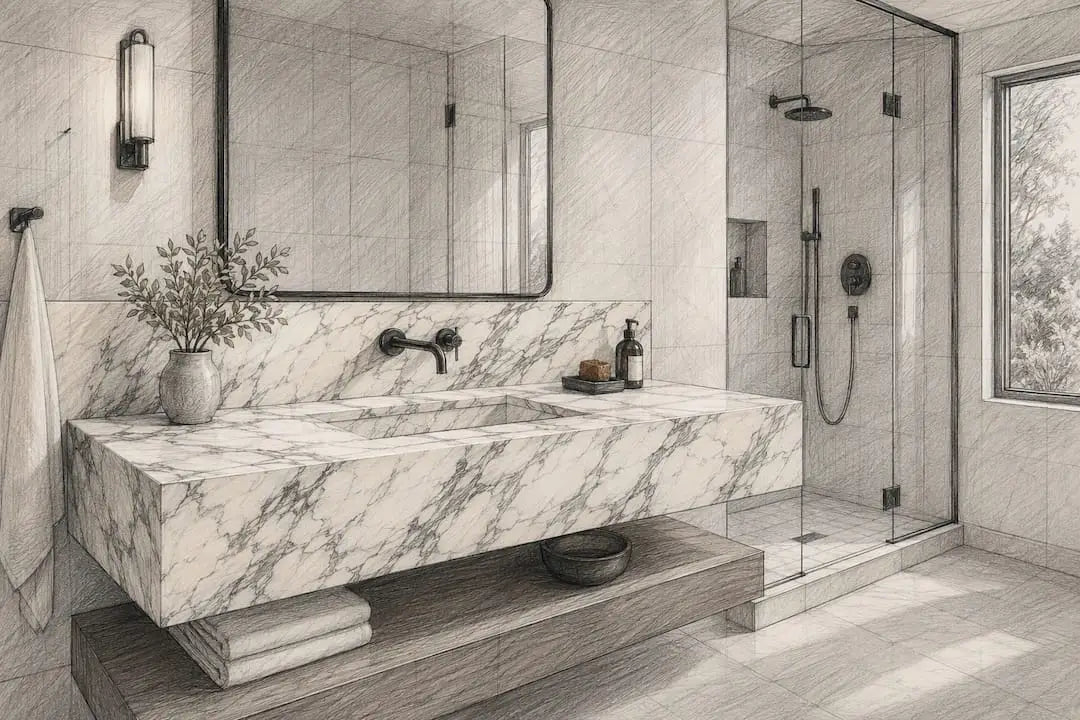
Color palettes that work best skew neutral and warm: creams, warm greys, black, and brass. Cool-toned blues and greens can work in small doses but risk clashing with the ivory undertone in the stone’s ground.
When Does Surfaces Galore Recommend Arabescato Marble?
We steer clients toward Arabescato when the project is design-led first, functional second: a statement island, a showpiece bathroom, a lobby wall meant to be photographed. For high-abuse family kitchens where citrus and red wine are daily visitors, we’re honest that a quartz or granite alternative may serve the household better long-term.
Setting expectations early matters more than any sealer. Etching over time is patina, not failure, and framing it that way before installation prevents disappointment later. A simple annual resealing conversation, agreed on up front, does more for client satisfaction than any warranty language ever could.
— John | Surfaces Galore
Order Arabescato Corchia Tile Samples From Surfaces Galore
If Arabescato’s veining has you sold, Surfaces Galore gets you fabrication-ready material faster than sourcing through multiple middlemen, since we import directly and ship nationwide with trade pricing available for designers and contractors.
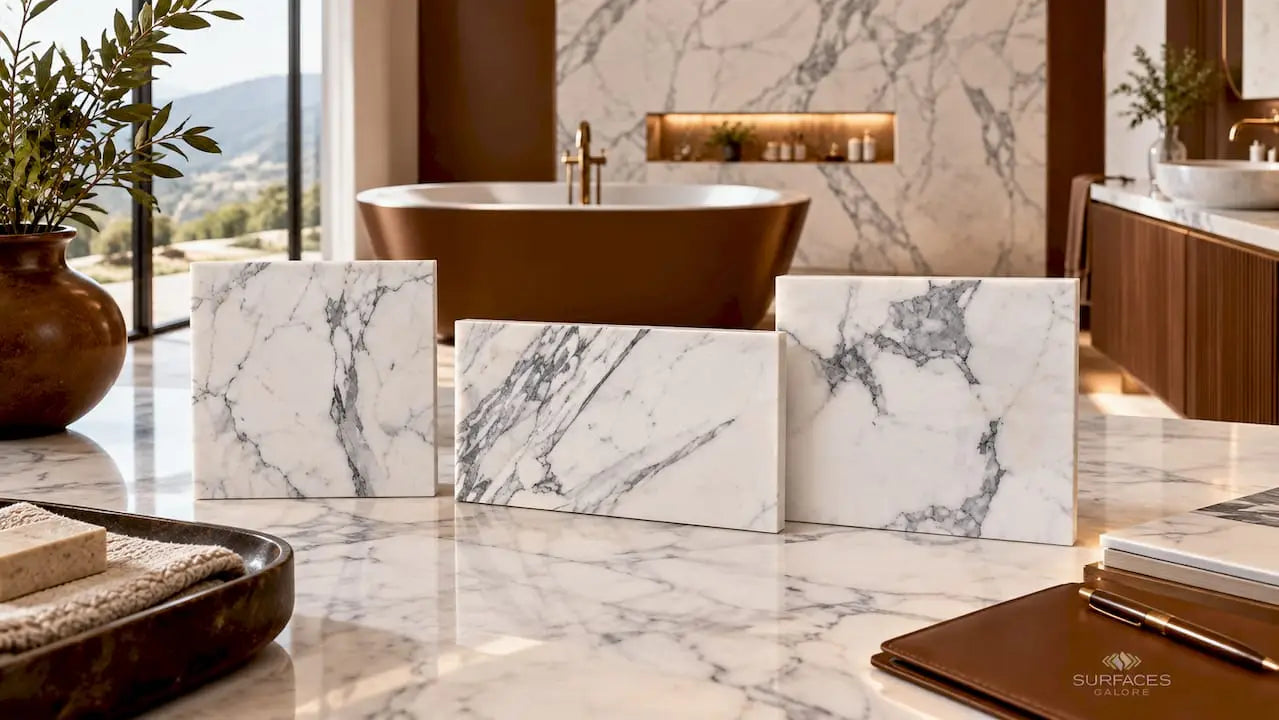
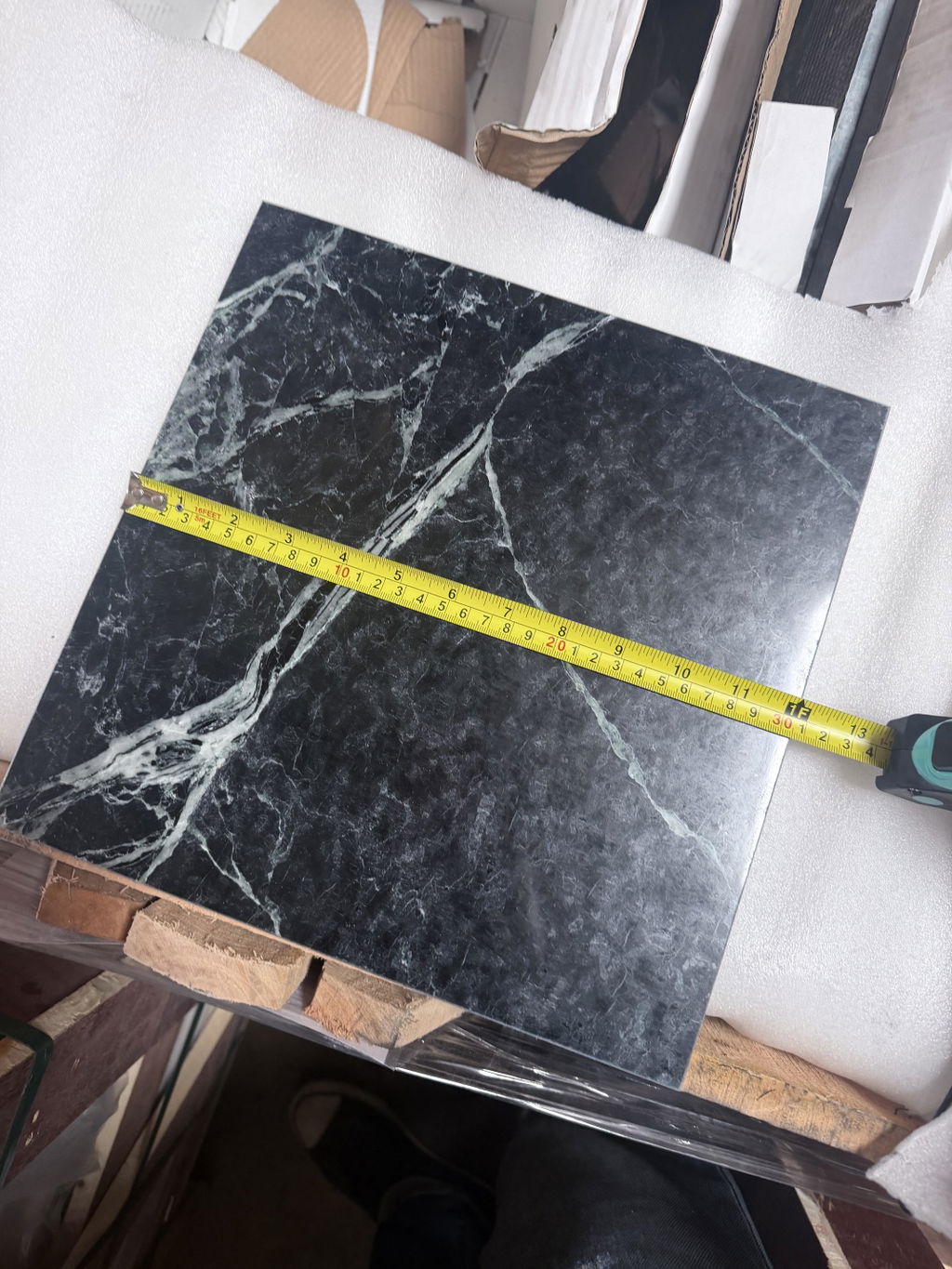
Our current Arabescato Corchia lineup covers three sizes in both polished and honed finishes: the 12x12 Arabescato Corchia tile for classic layouts, the 12x24 format for larger-format floors and walls, and the 18x18 Arabescato Corchia tile for statement flooring in bathrooms and entryways. Every SKU is available as a sample before you commit to a full order, and our team can put together a fabrication-ready cut list once you’ve settled on quantities and layout. Reach out through the product pages above to request samples, get trade pricing, or start a quote for your next remodel or build.
Where Can You Verify These Arabescato Marble Facts?
The technical claims and fabrication guidance in this guide draw from a short list of sources worth bookmarking if you’re specifying Arabescato for a project:
- StoneContact’s Arabescato marble specs for density and water absorption figures
- Surfaces Galore’s Arabescato marble guide for maintenance and finish recommendations
- Dynamic Stone Tools’ fabrication guide for slab handling and tooling advice
- Stone Intelligence’s Arabescato Carrara data sheet for hardness and classification details
Sources
- Arabescato Marble — StoneContact
- Arabescato marble: fabricating Italy’s bold-veined white stone — Dynamic Stone Tools
- Arabescato Carrara — Stone Intelligence
FAQ
What Is Arabescato Marble?
Arabescato marble is a calcitic natural stone quarried in Italy’s Apuan Alps, identified by its ivory white ground and bold, arching grey veining that resembles calligraphic brushstrokes.
What’s the Difference Between Carrara and Arabescato Marble?
Carrara marble shows fine, feathery, evenly distributed grey veins on a soft grey white background, while Arabescato has bolder, more sculptural veins that curl and arch across a brighter ivory ground, and it typically costs more than Carrara.
How Much Does Arabescato Marble Cost?
Pricing varies by quarry, slab size, finish, and fabrication complexity, and it generally lands between Carrara and Calacatta in price. Contact a supplier like Surfaces Galore directly for a current quote based on your specific project quantities and layout.
Is Arabescato Marble High Maintenance?
It requires more care than granite or quartz because it’s calcitic and acid sensitive, but with pH-neutral cleaners and annual resealing, it performs well for decades in the right applications.
Can Arabescato Marble Be Used Outdoors?
It’s best kept to covered or indoor applications; uncovered exterior use and pool coping aren’t recommended given its water absorption rate and vulnerability to freeze/thaw cycling and acidic chemical exposure.
Recommended
- 4 Phase Marble Design Checklist for Homeowners and Design Pros
- Marble Custom Fabrication for Luxury Homes
- Matching Marble Slabs for Seamless Luxury Surfaces
- Marble Countertop Installation for Elegant Results
This article is provided for general informational guidance only. Natural stone varies in color, veining, texture and performance. For installation, sealing, cleaning and maintenance, follow the product manufacturer’s instructions and consult a qualified installer or stone-care professional. Always test cleaning and sealing products in an inconspicuous area first. Surfaces Galore is not responsible for damage, discoloration, etching, staining, installation issues or other problems resulting from

Leave a comment