
Marble classifications explained for architects

Marble classification involves more than aesthetics. Understanding commercial grades, visual types, and provenance testing determines whether a slab delivers the structural integrity and design impact your high-end project demands. Misidentifying grades or confusing quartzite with marble risks both durability and client satisfaction. This guide clarifies the Natural Stone Institute’s commercial grading system, visual distinctions among popular varieties like Carrara and Calacatta, scientific provenance methods, and practical selection strategies. You will learn how to match marble characteristics to project requirements, avoid common pitfalls, and specify materials confidently.
Table of Contents
- Understanding Commercial Marble Grades A Through D
- Visual Classification: Marble Types And Aesthetic Distinctions
- Provenance And Scientific Methods In Marble Classification
- Practical Considerations And Nuanced Cases In Marble Selection
- Explore Premium Marble Options At Surfaces Galore
- Frequently Asked Questions About Marble Classifications
Key takeaways
| Point | Details |
|---|---|
| Commercial grades A-D | Grades indicate structural quality, filler use, and suitability for horizontal or vertical applications. |
| Visual classification | Carrara, Calacatta, and Statuario differ by veining intensity, durability, and luxury positioning. |
| Provenance testing | Isotopic and EPR methods determine quarry origins but cannot guarantee slab uniformity. |
| Practical selection | Match grade and type to project budget, aesthetic goals, and structural demands for optimal performance. |
Understanding commercial marble grades A through D
The Natural Stone Institute classifies marble into four commercial grades based on fissures, pits, voids, and veining uniformity. These grades directly affect structural integrity, filler requirements, and suitable applications. Architects must understand these distinctions to specify materials that meet both aesthetic and performance standards.
Grade A marble exhibits minimal defects, tight structure, and requires little to no resin filler. This premium grade suits countertops, high-traffic flooring, and feature walls where structural stability and visual consistency matter most. Grade B introduces moderate veining irregularities and minor fissures, often requiring light resin treatment. It works well for vertical applications and lower-traffic areas where slight imperfections remain acceptable. Grade C shows noticeable flaws, including voids and uneven veining, necessitating significant resin filling. This grade typically serves decorative vertical installations where structural demands stay minimal. Grade D contains substantial defects, heavy resin application, and compromised structural integrity. Use this grade exclusively for vertical applications like accent walls, never for countertops or flooring.
Grading affects slab selection by revealing how much resin filler manufacturers applied during processing. Excessive filler indicates underlying structural weakness and increases vulnerability to cracking under load. When specifying marble for horizontal surfaces, restrict choices to Grades A or B. Grade C may suffice for vertical elements in budget-conscious projects, but Grade D poses unacceptable risks for any load-bearing application.
Pro Tip: Inspect slabs under raking light to reveal resin-filled areas that appear glossier than natural stone. Excessive shine signals heavy filler use and potential structural compromise.
Commercial grades summarized:
- Grade A: Minimal defects, negligible filler, suitable for countertops and high-traffic flooring
- Grade B: Moderate irregularities, light resin, appropriate for vertical surfaces and lower-traffic areas
- Grade C: Noticeable flaws, significant filler, decorative vertical use only
- Grade D: Substantial defects, heavy resin, vertical accent applications exclusively
“Understanding marble grades ensures you select materials that balance aesthetic goals with structural requirements, preventing costly failures in high-end installations.”
Grading also influences maintenance expectations. Higher resin content in lower grades can yellow over time or react differently to cleaning agents compared to natural stone. When you prioritize longevity and consistent appearance, invest in Grade A or B materials. For additional guidance on matching marble characteristics to project needs, explore marble selection tips 2025. Similar grading principles apply to other natural stones, as detailed in travertine tile grades explained.
Visual classification: marble types and aesthetic distinctions
Visual classification distinguishes marble varieties by veining patterns, background color, and luxury positioning. Carrara features subtle grey veining on white backgrounds, Calacatta displays bold, dramatic veining with warmer tones, and Statuario presents striking, high-contrast veining commanding premium prices. These aesthetic differences guide design intent but also correlate with durability characteristics.
Dolomitic marble contains magnesium carbonate, offering greater hardness and acid resistance compared to calcitic marble composed primarily of calcium carbonate. Dolomitic varieties withstand kitchen environments better, though no marble resists acidic substances completely. Calcitic marbles like Carrara remain popular for their classic appearance despite requiring more diligent maintenance. When specifying marble for kitchens or bathrooms, consider dolomitic options if clients prioritize durability alongside aesthetics.
| Marble Type | Appearance | Durability | Optimal Applications | Price Tier |
|---|---|---|---|---|
| Carrara | Subtle grey veining, white background | Moderate (calcitic) | Bathrooms, low-traffic areas | Mid-range |
| Calacatta | Bold, warm-toned veining | Moderate (calcitic) | Feature walls, statement pieces | High |
| Statuario | Dramatic high-contrast veining | Moderate (calcitic) | Luxury focal points | Premium |
| Dolomitic varieties | Variable patterns | High (magnesium content) | Kitchens, high-traffic surfaces | Variable |
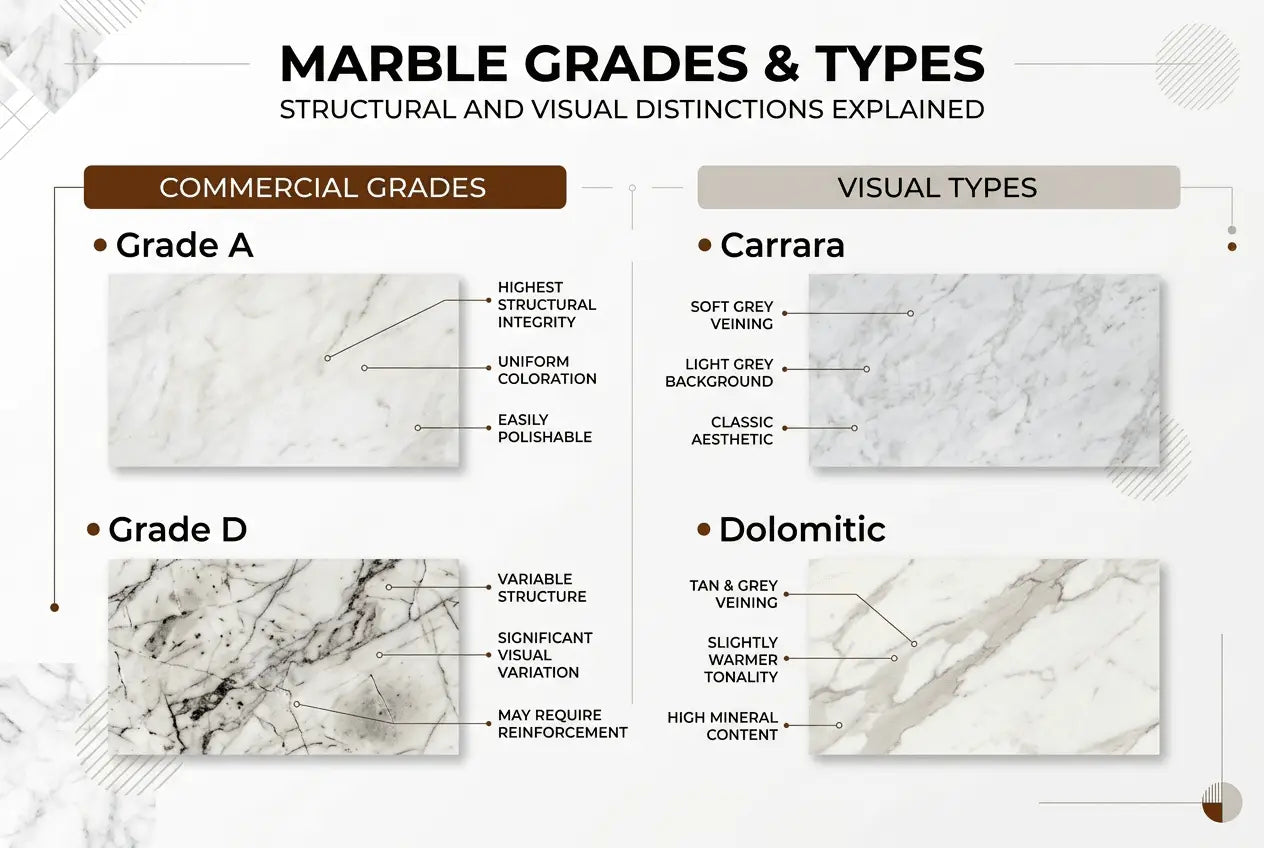
Visual classification prioritizes aesthetics over structural factors, meaning a visually stunning Calacatta slab may still fall into Grade C commercially if it contains significant fissures. Always evaluate both visual appeal and commercial grade when specifying materials. A Grade A Carrara slab delivers better long-term performance than a Grade D Calacatta, regardless of visual drama.
Factors to consider when choosing marble types:
- Veining intensity and pattern alignment with design vision
- Background color compatibility with surrounding materials
- Dolomitic versus calcitic composition for durability requirements
- Commercial grade alongside visual classification
- Budget constraints and client expectations for luxury positioning
Understanding how visual characteristics interact with durability helps you set realistic client expectations. A stunning Statuario countertop requires careful maintenance and sealing, while a dolomitic marble offers more forgiving performance. For insights on how surface treatments affect marble appearance and durability, review marble surface finishes explained. When selecting marble specifically for kitchens, consult best marble for kitchens and design for detailed comparisons.
Provenance and scientific methods in marble classification
Scientific methods using oxygen and carbon isotopes plus electron paramagnetic resonance determine marble quarry origins, providing architects with provenance data for authenticity verification and historical context. These advanced techniques analyze chemical signatures unique to specific geological formations, enabling differentiation between marble sources even when visual characteristics appear similar.
The scientific classification process follows these steps:
- Extract small samples from marble slabs or quarry blocks for laboratory analysis
- Measure oxygen and carbon isotope ratios using mass spectrometry to identify geological formation signatures
- Conduct EPR testing to detect paramagnetic centers created during marble crystallization
- Compare results against databases of known quarry signatures to determine probable origin
- Account for natural variability within individual quarries that may affect signature consistency
Provenance testing matters when clients demand authenticated materials for heritage restoration projects or luxury installations where origin stories add value. Knowing a slab originated from historic Carrara quarries rather than generic white marble sources justifies premium pricing and enhances project narratives. However, provenance data cannot guarantee uniformity across slabs from the same quarry.
Quarry variability presents challenges for architects assuming consistent material properties. Geological conditions shift within single quarries, producing marble blocks with different veining patterns, structural characteristics, and chemical compositions. A provenance certificate confirming Carrara origin does not ensure two slabs will match perfectly or perform identically. Always inspect individual slabs rather than relying solely on quarry designation.
Pro Tip: Request provenance documentation for high-profile projects where material authenticity affects client satisfaction, but supplement scientific data with visual inspection and commercial grade verification.
Limitations of provenance testing include cost, sample requirements, and inability to predict aesthetic or structural uniformity. These methods excel at confirming origins but cannot replace hands-on slab evaluation. For deeper understanding of how marble origins influence design outcomes, explore master marble origins. The broader context of marble’s role in interior design appears in role of marble in interiors.
Practical considerations and nuanced cases in marble selection
Real-world marble selection involves balancing budget constraints, aesthetic goals, and structural requirements. Grade B and C slabs with irregular veining serve budget-conscious projects where clients accept aesthetic compromises for cost savings. These lower grades work for vertical applications like backsplashes or accent walls where structural demands remain minimal and visual imperfections add character rather than detract from design intent.
Quartzite misidentification poses significant risks because this metamorphic rock resembles marble visually but offers superior hardness and acid resistance. Unscrupulous suppliers sometimes label quartzite as marble or vice versa, leading to performance mismatches. Differentiate materials using a simple acid test: apply lemon juice to an inconspicuous area. Marble fizzes due to calcium carbonate content, while quartzite remains inert. Always verify material identity before specifying, especially when durability expectations differ significantly between stone types.
Slab thickness directly affects structural performance and installation requirements. Standard 2cm slabs require plywood backing for spans exceeding 18 inches, while 3cm slabs span up to 24 inches unsupported. For kitchen islands or large countertop sections, specify 3cm material to minimize seam visibility and reduce installation complexity. Thicker slabs also convey luxury and substance, enhancing perceived value in high-end projects.
| Property | Marble | Quartzite |
|---|---|---|
| Hardness | Moderate (calcite 3 on Mohs scale) | High (quartz 7 on Mohs scale) |
| Acid resistance | Poor (fizzes with lemon juice) | Excellent (no reaction) |
| Veining patterns | Natural, varied | Often linear, metamorphic |
| Ideal applications | Bathrooms, low-acid environments | Kitchens, high-traffic areas |
| Maintenance | Regular sealing, careful cleaning | Minimal sealing, durable |
Practical tips for matching marble to project requirements:
- Specify Grade A or B for horizontal surfaces requiring structural integrity
- Accept Grade C for vertical decorative elements in budget-limited projects
- Verify material identity with acid testing when quartzite confusion risks exist
- Choose 3cm slabs for spans over 24 inches or luxury positioning
- Evaluate individual slabs rather than relying on quarry designations alone
Pro Tip: Beware suppliers offering premium marble names at suspiciously low prices. This often signals misidentification, lower commercial grades, or quartzite substitution that compromises design intent.
Common pitfalls include assuming all white marble performs identically, neglecting commercial grade verification, and trusting visual classification alone. A stunning Calacatta slab graded D fails structurally despite aesthetic appeal. Conversely, a Grade A Carrara slab delivers reliable performance even if less visually dramatic. For comprehensive guidance on marble selection, revisit marble selection tips 2025. Understanding thickness implications appears in marble thickness guide.
Explore premium marble options at Surfaces Galore
Surfaces Galore offers curated selections of premium marble slabs spanning commercial grades and visual varieties suited for diverse architectural projects. Our direct import model delivers authentic Italian Carrara, Calacatta, and Statuario alongside durable dolomitic options at competitive prices. Access expert guidance on matching marble characteristics to your specific design requirements, structural demands, and budget parameters.
Explore detailed product specifications, provenance information, and finish options to make informed material decisions confidently. Our team understands the nuances of commercial grading, visual classification, and practical application, helping you avoid common pitfalls while achieving timeless elegance. Visit Surfaces Galore to discover how premium natural stone elevates your next project.
Frequently asked questions about marble classifications
What does Grade A versus Grade D marble mean for durability?
Grade A marble contains minimal defects and negligible resin filler, delivering superior structural integrity for countertops and flooring. Grade D exhibits substantial flaws requiring heavy resin application, making it suitable only for vertical decorative installations where structural demands stay minimal.
How can I tell if a slab is true marble or quartzite?
Apply lemon juice to an inconspicuous area of the slab. Marble fizzes due to calcium carbonate reacting with acid, while quartzite remains inert because of its quartz composition. This simple acid test prevents costly misidentification.
Are higher grades always the best choice for kitchens?
Grade A or B marble suits kitchen countertops due to structural integrity and minimal filler content. However, even high-grade marble requires diligent maintenance and sealing because all marble remains vulnerable to acidic substances. Consider dolomitic varieties for enhanced durability in kitchen environments.
Does marble grade affect maintenance needs?
Lower grades containing more resin filler may yellow over time or react differently to cleaning agents compared to natural stone. Grade A marble with minimal filler maintains appearance more consistently, though all marble requires regular sealing and careful cleaning regardless of grade. For detailed maintenance protocols, review marble maintenance tips.
Can provenance testing guarantee uniformity in marble slabs?
Provenance testing confirms quarry origins but cannot guarantee uniformity because geological conditions vary within individual quarries. Two slabs from the same source may exhibit different veining patterns, structural characteristics, and chemical compositions. Always inspect individual slabs rather than relying solely on provenance certificates.

Leave a comment