
How to Order Tile in Bulk Online: 2026 Buyer's Guide

TL;DR:
- Ordering tile in bulk online offers significant cost savings by purchasing large quantities directly from suppliers. Proper preparation, including detailed specifications and accurate quantity calculations, ensures a successful order and prevents costly mistakes. Shipping standards and quality controls protect your investment, especially when sourcing natural stone tiles for large projects.
Ordering tile in bulk online is defined as purchasing large quantities of tile directly from a supplier or importer using a structured digital procurement process. Contractors, designers, and homeowners who learn how to order tile in bulk online gain real cost advantages. Volume buying reduces per-square-foot prices by 20% to 50% compared to retail purchasing. That kind of savings on a large renovation or multi-unit project is not marginal. It changes the entire project budget. Surfacesgalore ships premium marble, limestone, and travertine tiles nationwide, making it a reliable starting point for buyers ready to source natural stone at scale.
How to order tile in bulk online: what to prepare first
The single most common mistake buyers make is contacting suppliers before they have their specifications ready. A supplier cannot give you an accurate quote without knowing exactly what you need. Vague requests produce vague pricing, and vague pricing leads to budget overruns.
A technical brief with precise specs is required for accurate bulk tile quotes. Without it, hidden costs from shipping and varying quality grades will surface after you have already committed to an order. Preparing your brief before you reach out to any online tile supplier is the single step that separates experienced buyers from first-timers.
The core specifications every bulk order needs
Before you request a quote from any online tile supplier, gather the following details:
- Tile size and format: State exact dimensions in inches or millimeters (for example, 12x24 in or 600x600 mm). Large format tiles above 24 inches on one side require different handling and packaging.
- Finish type: Polished, honed, brushed, or tumbled. Each finish affects light reflection, slip resistance, and maintenance requirements.
- Thickness: Standard floor tiles run 3/8 in to 1/2 in thick. Thicker tiles carry more weight per pallet and affect freight costs.
- Edge profile: Rectified edges allow tighter grout joints (1/16 in). Non-rectified edges require wider joints (1/8 in or more).
- PEI rating: The Porcelain Enamel Institute wear rating runs from PEI 0 (wall use only) to PEI 5 (heavy commercial traffic). Specify the correct rating for your application.
- Water absorption rate: Tiles for wet areas like showers and pool surrounds must meet ANSI A137.1 standards for low water absorption.
- Usage environment: Floor, wall, wet area, exterior, or commercial. This determines which technical grades are acceptable.
- Delivery timing and packaging: State your required delivery window and whether you need palletized delivery or inside delivery.
Pro Tip: Request that your supplier specify the firing batch and dye lot on the invoice. For large continuous tile areas, require single firing batch production contractually to avoid visible dye lot mismatches after installation.
The usage environment detail matters more than most buyers realize. A tile rated for residential floor use will fail prematurely in a commercial kitchen. Specifying the wrong PEI rating or water absorption class is a quality error that no amount of negotiation fixes after delivery.
How do you calculate tile quantity for a bulk order?
Accurate quantity calculation is the foundation of a successful bulk tile purchase online. Order too little and you face a costly reorder from a different batch. Order too much and you tie up capital in excess inventory. The right number comes from a structured calculation, not a rough estimate.
Step-by-step quantity calculation
-
Measure the total project area. Multiply length by width for each room or surface. Add all areas together to get gross square footage. For irregular spaces, break the area into rectangles and sum them. A step-by-step measuring guide helps avoid common errors on complex floor plans.
-
Subtract fixed obstructions. Remove square footage for islands, cabinets, bathtubs, and any built-in features that will not receive tile. This gives you net square footage.
-
Apply the correct waste factor. Waste factors vary by pattern: 10% for a straight grid layout, up to 20% for herringbone or mosaic patterns. Large format tiles above 24 inches add an additional 5% waste due to more cuts per tile. Apply the waste factor before rounding up to boxes.
-
Add attic stock overage. Order an additional 5% to 10% from the same firing batch for future repairs. Even ordering the same SKU later risks visible color inconsistencies due to batch variation. This overage is not waste. It is insurance.
-
Convert to boxes. Divide your total adjusted square footage by the coverage per box listed by the supplier. Always round up to the nearest full box.
Waste factor reference table
| Layout pattern | Waste factor | Notes |
|---|---|---|
| Straight grid | 10% | Lowest waste, most efficient cut use |
| Staggered / offset | 15% | Common for subway tile and plank formats |
| Herringbone | 20% | High cut frequency, significant offcuts |
| Mosaic sheet | 20% | Sheet trimming adds consistent waste |
| Large format (24 in+) | Add 5% | Apply on top of pattern waste factor |
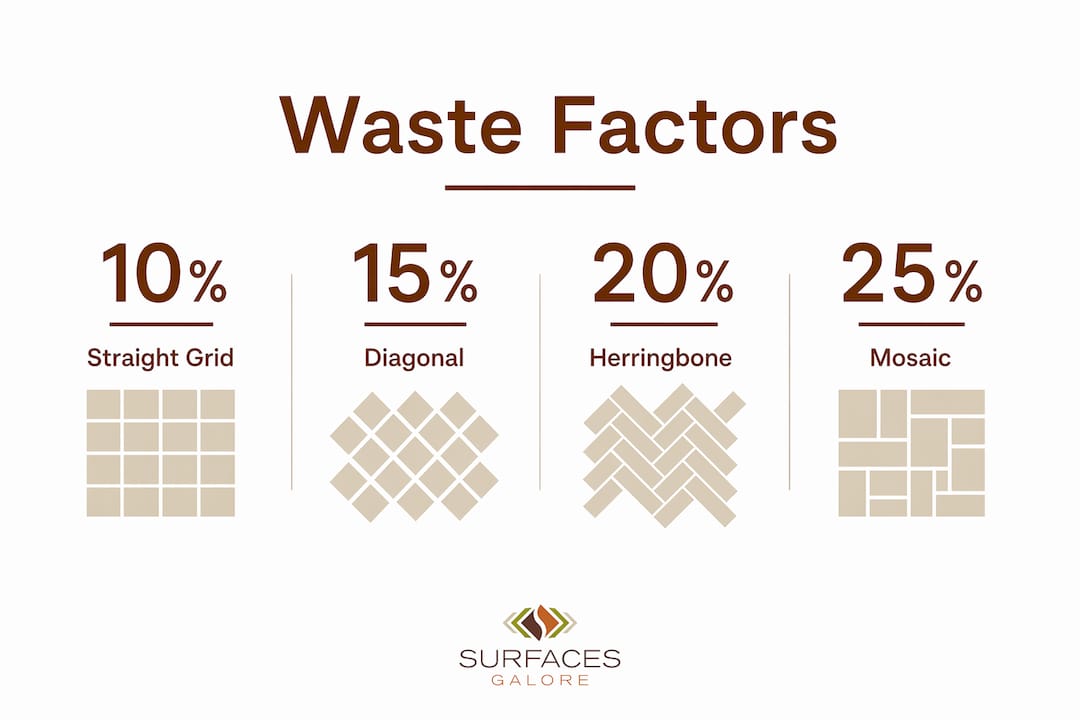
Example: A 1,000 sq ft floor in a herringbone pattern with 24x48 in tiles requires 1,000 sq ft × 1.20 (herringbone) × 1.05 (large format) × 1.07 (attic stock) = approximately 1,347 sq ft total. Divide by box coverage to get your order quantity.
For a deeper look at calculating tile overage, the math changes slightly depending on tile shape and room geometry. Getting this number right before you place a bulk order online protects your project from mid-installation shortfalls.
What packaging and shipping standards protect bulk tile orders?
Packaging is where many bulk tile orders fail silently. Buyers focus on price and product quality, then discover on delivery day that 8% of their order arrived as rubble. Buyers often overlook requesting loading and packaging specs, which leads to hidden breakage costs during shipment.
Pallet and container requirements
Export packing requires fumigated wooden pallets, edge protection, moisture-resistant shrink wrap, and clear pallet marking. These are not optional extras. They are the minimum standard for tiles traveling long distances.
Key packaging and shipping requirements for bulk tile orders include:
- Fumigated wooden pallets: Required for international shipments to meet ISPM 15 phytosanitary standards. Non-compliant pallets get rejected at customs.
- Edge protection: Cardboard or foam corner guards on every pallet prevent chipping during forklift handling.
- Moisture-resistant shrink wrap: Tiles absorb moisture during ocean transit. Shrink wrap protects both the tile surface and the pallet structure.
- Clear pallet labeling: Each pallet must show product code, batch number, quantity, gross weight, and destination. This makes receiving and inventory checks faster.
- Strapping: Steel or polyester strapping holds the pallet load stable during container movement.
Pro Tip: Ask your supplier for a packing list that matches pallet numbers to invoice line items. This makes it possible to identify which pallet contains which product during unloading, saving hours on large deliveries.
Container selection for heavy tile shipments
Large tile shipments typically use 20ft containers due to weight limits of approximately 26–28 metric tons, even when a 40ft container would offer more volume. Natural stone tiles are dense. A full 40ft container loaded with marble or travertine will exceed the legal road weight limit before it is physically full. The 20ft container is the standard choice for heavy natural stone bulk orders.
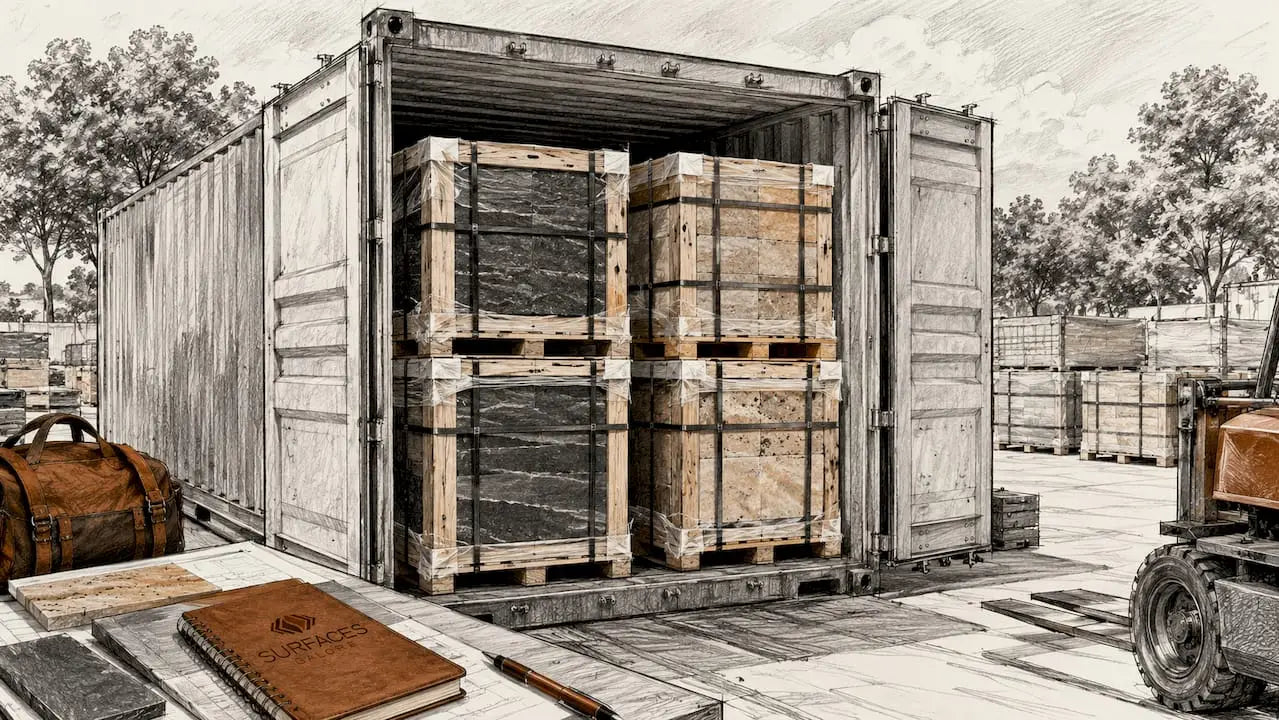
Proper container loading also means distributing weight evenly across the container floor. Uneven loading causes pallets to shift during transit, which creates pressure cracks in tile stacks. Request a container loading plan from your freight forwarder before the shipment is sealed.
How do you evaluate supplier quotes and control quality on bulk tile orders?
Price comparison across suppliers is only useful when you are comparing the same thing. Most buyers receive quotes that look different because they are different. Getting this step right separates a successful bulk tile purchase from an expensive lesson.
Landed cost vs. unit price
Low unit price quotes often omit shipping, duty, and breakage allowances. A low factory price can be more costly overall when you add inland transport, freight, insurance, and import fees. The only number that matters is the landed cost: the total price per square foot delivered to your project site or warehouse.
When requesting quotes from online tile suppliers, specify the same criteria for every supplier:
- Tile size, finish, thickness, and PEI rating (identical across all quotes)
- Port of origin and destination address
- Incoterms (CIF or DDP are most transparent for buyers)
- Packaging standard (fumigated pallets, shrink wrap, edge protection)
- Delivery timeline
Quality control steps before and after production
Proper sample approval and quality checks prevent receiving inferior grades sold as low-cost offers. Buyers should specify hardness, water absorption, edge rectification, and PEI rating to get comparable quality across quotes.
Follow this quality control sequence for every bulk order:
- Request physical samples before confirming the order. Approve the sample in writing and keep a reference piece for comparison at delivery.
- Confirm the batch reference number. Ask the supplier to lock in the firing batch for your full order quantity.
- Request a pre-shipment inspection report. A third-party inspector at the factory checks tile dimensions, surface quality, and quantity before loading.
- Inspect on delivery. Check a random sample of boxes from different pallets against your approved sample. Document any discrepancies immediately.
- Retain attic stock from the original batch. Store 5% to 10% of your order in a dry location for future repairs.
Pro Tip: When planning a tile project at scale, build a one-page specification sheet that you send identically to every supplier. This removes ambiguity and makes quote comparison straightforward.
The quality control process is not bureaucracy. It is the mechanism that ensures the tile you approved in a sample arrives in full at your job site. Skipping any step in this sequence shifts risk entirely onto you.
Key takeaways
Ordering tile in bulk online requires precise specifications, accurate quantity calculations, professional packaging standards, and landed cost comparisons to protect both your budget and your project timeline.
| Point | Details |
|---|---|
| Prepare specs before quoting | Define tile size, finish, PEI rating, and usage environment before contacting any supplier. |
| Calculate with waste factors | Apply 10%–20% waste by pattern type, plus 5% for large format tiles, before rounding up to boxes. |
| Order attic stock | Add 5%–10% overage from the same firing batch to cover future repairs with an exact color match. |
| Compare landed cost | Always compare total delivered cost, not unit price, to get an accurate picture of what you will pay. |
| Require export packaging | Insist on fumigated pallets, edge protection, shrink wrap, and clear labeling to prevent transit breakage. |
What I have learned from years of bulk tile procurement
The most expensive mistake I see contractors and designers make is treating bulk tile ordering as a purchasing task rather than a project management task. You are not just buying tile. You are coordinating specifications, logistics, quality control, and timing across multiple parties. When one element slips, the whole project feels it.
The specification brief is where I always start. A clear, one-page document with exact tile dimensions, finish, PEI rating, water absorption class, and delivery requirements does more to protect a project than any contract clause. Suppliers respond to clarity. Vague requests attract vague commitments.
Logistics is the part that surprises people most. I have seen projects delayed not because the tile was wrong, but because nobody specified fumigated pallets and the shipment was held at customs. Or because the buyer assumed a 40ft container was better value, only to find the weight limit was exceeded before the container was half full. These are not obscure problems. They are predictable, and they are avoidable with the right preparation.
On quality, my honest advice is this: never skip the physical sample approval step. I do not care how trusted the supplier is or how tight the timeline is. The sample is your legal and practical reference point. If the delivered tile does not match the approved sample, you have a documented basis for a claim. Without it, you have a dispute.
For natural stone specifically, the batch consistency issue is real. Marble, limestone, and travertine are quarried materials. Two tiles from the same SKU but different quarry cuts can look noticeably different side by side. Requiring single firing batch production in writing is not overcautious. It is standard practice for any serious project. Surfacesgalore works with buyers on exactly this kind of specification detail, which is one reason I point contractors and designers there for natural stone sourcing.
— cihan
Natural stone tile collections and bulk order support at Surfacesgalore
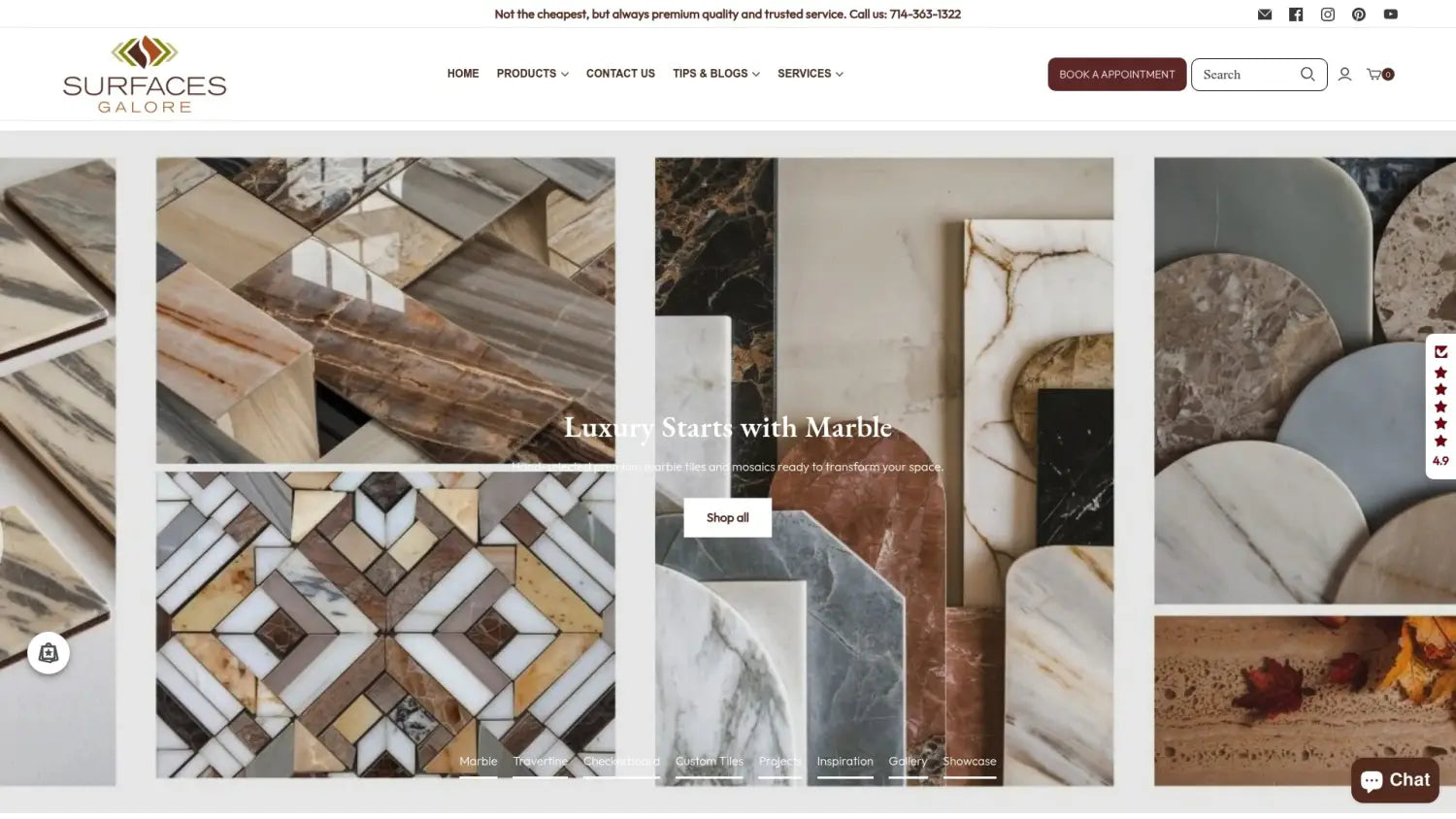
Surfacesgalore is a direct importer of premium marble, limestone, and travertine tiles, mosaics, and decorative stone pieces, shipping nationwide from Anaheim, California. Contractors, designers, and homeowners working on large-scale projects get access to authentic natural stone at direct-import pricing, without the retail markup. The natural stone tile collections cover a wide range of formats, finishes, and applications, from polished marble floor tiles to honed limestone wall cladding and tumbled travertine for outdoor use. The team at Surfacesgalore supports bulk orders with specification guidance and product matching, so you get the right tile for your project the first time. Browse the full collection and reach out for bulk order assistance today.
FAQ
What is the minimum quantity for a bulk tile order online?
Minimum order quantities vary by supplier, but most online tile suppliers set bulk pricing thresholds at 500 to 1,000 square feet. Direct importers like Surfacesgalore can advise on minimum quantities for specific natural stone products.
How do waste factors affect how many tiles I need to order?
Waste factors range from 10% for straight grid layouts to 20% for herringbone or mosaic patterns, with large format tiles adding another 5%. Apply the waste factor to your net square footage before calculating box quantities.
Why should I order extra tile from the same batch?
Ordering 5%–10% overage from the same firing batch protects you against color mismatches in future repairs. Even the same SKU ordered later can show visible variation due to natural quarry differences.
What does landed cost mean for bulk tile orders?
Landed cost is the total price per square foot delivered to your site, including unit price, freight, insurance, import duties, and inland transport. Comparing landed cost across suppliers gives an accurate picture of what you will actually pay.
What tile pattern information helps when ordering tiles in large quantities?
Specifying your tile layout pattern before ordering lets you apply the correct waste factor and calculate an accurate quantity. Herringbone and diagonal patterns require significantly more tile than straight grid layouts for the same square footage.

Leave a comment