
Italian Carrara Marble: Properties, Grades, and Design Uses

TL;DR:
- Italian Carrara marble is a natural stone from Tuscany known for its white to blue-gray hues and soft veining. It has been used for over 2,000 years in iconic sculptures and architecture, with authenticity verified through origin documentation and physical tests. Proper slab selection, grading, and maintenance are essential to ensure long-lasting beauty and value in design projects.
Italian Carrara marble is a natural metamorphic stone quarried in the Apuan Alps of Tuscany, Italy, prized for its white to blue-gray base and soft, feathery gray veining. The Carrara quarrying region has supplied stone to architects and sculptors for over 2,000 years, producing material used in the Pantheon in Rome and Michelangelo’s David. Today, bianco Carrara remains the most widely specified Italian marble in residential and commercial design. Its combination of visual elegance, relative affordability, and broad availability makes it the benchmark against which other white marbles are measured.
What is Italian Carrara marble and how is it formed?
Italian Carrara marble is defined geologically as a crystalline limestone recrystallized under intense heat and pressure over millions of years. The Apuan Alps contain one of the world’s largest marble deposits, and the stone extracted there carries a mineral composition dominated by calcite, which gives it both its characteristic whiteness and its sensitivity to acids. The gray veining results from graphite and other mineral inclusions distributed through the calcite matrix during metamorphism. No two slabs share identical veining, which is precisely what makes each installation unique.
The stone’s density and crystalline structure place it in a distinct category from softer limestones, yet it remains softer and less dense than granite. That physical reality shapes every decision from fabrication to daily care. Carrara white marble registers a Mohs hardness of around 3, meaning it scratches more readily than quartz or granite but polishes to a luminous finish that neither material can replicate naturally.
How do you recognize authentic Italian Carrara marble?
Authentic Italian Carrara marble requires traceability to the Carrara region through quarry origin documentation, batch numbers, and import certificates. The absence of these documents strongly suggests an imitation or a lower-quality substitute. This matters because the global stone market includes many white marbles from Turkey, China, and Greece that are marketed under names similar to Carrara but carry different physical properties and veining characteristics.
Physical and tactile tests
Genuine Carrara marble feels naturally cool and dense to the touch. Resin-treated or chemically coated stones feel sticky or carry an artificially glossy surface that does not match the matte depth of real marble. Run your hand across the surface: authentic stone has a slight texture even when polished, because the crystalline structure creates micro-relief.
Water absorption is another reliable test. Genuine Carrara marble absorbs water slowly, showing gradual darkening when a few drops are applied to an unpolished area. Rapid darkening indicates untreated natural stone, while water beading on the surface points to a coating or resin treatment that masks the stone’s true porosity. Both extremes tell you something important about what you are buying.
Visual cues and market pitfalls
The veining in authentic Carrara marble flows organically through the slab, with natural variation in width and intensity. Perfectly uniform veining repeated at regular intervals signals a printed or engineered product. Natural impurities, minor color shifts, and occasional fossil inclusions are signs of authenticity, not defects.
- Check for quarry origin certificates and batch numbers before purchasing
- Inspect the back of the slab: authentic marble shows natural crystal structure, not a uniform gray backing
- Request import documentation from your supplier
- Compare multiple slabs from the same batch for natural variation rather than identical patterning
- Ask whether the stone has been resin-treated, which affects porosity and long-term sealing behavior
Pro Tip: Lay several slabs dry side by side in the warehouse before committing to a purchase. Vein direction and color tone shift noticeably across a batch, and seeing full slabs together reveals whether the variation is manageable for your layout.
Surfacesgalore sources its Carrara marble directly from Italian quarries and provides the documentation needed to verify authenticity, which removes the guesswork that plagues buyers working through intermediaries.
How does quality grading work for Carrara marble?
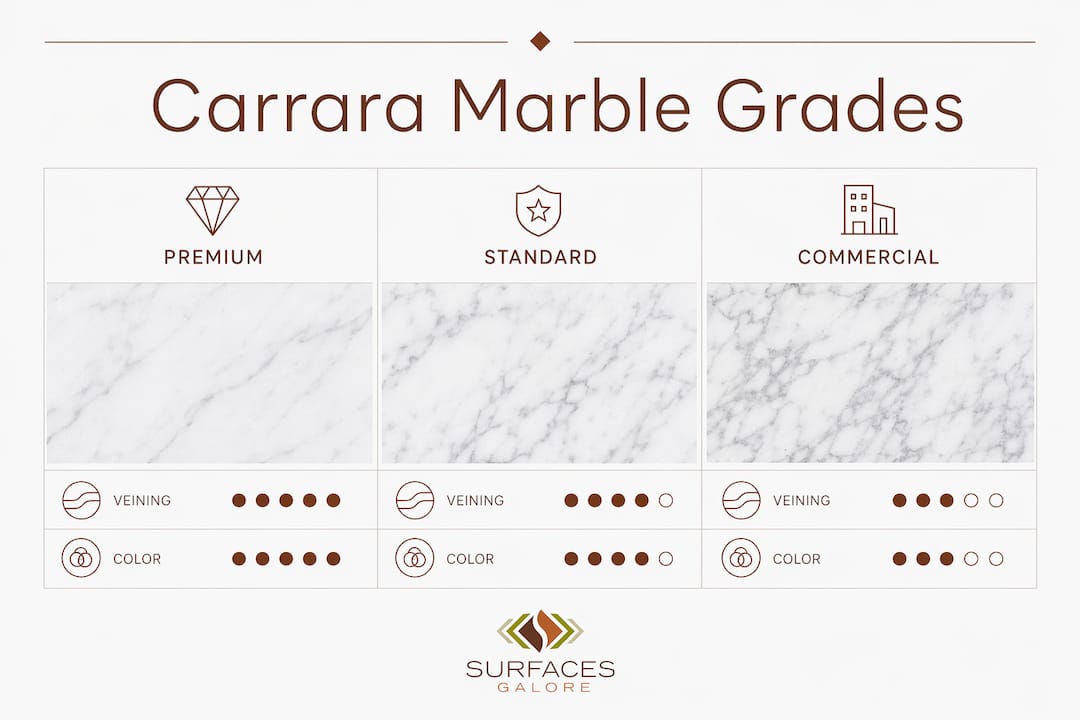
Color and veining variations are inherent in Carrara marble due to geological formation, and quality grading depends on whiteness level, veining consistency, and the presence of impurities. Understanding these grades prevents mismatched expectations and budget overruns on large projects.
The stone industry generally recognizes three broad tiers for Carrara marble: premium, standard, and commercial. Each tier reflects a different balance of visual consistency, whiteness, and veining character.
| Grade | Base Color | Veining Character | Typical Use |
|---|---|---|---|
| Premium | Bright white, minimal variation | Fine, light gray, consistent flow | High-end residential, luxury hospitality |
| Standard | White to light gray, moderate variation | Medium gray, natural irregularity | Kitchens, bathrooms, general flooring |
| Commercial | Blue-gray base, notable variation | Heavy, bold, or irregular veining | Feature walls, accent applications |
Veining types and their design implications
Fine veining produces a quieter, more uniform surface that suits minimalist interiors and large continuous installations like carrara marble flooring in open-plan spaces. Medium veining is the most versatile, working equally well in kitchens and bathrooms without overpowering other design elements. Heavy veining creates strong visual movement and works best as a focal point rather than a field tile.
Dry layout of full slabs before fabrication is the single most effective technique for managing natural variation. Fabricators physically arrange slabs in sequence on the warehouse floor to evaluate vein direction, color continuity, and the overall visual flow before any cutting begins. Skipping this step on a large kitchen or bathroom project is the most common cause of mismatched installations.
Effective marble slab procurement requires locking a full batch at the time of purchase rather than ordering incrementally. Color and veining shift between quarry pulls, and a second order from the same supplier rarely matches the first batch precisely. For projects over 200 square feet, batch locking is not optional.
Pro Tip: When reviewing slabs, photograph them in natural daylight and under artificial lighting. The same slab can read as cool blue-gray under LED and warm white in sunlight, which affects how it coordinates with cabinetry and fixtures.
What are the best applications for Carrara marble in interior design?
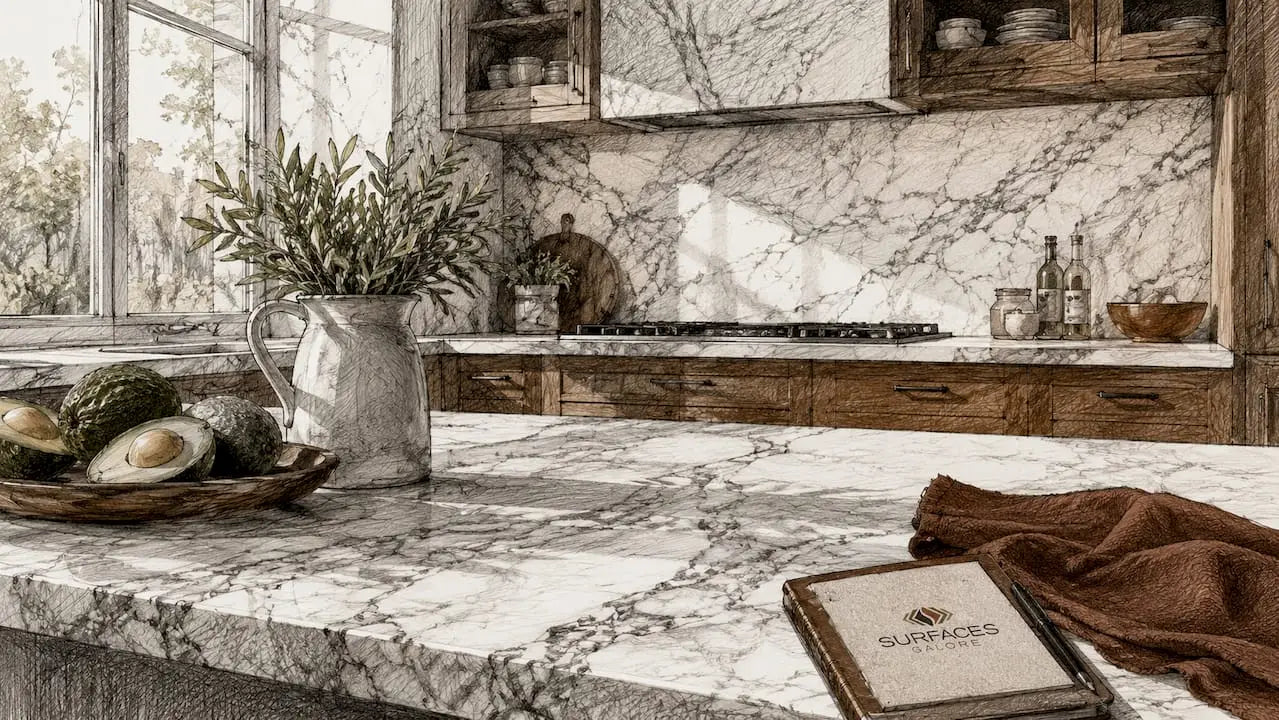
Carrara marble suits a wide range of applications because its neutral gray-white palette coordinates with virtually every design direction. Carrara marble in the kitchen remains the most popular application in American residential design, where it appears on countertops, backsplashes, and island surfaces. Bathroom vanities, shower walls, and floor tile represent the second major category. Hospitality projects use it extensively for lobby flooring, feature walls, and reception counters.
Finish options: honed vs. polished
The finish you choose changes both the look and the performance of the stone. Polished Carrara marble reflects light strongly, amplifying the depth of the veining and creating a formal, high-gloss appearance. Honed Carrara marble tile carries a matte surface that reads as softer and more casual, and it hides minor scratches and etch marks more effectively than polished stone.
For carrara marble floor tile, honed finishes are the professional standard. Polished marble floors increase slip risk, particularly in wet areas like bathrooms and entryways. Honed surfaces provide better grip without sacrificing the stone’s elegant character.
Cost and value considerations
Carrara marble tile typically costs $8–$20 per square foot for material. Installed countertops range from $60–$100 per square foot, making Carrara the most affordable Italian marble option available. That price positions it competitively against mid-range engineered quartz while delivering a natural material that quartz cannot replicate in terms of depth and aging character.
The top five design benefits of specifying Carrara marble:
- Timeless visual appeal: The gray-white palette has remained in continuous use across architectural periods from ancient Rome to 2026 minimalism.
- Versatile coordination: Carrara’s neutral base works with warm wood tones, cool grays, black accents, and brass or chrome fixtures equally well.
- Natural uniqueness: No two slabs are identical, giving every installation a one-of-a-kind character that manufactured surfaces cannot produce.
- Finish flexibility: The same stone reads formally in polished form and casually in honed form, serving different rooms within one project.
- Long-term value: Properly maintained Carrara marble increases property appeal and holds its visual relevance across decades of design trends.
How do you maintain Carrara marble surfaces long-term?
Carrara marble is softer and less dense than granite, with relatively high water absorption and sensitivity to acidic substances. That combination requires a consistent maintenance routine rather than occasional attention. Sealing is the first line of defense. Apply a penetrating stone sealer at installation and repeat every 12–18 months depending on use intensity. A properly sealed surface resists staining from water, oils, and mild food contact.
Acid sensitivity is the property that catches most owners off guard. Vinegar, lemon juice, wine, and tomato-based products all etch the calcite surface on contact, leaving dull spots that are distinct from scratches. The fix is straightforward: wipe spills immediately and never use acidic cleaners on marble. Use pH-neutral stone cleaners for daily maintenance. Products formulated for natural stone, available at most tile and stone suppliers, protect the surface without stripping the sealer.
Embracing the patina
Carrara marble develops a patina of minor scratches and etch marks over time, and many designers consider this an asset rather than a flaw. The lived-in character of aged marble is precisely what makes historic European interiors feel authentic. A kitchen counter that shows years of use carries a warmth that a pristine engineered surface never achieves. Accepting this reality before installation prevents frustration and allows you to appreciate the stone’s evolution.
For surfaces where the patina becomes uneven or pronounced, professional honing and repolishing restore the original finish. Most marble fabricators offer this service, and a single professional restoration extends the surface’s life by decades.
Pro Tip: Choose honed carrara marble tile for bathroom floors and shower entries. The matte finish reduces visible etch marks, hides water spots, and provides better traction than polished stone, making it the practical choice without sacrificing elegance.
Surfacesgalore recommends pairing any Carrara marble installation with a quality penetrating sealer applied before grouting to protect the stone from the moment it is set. The marble patina guide on the Surfacesgalore blog covers specific product recommendations and long-term care schedules in detail.
Key Takeaways
Italian Carrara marble delivers lasting design value when buyers verify authenticity, select the right grade for their application, and commit to consistent sealing and pH-neutral cleaning.
| Point | Details |
|---|---|
| Verify authenticity first | Require quarry origin certificates, batch numbers, and import documentation before purchasing. |
| Match grade to application | Premium grade suits luxury projects; standard grade covers most kitchens and bathrooms effectively. |
| Dry-lay slabs before fabrication | Physical slab layout before cutting prevents mismatched veining and color inconsistency at installation. |
| Choose honed for floors | Honed finishes reduce slip risk and hide etch marks better than polished surfaces in high-traffic areas. |
| Seal and maintain consistently | Apply penetrating sealer at installation and repeat every 12–18 months to protect against staining and acid damage. |
Why I think most buyers underestimate the slab selection process
The single biggest mistake I see in Carrara marble projects is treating slab selection as a formality. Buyers approve a small sample, place an order, and then react with surprise when the installed material looks nothing like what they approved. A 4-inch sample cannot show you how the veining moves across a 10-foot kitchen island. It cannot tell you whether the gray tones read cool or warm in your specific lighting conditions. It tells you almost nothing useful.
The dry-lay process is where real design decisions happen. When you see six or eight full slabs arranged in sequence on a warehouse floor, you understand the material in a way that no sample board communicates. You see how the veining flows or breaks, where the color shifts, and whether the batch has the consistency your project requires. Fabricators who skip this step are cutting corners, and the result shows up in the finished installation.
I also think the conversation around marble maintenance is often framed in a way that scares buyers unnecessarily. Yes, Carrara marble requires sealing. Yes, it etches when exposed to acids. But so does every natural calcite-based stone, and the maintenance routine is genuinely simple once it becomes habit. The buyers who struggle are the ones who expected marble to behave like quartz. The ones who thrive are the ones who understood what they were choosing and planned accordingly.
The matching marble slabs guide from Surfacesgalore is the most practical resource I have seen for helping buyers navigate the slab selection process without a fabricator present. Read it before you visit a showroom.
— cihan
Authentic Carrara marble collections at Surfacesgalore
Surfacesgalore imports Italian Carrara marble directly from Tuscan quarries, with full origin documentation and batch traceability included on every order. The collection covers bianco Carrara marble tile in multiple formats, from large-format floor tile to mosaic sheets and decorative pieces, all available for nationwide shipping from Anaheim, California.
Whether you are specifying carrara white marble tile for a bathroom renovation or sourcing material for a hospitality lobby, the Surfacesgalore team provides expert guidance on grade selection, finish options, and quantity planning. Stone fabricators can also use a countertop estimating tool to calculate material needs accurately before placing an order. Browse the full natural stone catalog at Surfacesgalore and connect with a stone specialist to confirm the right product for your project.
FAQ
What makes Italian Carrara marble different from other white marbles?
Italian Carrara marble is quarried specifically in the Apuan Alps of Tuscany and carries a distinct gray-white base with soft feathery veining produced by graphite inclusions. White marbles from other regions differ in mineral composition, veining character, and physical properties, even when marketed under similar names.
How do I verify that Carrara marble is genuine?
Authentic Carrara marble comes with quarry origin certificates, batch numbers, and import documentation. A stone that absorbs water slowly and feels naturally cool and dense to the touch also shows the physical properties of genuine, untreated marble.
Is honed or polished Carrara marble better for floors?
Honed carrara marble tile is the recommended choice for flooring because it reduces slip risk and hides etch marks more effectively than polished stone. Polished finishes work well on walls and countertops where traction is not a concern.
How often does Carrara marble need to be sealed?
Carrara marble requires a penetrating stone sealer at installation and resealing every 12–18 months depending on traffic and use intensity. High-use surfaces like kitchen countertops benefit from annual sealing.
What is the typical cost of Carrara marble tile and countertops?
Carrara marble tile runs $8–$20 per square foot for material. Installed countertops typically cost $60–$100 per square foot, making it the most affordable Italian marble option on the market.

Leave a comment