
Marble Price per Square Foot: 2026 Buyer's Guide

TL;DR:
- Marble prices vary widely based on type, quality, craftsmanship, and origin, ranging from $75 to $250 per square foot installed. The highest costs are for premium varieties like Calacatta marble from Italy, which also involves import and transportation expenses. Proper planning, slab selection, and understanding ongoing maintenance are essential for a successful marble project.
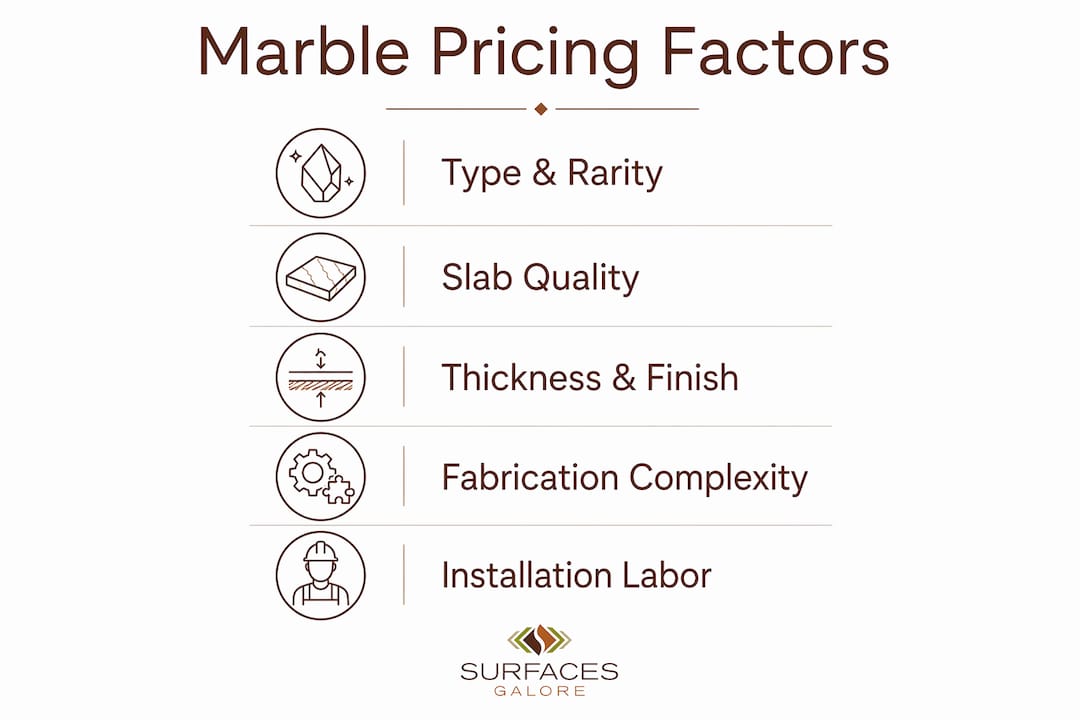
Marble pricing is defined by material type, slab quality, fabrication complexity, and installation labor, with typical installed costs ranging from $75 to $250 per square foot. The U.S. national average sits at $100–$150 per square foot for quality installations. Full kitchen projects generally run $3,000–$8,500, and luxury builds can exceed $10,000. If you are asking what is the price of marble for your next renovation, the honest answer is that no single number covers it. Understanding the variables behind that range is what separates a well-planned project from a budget surprise.
What is the price of marble, and what drives it?
Marble cost is not a fixed number. It is the sum of several layers: the raw material, the grade of the slab, how it is cut and finished, and who installs it. Each layer adds or subtracts from the final invoice.
Marble type and rarity
The variety of marble you choose is the single biggest price driver. Carrara marble costs $75–$120 per square foot installed, making it the most accessible option for residential projects. Calacatta marble, quarried from a smaller section of the Apuan Alps in Italy, runs $150–$250 per square foot installed. Calacatta prices have risen 15–25% over the last five years because demand for its bold, dramatic veining has outpaced supply. Other premium varieties such as Statuario and Arabescato fall in the upper mid-range, typically $130–$200 per square foot depending on slab quality and origin.
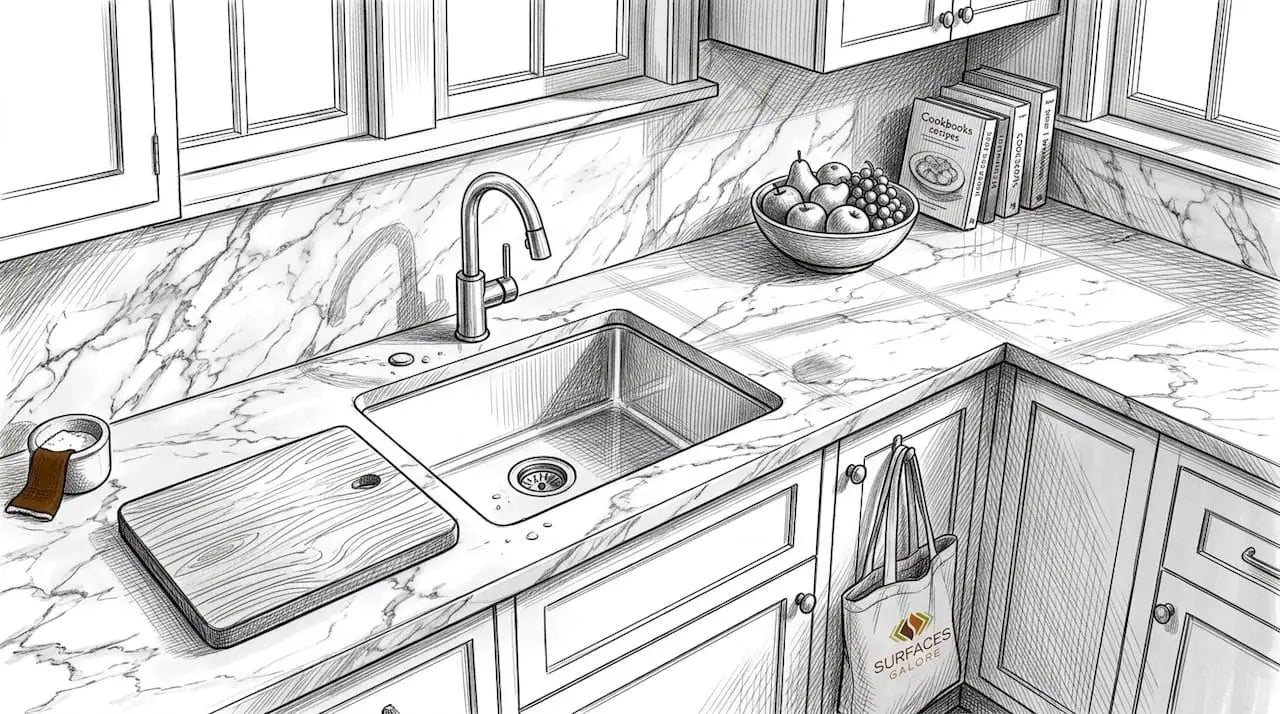
For a deeper look at how Calacatta differs from other white marbles, the Calacatta marble guide at Surfacesgalore breaks down its characteristics and typical price positioning.
Slab quality and grading
Marble slabs are graded from commercial to luxury, and the grade directly affects cost. Commercial-grade slabs carry more natural variations, minor fissures, and inconsistent veining. Luxury-grade slabs are selected for uniform color, tight veining, and structural integrity. Premium slabs cut from the heart of a single block can cost significantly more than edge slabs from the same quarry. That price gap reflects both visual consistency and the reduced risk of cracking during fabrication.
Slab thickness and surface finish
Standard countertop slabs come in 2 cm and 3 cm thicknesses. The 3 cm option costs more per square foot but requires less edge buildup, which saves on fabrication labor. Surface finish also shifts price. Polished finishes are the most common and least expensive to produce. Honed, leathered, and brushed finishes require additional processing steps, adding $5–$15 per square foot to material costs.
Extraction, quarry location, and transportation
Italian marble commands a premium because of quarry location, extraction difficulty, and centuries of reputation. Shipping stone from Carrara or Siena to a U.S. port adds freight, customs, and handling costs that domestic quarries in Georgia or Vermont do not carry. Supply chain logistics and fuel prices create additional cost fluctuations that vary by season and global demand.
- Marble type: Carrara is the most affordable; Calacatta and Statuario carry the highest premiums.
- Slab grade: Luxury-grade slabs cost more but reduce fabrication waste and visual inconsistency.
- Thickness: 3 cm slabs cost more per unit but reduce edge-building labor.
- Surface finish: Polished is standard; honed and leathered add processing cost.
- Origin: Italian quarries add import logistics costs that domestic stone avoids.
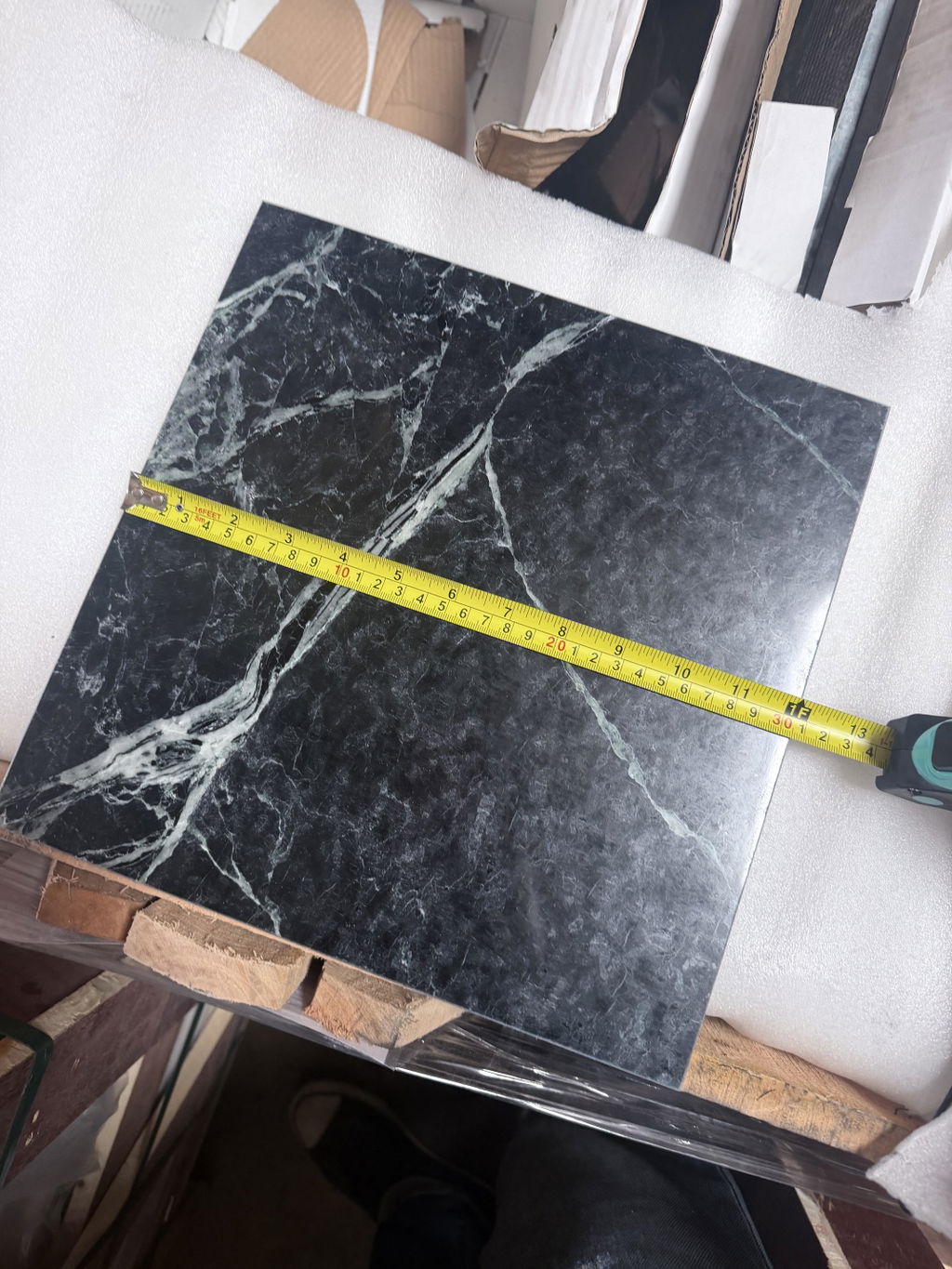
Pro Tip: Ask your supplier to show you the full slab before purchase, not just a sample tile. Veining patterns vary dramatically across a single slab, and what looks subtle in a 4-inch sample can appear bold at full scale.
How do fabrication and installation affect marble pricing?
Material cost is only part of the equation. Fabrication and installation together often account for 40–60% of the total project cost. Skipping a qualified installer to save money is the most common mistake buyers make.
Labor rates and regional variation
Marble installation labor averages $35–$45 per hour, with labor adding $30–$50 per square foot to the overall cost. Metropolitan markets such as New York, Los Angeles, and San Francisco run 15–25% above those averages. That premium reflects higher overhead for specialized fabricators and the cost of operating in dense urban areas. Rural and suburban markets generally stay within the standard range.
Fabrication complexity: the hidden cost multiplier
Fabrication is where budgets expand unexpectedly. The following factors each add measurable cost to a marble installation:
- Edge profiles: A simple eased edge is the least expensive option. Ogee, waterfall, and mitered edges require precision cutting and add $15–$40 per linear foot.
- Cutouts: Sink cutouts, cooktop openings, and faucet holes each require precise cuts. Each cutout typically adds $100–$300 to the fabrication bill.
- Bookmatching: This technique mirrors two adjacent slabs to create a symmetrical vein pattern. It requires careful slab selection and precise alignment, adding significant labor time.
- Waterfall edges: A waterfall countertop, where the stone continues vertically down the side of an island, adds $500–$1,500 per installation due to the precision of the mitered join.
- Polishing and sealing: Post-installation polishing and the first professional seal add $1–$3 per square foot but protect the investment immediately.
Fabrication complexity can increase labor costs by 20–50% compared to a straightforward countertop installation. A project that looks simple on paper can double in labor cost once edge work and cutouts are added.
Why professional expertise matters
Marble is unforgiving. A crack from an improper cut or a poorly supported slab cannot be undone. Experienced fabricators understand the grain direction of each slab and cut accordingly. They also know which marble varieties are prone to fissuring under stress, which affects how they handle and support the stone during installation. Paying for expertise upfront prevents costly replacements later.
Pro Tip: Request an itemized quote that separates material cost, fabrication, and installation labor. This lets you compare bids accurately and identify where costs differ between contractors.
How to estimate total costs for your marble project
Accurate budgeting starts with precise measurement and a realistic understanding of all cost layers. Guessing square footage or ignoring waste factors leads to mid-project shortfalls.
Measuring and accounting for waste
Marble slabs average 60–70 square feet, and adding 10–15% extra material is standard practice for waste and installation cuts. That buffer protects against shortage and color mismatches if a section needs to be recut. For complex layouts with diagonal patterns or bookmatching, increase the buffer to 20%.
Tiles vs. slabs: a cost comparison
Marble tiles and slabs serve different applications and carry different price points.
| Format | Typical material cost | Best use case | Installation complexity |
|---|---|---|---|
| Marble tiles (12"x12") | $5–$25 per sq ft | Floors, backsplashes, showers | Moderate |
| Marble tiles (24"x24") | $15–$40 per sq ft | Large floors, feature walls | Moderate to high |
| Marble slabs | $40–$180 per sq ft | Countertops, vanities, islands | High |
| Bookmatched slabs | $80–$250 per sq ft | Feature walls, luxury countertops | Very high |
Tiles are the most accessible entry point for the cost of marble flooring. They allow partial DIY installation in some cases, though professional installation is still recommended for wet areas like showers. Slabs require professional fabrication without exception.
Maintenance costs over time
Marble requires sealing to resist staining and etching. Annual sealing costs $50–$150, and marble typically needs sealing 2–3 times per year depending on use and traffic. A kitchen countertop in daily use needs more frequent attention than a marble vanity top in a guest bathroom. Over a ten-year period, maintenance adds $1,000–$4,500 to the total investment. That figure belongs in any honest budget calculation.
- Always add 10–15% to your measured square footage for waste.
- Get separate quotes for material, fabrication, and installation.
- Budget $50–$150 per sealing session, two to three times per year.
- Factor in the cost of professional cleaning if the marble is etched or stained.
- For flooring projects, confirm whether the subfloor needs leveling before tile installation, as this adds labor cost.
For guidance on selecting the right marble slab options for your budget, Surfacesgalore offers detailed resources on grades and formats.
How do market trends and sourcing affect marble price in 2026?
Marble pricing in 2026 reflects a market shaped by supply chain pressure, rising demand for rare vein patterns, and the lasting premium attached to Italian stone. Buyers who understand these dynamics make better sourcing decisions.
The Italian marble premium
Italian marble carries a premium that goes beyond aesthetics. Quarries in Carrara operate under strict extraction limits to preserve the mountain. That scarcity, combined with the stone’s historical reputation in architecture and sculpture, sustains prices that domestic alternatives cannot match. Fuel costs and port logistics add further variability. A shipment delayed by supply chain disruption can push prices up by 10–15% for a specific batch.
Rising demand for unique vein patterns
Designers and homeowners increasingly request marble with dramatic, one-of-a-kind veining. That preference has pushed prices for statement slabs well above standard market rates. Slab pricing varies widely even within the same stone type because vein structure, bookmatching potential, and slab position within the original block all affect value. A slab with a bold diagonal vein from the block’s center commands more than a plain slab from the same quarry.
The advantage of ordering ahead
Premium marble is often reserved months in advance through established supplier relationships. Buyers who rely on in-stock inventory at the last minute are limited to lower grades and common patterns. Planning your slab selection six to twelve months before installation gives you access to the full range of available material and protects against price spikes.
“Supply chain and quarry logistics significantly influence marble costs and availability. Sourcing from a direct importer with established quarry relationships reduces both cost and lead time risk. Buyers who treat sourcing as an afterthought consistently pay more for less.”
Working with a direct importer like Surfacesgalore, which sources marble, limestone, and travertine directly from quarries and ships nationwide, removes several layers of markup from the supply chain. That direct relationship also means better access to premium slabs before they reach the general market.
Key Takeaways
Marble pricing is best understood as a total investment that combines material grade, fabrication complexity, installation labor, and ongoing maintenance costs rather than a single price per square foot.
| Point | Details |
|---|---|
| Installed cost range | Marble typically costs $75–$250 per square foot installed, with the national average at $100–$150. |
| Type drives price | Carrara runs $75–$120 per sq ft; Calacatta and premium types reach $150–$250 per sq ft. |
| Fabrication adds cost | Edge profiles, cutouts, and bookmatching can increase labor costs by 20–50%. |
| Budget for waste and maintenance | Add 10–15% for material waste and $50–$150 per sealing session, two to three times per year. |
| Source early | Premium slabs sell months ahead; direct importers like Surfacesgalore offer better access and pricing. |
Why I think most buyers misread marble pricing
Most buyers walk into a marble purchase focused entirely on the material price per square foot. That number is the least useful figure in the entire transaction. I have seen projects where a buyer saved $20 per square foot on Carrara only to spend it twice over on fabrication corrections and a rushed installation that cracked a slab.
The real cost of marble is a system. The material, the fabricator, the installer, and the maintenance plan all interact. A $90 per square foot Carrara slab installed by an experienced team with proper edge work and immediate sealing will outlast a $70 slab rushed through by the lowest bidder. The difference shows up within two years, usually in the form of chips, stains, or hairline cracks near cutouts.
The other misconception I see constantly is treating marble as a one-time purchase. Marble is porous. It etches from acidic liquids. It stains if left unsealed. Buyers who compare marble to porcelain or quartz on price alone ignore the maintenance commitment that comes with natural stone. That is not a reason to avoid marble. It is a reason to budget honestly.
My practical advice: visit a slab yard in person, or work with a supplier like Surfacesgalore that lets you review actual slab inventory. Hand-selecting your slab, or having a specialist do it for you, is the single best way to control both quality and cost. The slab face selection process matters more than most buyers realize, and it costs nothing extra to do it right.
— cihan
Marble collections and expert guidance at Surfacesgalore
Surfacesgalore is a direct importer of premium natural stone based in Anaheim, California, shipping marble tiles, slabs, mosaics, and decorative pieces nationwide to homeowners, designers, and contractors.
Whether you are pricing out a kitchen countertop, a master bath floor, or a full-scale commercial installation, Surfacesgalore carries marble in a range of grades and formats to fit different budgets and design goals. The team works directly with quarries to source authentic stone at prices that reflect the direct-import model. Browse the natural stone tile collections or reach out to a specialist to get guidance on slab selection, material quantities, and project planning before you commit to a budget.
FAQ
What is the average marble price per square foot in 2026?
Marble costs $75–$250 per square foot installed, with the U.S. national average at $100–$150 per square foot for quality installations.
What is the most affordable marble option for flooring?
Carrara marble is the most accessible type, with installed costs starting at $75 per square foot. Marble tiles in standard 12"x12" formats offer the lowest entry point for marble flooring projects.
How much does a full kitchen marble countertop cost?
Full kitchen marble countertop installations typically range from $3,000 to $8,500, with luxury projects exceeding $10,000 depending on marble type, edge profiles, and fabrication complexity.
Does marble require ongoing maintenance costs?
Marble needs sealing 2–3 times per year. Each professional sealing session costs $50–$150, adding $100–$450 annually to the total cost of ownership.
Why does Calacatta marble cost more than Carrara?
Calacatta comes from a smaller, more restricted quarry area in Italy and features bolder veining that is in high demand. Its prices have risen 15–25% over the last five years due to limited supply and strong market demand.

Leave a comment