
What Is Italian Marble? Types, Uses, and Expert Tips

TL;DR:
- Italian marble is a rare, high-quality metamorphic stone quarried in Italy, valued for its crystalline structure and cultural significance. Its fine grain and high calcite purity make it durable, reflective, and suitable for luxury architectural and design applications. Proper selection, layout, and maintenance ensure long-lasting beauty and increased property value.
Italian marble is defined as a high-purity metamorphic stone quarried in Italy, prized for its fine crystalline structure, natural luster, and centuries-long role in luxury architecture and sculpture. No other natural stone carries the same combination of geological rarity and cultural weight. Michelangelo chose Carrara marble to sculpt the David, and that same stone still lines the floors of five-star hotels and private residences worldwide. For designers, architects, contractors, and homeowners, understanding what Italian marble is, where it comes from, and how to use it correctly is the foundation of any serious renovation decision.
What is Italian marble, geologically speaking?
Italian marble is a metamorphic rock formed when marine limestone undergoes intense heat and pressure deep within the earth’s crust. The process takes place over 50–70 million years, producing a stone with a calcite purity level above 95%. That level of purity is rare in natural stone and directly explains why Italian marble looks and performs the way it does.
The most significant deposits sit in the Apuan Alps in Tuscany, a mountain range that has been quarried since ancient Roman times. The geological conditions there, including the specific pressure gradients and mineral composition of the original limestone, created a stone with an unusually fine and uniform crystal structure. That fine grain is what gives Italian marble its characteristic translucency, the way light penetrates slightly below the surface before reflecting back.
Why crystal structure matters for design
The fine grain and uniform color of Italian marble make it easier to carve and polish than most other natural stones. Sculptors have known this for centuries. For modern design applications, the same property means cleaner cuts, sharper edges on countertop profiles, and a mirror-like polish that holds up under professional finishing. Granite, by contrast, has a coarser interlocking crystal structure that scatters light rather than reflecting it evenly.
Italian marble also enhances natural light reflection, contributing to brighter and more spacious-feeling interiors. This is not a marketing claim. It is a direct result of calcite’s optical properties. Rooms finished in white or light-veined Italian marble consistently read as larger and more open than the same rooms finished in darker or more opaque materials.
| Property | Italian Marble | Typical Granite |
|---|---|---|
| Calcite purity | 95%+ | Low (mixed minerals) |
| Crystal structure | Fine and uniform | Coarse and interlocking |
| Light behavior | Translucent reflection | Surface scatter |
| Workability | High (precise carving) | Moderate |
| Formation region | Apuan Alps, Tuscany | Various global sources |
Pro Tip: When reviewing marble samples, hold a flashlight behind a thin slab. Italian marble with high calcite purity will glow slightly. That translucency test is a fast, reliable indicator of stone quality before you commit to a purchase.
What are the main types of Italian marble?
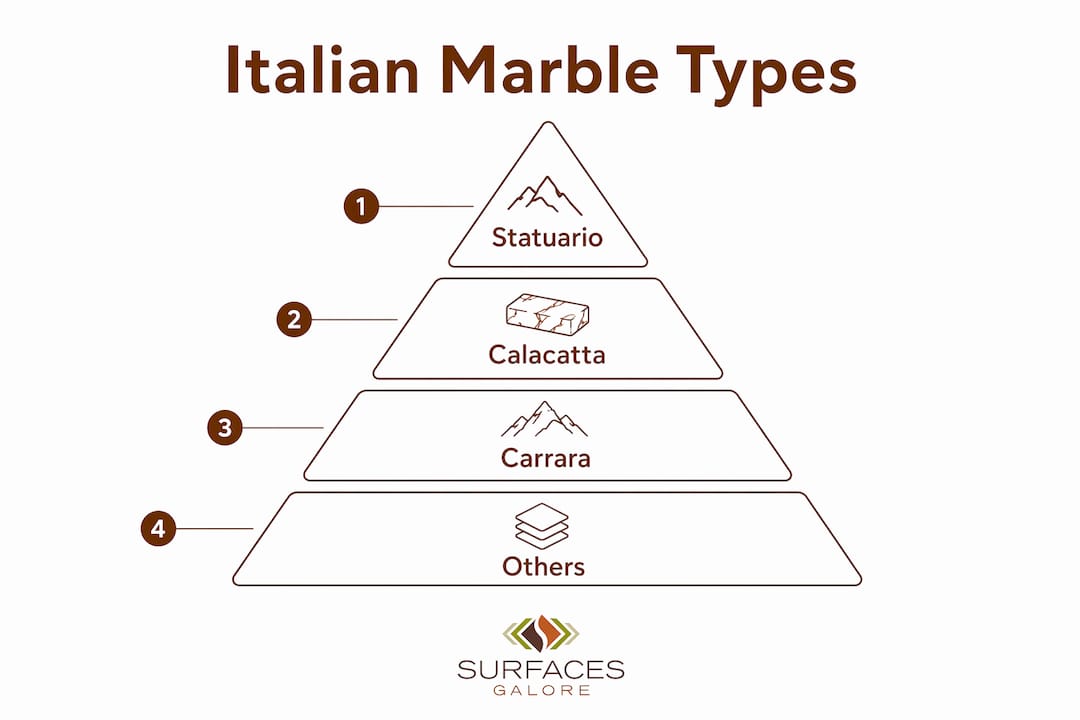
The three most recognized Italian marble types are Carrara, Calacatta, and Statuario. All three come from the Carrara region in Tuscany, but they differ significantly in appearance, rarity, and appropriate application. Choosing the wrong type for a given space is one of the most common and costly mistakes in luxury renovation.
Carrara
Carrara marble has a white or grayish-white base with soft, feathery gray veins. It is the most widely available of the three types and the most affordable. Architects specify Carrara for large-surface applications, including flooring, shower walls, and bathroom cladding, where a calm and consistent visual tone is the goal. Its subtle veining works well in spaces that rely on natural light and open layouts.
Calacatta
Calacatta marble features a brighter white background with bold, dramatic veins that often carry gold or warm brown highlights. It is rarer than Carrara and commands a higher price per slab. Architects prefer Calacatta for statement areas: kitchen islands, fireplace surrounds, and feature walls where the veining becomes the focal point of the room. Using Calacatta across an entire floor can overwhelm a space. It performs best in smaller, high-impact installations.
Statuario
Statuario is the rarest and most expensive of the three. It has a pure white base with thick, clearly defined gray veins that run in bold, almost graphic patterns. Statuario is chosen for statement areas where the stone itself is meant to function as art. Luxury hotel lobbies, bespoke bathroom vanities, and custom sculpture work are its natural territory.
Other noteworthy types
Beyond the Carrara trio, Italian marble includes several other varieties worth knowing:
- Botticino: A warm beige marble from the Brescia region, often used in flooring and wall panels for a softer, warmer palette.
- Nero Marquina: A deep black marble with white veining, sourced from the Basque region and widely used as a contrast element in contemporary design.
- Rosa Portogallo: A pink-toned marble suited for decorative accents and feature walls in residential interiors.
- Emperador: A rich brown marble with fine white veining, frequently specified for bathroom floors and commercial lobbies.
Pro Tip: Always request full slab images, not just tile samples, before finalizing a Calacatta or Statuario order. Veining patterns vary dramatically from slab to slab, and what looks balanced in a small sample can appear chaotic at full installation scale.
Where is Italian marble used in residential and commercial design?
Italian marble appears across nearly every surface category in high-end design, and its cultural prestige adds value that purely synthetic or engineered materials cannot replicate. The stone’s physical properties, including its density, polish retention, and light behavior, make it genuinely functional, not just decorative.
Flooring and wall cladding
Large-format Italian marble slabs with careful vein matching create seamless floor and wall installations that read as a single continuous surface. Minimizing joints improves both the aesthetic and the perceived value of the space. This technique, called book-matching, involves mirroring adjacent slabs so the veins form a symmetrical pattern across the seam. It requires precise planning and skilled installation, but the result is unmistakable.
Kitchen and bathroom surfaces
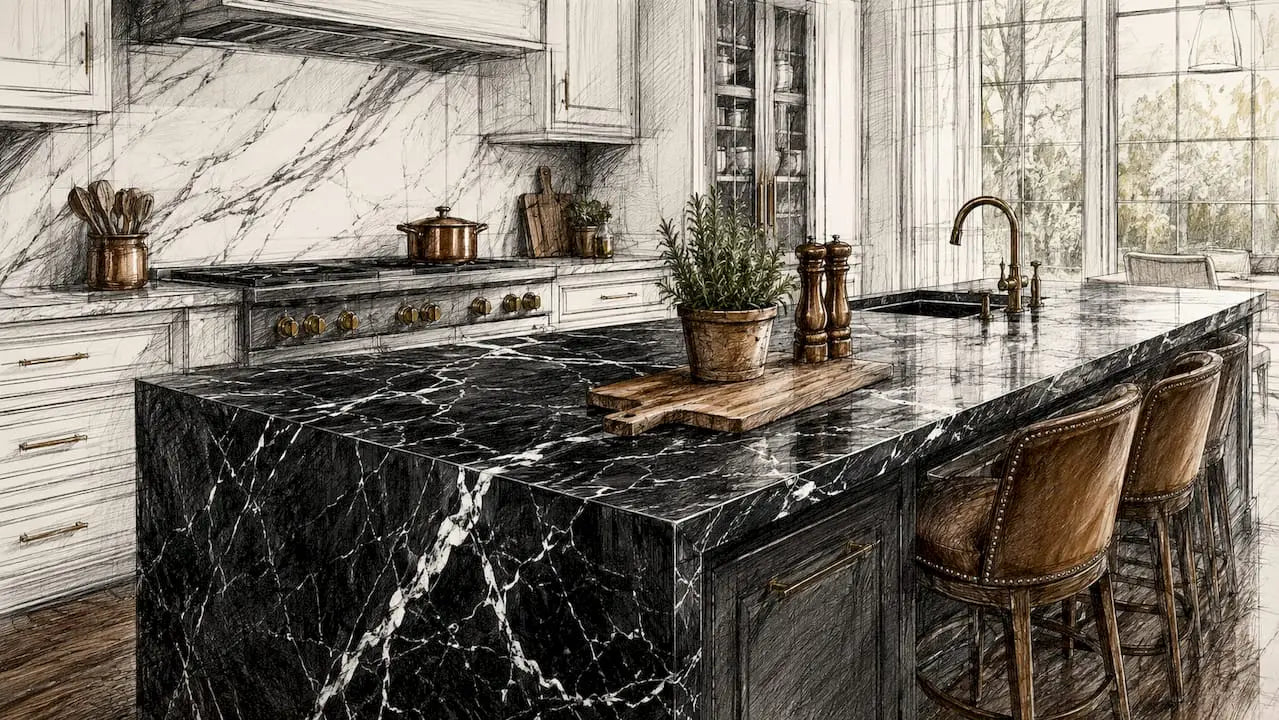
Italian marble is the material of choice for kitchen islands, bathroom vanity tops, and backsplashes in luxury residential projects. Its cool surface temperature makes it practical for pastry preparation, which is why professional kitchens have used marble slabs for centuries. In bathrooms, marble wall panels and floor tiles create a spa-like environment that tile alternatives cannot fully replicate.
Architectural accents and decorative elements
Beyond flat surfaces, Italian marble serves as the material for:
- Fireplace surrounds and mantels in formal living rooms
- Stair treads and risers in grand entry halls
- Custom mosaic inlays in floors and shower niches
- Architectural columns, corbels, and molding profiles
- Outdoor fountain basins and garden sculpture in protected settings
Each of these applications takes advantage of marble’s workability. The stone accepts precise carving and holds sharp detail, which is why it remains the preferred material for custom decorative work even when lower-cost alternatives exist.
Commercial applications
Hotels, corporate headquarters, retail flagships, and cultural institutions specify Italian marble for lobbies, reception desks, and public restrooms. The material signals quality to visitors immediately. For commercial buyers, the long-term asset value of marble installations justifies the higher upfront cost, particularly in properties where brand perception directly affects revenue.
You can see a full breakdown of current applications in this 2026 marble design guide from Surfacesgalore, which covers flooring, wall cladding, and decorative architectural uses in detail.
How do you choose and maintain Italian marble?
Choosing Italian marble correctly starts before you select a type. The space’s function, traffic level, lighting conditions, and existing color palette all determine which variety performs best. Maintenance planning must happen at the same time as material selection, not after installation.
Selecting the right slab
- Assess the space function first. High-traffic floors need a harder, more uniform marble like Carrara. Low-traffic statement areas can support the drama of Calacatta or Statuario.
- Request pre-polished slabs for review. Pre-polished slab selection is best practice for premium projects because it lets you assess the final appearance accurately before installation. A honed or brushed finish changes the stone’s color and sheen significantly.
- Prepare a detailed layout drawing. Detailed layout drawings manage veining and joints for a seamless aesthetic. Mark where each slab will land, and confirm that vein direction and pattern flow logically across the installation.
- Check for consistent thickness. Slab thickness variation causes lippage at joints, which is both a tripping hazard and a visual flaw. Specify a tolerance of no more than 1–2 mm across the batch.
- Source from a verified importer. Authentic Italian marble carries documentation of its quarry origin. Surfacesgalore imports directly and provides provenance information for its premium marble collections, which simplifies verification for designers and contractors.
Maintenance: what the stone actually needs
Italian marble is softer and more porous than granite, making it susceptible to staining but manageable with proper care. That porosity is not a defect. It is a natural property of calcite-based stone, and it responds well to a consistent maintenance routine.
The core maintenance steps are:
- Seal on installation and annually after that. A penetrating stone sealer fills the pore structure and blocks liquids from reaching the calcite. Reapply every 12 months in kitchens and bathrooms, and every 18–24 months in lower-traffic areas.
- Clean with pH-neutral products only. Acidic cleaners, including vinegar, lemon juice, and many standard household sprays, etch the calcite surface and leave dull spots that require professional polishing to remove.
- Wipe spills immediately. Red wine, coffee, and cooking oils penetrate unsealed marble within minutes. Blot rather than wipe to avoid spreading the stain.
- Polish periodically to restore luster. A professional diamond-pad polish restores the mirror finish when surface scratches accumulate. Most residential installations need this every 3–5 years depending on use.
Italian marble can be restored to its original shine, which means damage is rarely permanent. That restorability is a key advantage over engineered surfaces, which cannot be refinished once worn.
Pro Tip: Place felt pads under all decorative objects on marble surfaces. Metal bases and ceramic vases scratch the polish with even minor movement. Prevention costs nothing. Repair costs significantly more.
For a complete maintenance protocol, Surfacesgalore publishes detailed guidance on sealing and polishing marble that covers both residential and commercial scenarios.
Key Takeaways
Italian marble is a high-purity metamorphic stone that combines geological rarity, proven durability, and restorability to deliver long-term value in both residential and commercial design projects.
| Point | Details |
|---|---|
| Geological distinction | Italian marble forms over 50–70 million years with 95%+ calcite purity, producing its signature luster. |
| Type selection matters | Carrara suits large calm surfaces; Calacatta and Statuario work best as high-impact focal points. |
| Maintenance is manageable | Annual sealing, pH-neutral cleaning, and prompt spill response prevent most damage. |
| Restorability adds value | Professional polishing restores the original finish, making damage rarely permanent. |
| Slab review is non-negotiable | Always assess pre-polished full slabs and prepare layout drawings before installation begins. |
Why I still recommend Italian marble when clients push back on the price
Clients ask me regularly whether Italian marble is worth the cost compared to engineered quartz or imported porcelain. My answer is always the same: it depends on what you want the space to do in 20 years.
Engineered surfaces are consistent and low-maintenance. They are also static. They look the same the day they are installed as they do a decade later. Italian marble ages. It develops a patina. Foot traffic polishes the high points of a floor over time, creating a depth that no factory process replicates. That aging is not wear. It is character, and in the right project, it is exactly what the client is paying for.
What I have learned from working with Italian marble across dozens of projects is that the biggest mistakes happen at the selection stage, not the maintenance stage. Designers choose Calacatta because it photographs beautifully, then install it across 2,000 square feet of open-plan flooring where the bold veining creates visual chaos rather than elegance. The stone is not wrong. The application is. Architects who balance marble type selection based on space function, light conditions, and durability needs consistently get better results than those who choose on aesthetics alone.
The other thing clients underestimate is how marble interacts with natural light. A north-facing room finished in Carrara reads completely differently from the same room finished in a darker stone. The light reflection properties of high-calcite marble are a genuine design tool, not a side effect. I factor that into every specification.
Italian marble is also a long-term investment that adds tangible value to luxury properties. Real estate appraisers and discerning buyers recognize it. That recognition does not apply to porcelain that mimics marble. The real thing carries provenance, and provenance has value.
— cihan
Premium Italian marble collections at Surfacesgalore
Surfacesgalore is a direct importer of authentic Italian marble, limestone, and travertine, shipping nationwide from Anaheim, California to designers, architects, contractors, and homeowners.
The Surfacesgalore catalog includes Carrara, Calacatta, and specialty Italian marble tiles, mosaics, and decorative pieces suited for flooring, wall cladding, kitchen surfaces, and custom architectural work. Every product comes with provenance documentation and is available for review by designers and project teams. Browse the full natural stone tile collection to find the right marble for your next project, or contact the Surfacesgalore team directly for specification support and expert guidance on slab selection and layout planning.
FAQ
What is Italian marble made of?
Italian marble is made of calcite, a mineral formed when marine limestone recrystallizes under heat and pressure. The highest-quality Italian marble contains more than 95% calcite, which produces its characteristic white color and translucent luster.
How does Italian marble differ from other natural stones?
Italian marble has a finer crystal structure and higher calcite purity than most other natural stones, including granite and sandstone. That structure gives it superior light reflection, greater workability for carving, and a polish quality that other stones cannot match.
Which Italian marble type is best for kitchen countertops?
Calacatta marble is the most popular choice for kitchen countertops because its bold veining creates a strong visual statement on a surface that becomes the room’s focal point. Carrara works well for larger kitchen surfaces where a calmer, more uniform look is preferred.
How often does Italian marble need to be sealed?
Italian marble requires sealing at installation and then annually in high-use areas like kitchens and bathrooms. Lower-traffic surfaces such as bedroom floors or decorative wall panels typically need resealing every 18–24 months.
Is Italian marble a good long-term investment?
Italian marble adds tangible value to luxury properties and can be professionally restored to its original finish, making it a durable long-term asset. Real estate buyers and appraisers recognize authentic marble as a quality indicator that engineered alternatives do not replicate.

Leave a comment