

Examples of Marble Applications: 2026 Design Guide

TL;DR:
- Marble applications in 2026 include both classic uses in kitchens and bathrooms and innovative structural elements like 3D carved walls and lightweight panels. Finish types significantly influence marble’s appearance, safety, and durability, with honed and leathered finishes favored for high-traffic and wet areas. Creative and sustainable marble implementations broaden design possibilities beyond traditional surfaces, emphasizing strategic use and full slab evaluation.
Marble applications are defined as the deliberate use of natural marble stone in architecture, interior design, and construction to achieve both aesthetic and functional goals. From kitchen countertops and bathroom floors to 3D CNC-carved feature walls and sustainable modular facades, the range of marble uses in architecture and design is broader in 2026 than at any previous point. Large-format marble tiles measuring 12x24 inches or larger now lead flooring and wall trends, minimizing grout lines and creating spa-like continuity. This guide covers the most compelling examples of marble applications across residential and commercial projects, with finish comparisons and practical selection advice for designers and homeowners alike.
1. Examples of marble applications in classic residential spaces
The most recognized marble uses in residential design center on kitchens and bathrooms. These spaces benefit from marble’s natural density, heat resistance, and visual depth in ways that synthetic materials simply cannot replicate.
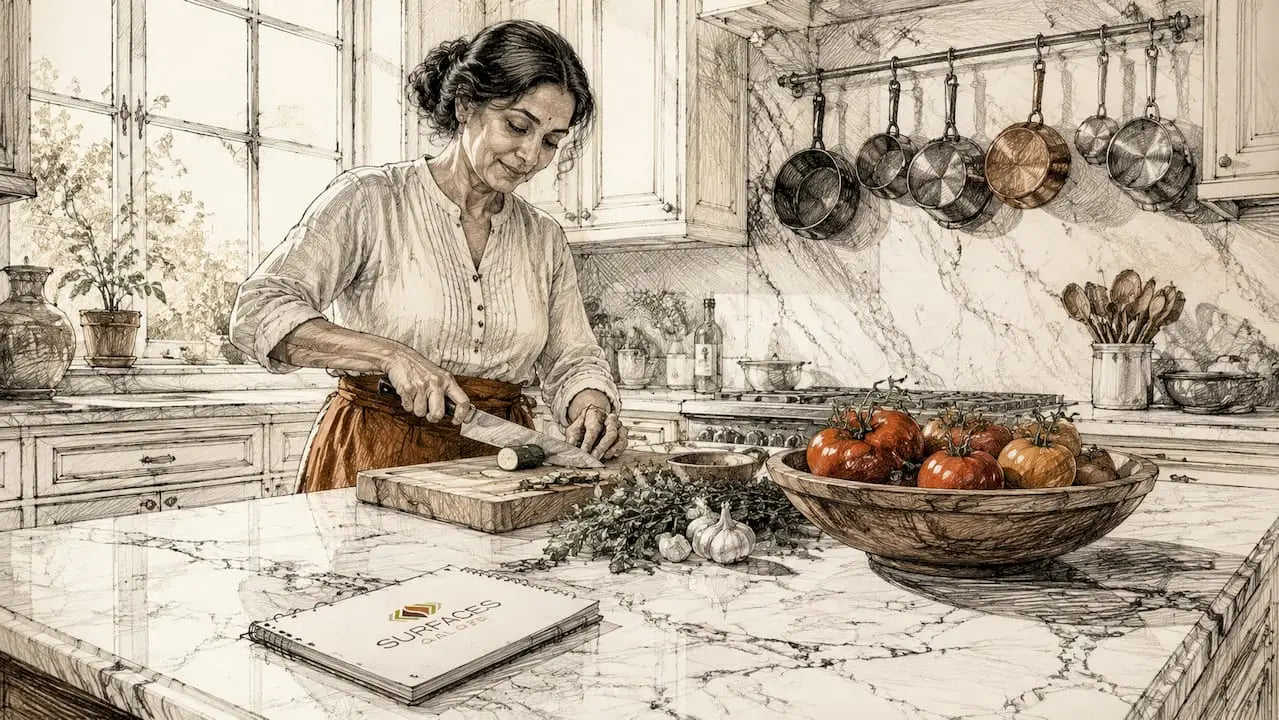
Kitchen countertops and islands remain the single most popular application. Carrara marble, with its soft gray veining on a white background, is the go-to choice for kitchen islands because it pairs with nearly every cabinet color. Calacatta marble, which carries bolder gold and gray veins, is preferred for statement countertops where the stone itself is the focal point.
Bathroom vanities, walls, and floors represent the second major category. Marble in home decor reaches its highest expression in master bathrooms, where floor-to-ceiling marble creates a unified, gallery-like environment. Designers often use the same slab material on the vanity top and the adjacent wall to build visual continuity.
Fireplace surrounds are a third classic application that many homeowners overlook. Marble has been used around fireplaces since the Renaissance, and the material’s heat tolerance makes it genuinely practical, not just decorative. A honed Nero Marquina surround, for example, creates a dramatic focal point without the maintenance demands of a polished finish.
- Kitchen countertops and islands (Carrara, Calacatta)
- Bathroom vanity tops and shower walls
- Large-format floor tiles for living rooms and entryways
- Fireplace surrounds and hearth panels
- Stair treads and risers in foyers
Pro Tip: When using marble on a kitchen island, apply a penetrating sealer before first use and reseal annually. This does not make the surface acid-proof, but it significantly slows etching from citrus and wine.
2. Creative marble applications pushing contemporary design boundaries
Beyond classic uses, creative marble applications in 2026 are redefining what stone can do structurally and visually. These approaches treat marble as an architectural medium rather than a surface covering.
3D CNC-carved marble walls are the most technically advanced application gaining traction in high-end residential and hospitality projects. 3D CNC-carved marble walls provide tactile surfaces that enhance both aesthetics and acoustics in open-concept interiors. The carved geometry breaks up sound waves while creating light-and-shadow effects that shift throughout the day. This makes them simultaneously art installations and functional acoustic diffusers.
Bookmatched slab walls involve mirroring two consecutive slabs cut from the same block so their veining forms a symmetrical pattern. The result looks like a natural Rorschach image across an entire wall. This technique is most effective in hotel lobbies, executive offices, and residential living rooms where the wall itself becomes the design statement. Surfacesgalore covers the bookmatching technique in detail for anyone planning this type of installation.
Lightweight marble veneer panels are changing what is structurally possible. Lightweight marble composites allow complex geometries, curved ceilings, and furniture installations with reduced structural load compared to solid slabs. Some modules weigh as little as 7 kg, enabling curved ceiling installations and furniture wrapping that full-thickness stone could never achieve.
Sustainable modular elements represent the most forward-thinking category. The Mucuri Cobogó, developed in Brazil, uses about 70% recycled marble waste in a modular architectural element suitable for partitions and facades. These modules avoid energy-intensive firing processes while maintaining the visual and tactile character of natural stone. For designers working on LEED-certified or low-carbon projects, this is a genuinely viable option.
- 3D CNC-carved feature walls (acoustic and visual function)
- Bookmatched slab walls for continuous veining
- Lightweight veneer panels for curved and ceiling installations
- Recycled marble modular elements for facades and partitions
- Marble-wrapped furniture and custom millwork
3. How marble finish types influence applications and functionality
Finish selection is the single most consequential decision in any marble project. The same Calacatta slab will perform and look completely different depending on whether it receives a polished, honed, or leathered finish. Finish choice significantly affects both the look and performance of marble installations, impacting slip safety, longevity, and visual character.
Polished finish
A polished finish produces a mirror-like gloss that amplifies veining color and depth. Polished marble surfaces offer high gloss and richer veining but are slippery and prone to visible wear. This makes polished marble best suited for feature walls, fireplace surrounds, and low-traffic luxury areas where visual impact outweighs durability concerns.
Honed finish
A honed finish is matte or satin in appearance. Honed and leathered finishes are preferred for flooring and wet zones due to better slip resistance and a muted appearance of etches and wear. Honed marble is the practical choice for bathroom floors, kitchen countertops in active households, and any surface that sees daily foot or hand traffic. Surfacesgalore’s guide to marble surface finishes explains the visual differences between these options with real project examples.
Leathered finish
A leathered finish adds a subtle texture by brushing the surface after honing. The texture hides fingerprints and water spots better than either polished or honed finishes, making it ideal for kitchen islands and outdoor applications. The tactile quality also adds a layer of visual interest that flat finishes cannot match.
| Finish | Appearance | Slip resistance | Best uses | Key drawback |
|---|---|---|---|---|
| Polished | High gloss, vivid veining | Low | Feature walls, fireplace surrounds | Slippery, shows wear |
| Honed | Matte or satin | Medium | Floors, countertops, wet areas | Absorbs stains faster |
| Leathered | Textured, soft sheen | Medium-high | Kitchen islands, outdoor surfaces | Harder to clean grout lines |
Pro Tip: Mix finishes within a single space for both practical and design benefits. Use a honed floor with a polished vanity top in a bathroom. The contrast adds visual depth while keeping the floor safe underfoot.
4. Situational recommendations for choosing the right marble application
Choosing the right marble application depends on the specific environment, traffic level, and design intent of your project. Generic advice rarely holds. Here is a structured approach based on common project scenarios.
1. Choosing tile size for space perception
Large-format tiles (12x24 inches or larger) make small rooms feel significantly larger by reducing the number of grout lines the eye registers. Use them in bathrooms under 100 square feet or narrow hallways where you want to push the walls back visually. Smaller mosaic tiles, by contrast, add texture and pattern interest in shower niches, backsplashes, and accent borders.
2. Marble in wet areas
Wet areas require specific finish and placement decisions. For shower floors, a honed or leathered finish is the safe choice. Surfacesgalore covers marble in wet areas with detailed guidance on which finishes perform best in high-moisture environments. For shower walls, polished marble is acceptable because the vertical surface does not present a slip risk, and the gloss finish is easier to wipe clean.
3. Marble as an architectural element vs. decoration
Designers view marble as an architectural element rather than mere decoration, integrating it in fireplaces, window casings, and feature walls to build a cohesive stone language throughout a space. This approach produces more sophisticated results than treating marble as a single accent piece. If you use Calacatta on the kitchen island, consider carrying the same stone into the adjacent backsplash or a nearby bathroom vanity to create a through-line.
4. Maintenance and durability in active households
Maintenance challenges of polished marble include susceptibility to acid etching and scratching, which sealing mitigates but does not eliminate. Families with children or heavy kitchen users should default to honed or leathered finishes on horizontal surfaces. Reserve polished marble for vertical surfaces and low-contact areas where its visual impact is highest and its vulnerabilities matter least.
5. Viewing slabs in person before purchasing
Selecting marble slabs in person to see vein continuity is the most important step in any large marble project. Photos and samples do not capture how veining flows across a full slab or how adjacent slabs will align on a wall. Visit the warehouse, stand the slabs upright, and mock up the layout before committing. This single step prevents the patchwork effect that undermines otherwise well-executed marble installations.
Key takeaways
Marble’s most effective applications combine the right finish type with the right environment, treating stone as an architectural element rather than a surface afterthought.
| Point | Details |
|---|---|
| Finish type determines performance | Choose honed or leathered for floors and wet areas; reserve polished for walls and low-traffic surfaces. |
| Large-format tiles maximize visual impact | Tiles 12x24 inches or larger reduce grout lines and make spaces feel more open and unified. |
| Creative applications extend marble’s range | 3D carving, bookmatching, and lightweight veneers allow marble in ceilings, curves, and acoustic walls. |
| Sustainability is now a real option | Recycled marble modular elements like Mucuri Cobogó use 70% waste material without sacrificing stone character. |
| View full slabs before purchasing | In-person slab selection prevents vein mismatch and ensures design coherence across large surfaces. |
Why I think most people are using marble too conservatively
I have spent years watching designers and homeowners default to marble in exactly two places: the kitchen countertop and the master bath floor. Both are excellent choices. Neither is the full story.
The most interesting marble projects I have seen treat the stone as a building material, not a finish. A fireplace surround that carries the same Calacatta veining up to the ceiling cornice. A foyer floor where the marble tile pattern dictates the entire color palette of the room. A curved reception desk wrapped in lightweight veneer panels that would have been structurally impossible with full-thickness stone. These projects do not use more marble. They use it more deliberately.
The sustainability angle is also underused. Most clients do not know that recycled marble products exist at a commercial scale. When I mention that modular elements made from marble powder and waste can qualify for green building credits, the conversation changes. Marble stops being a luxury indulgence and starts being a considered material choice.
My honest recommendation: before you finalize any marble specification, ask your supplier to show you the full slab, not just a sample. Ask about finish options beyond polished. And ask whether the stone can carry through to a second surface in the same space. Those three questions will produce a better result than any mood board.
— cihan
Discover premium marble at Surfacesgalore
Surfacesgalore is a direct importer of premium natural marble, limestone, and travertine tiles based in Anaheim, California, shipping nationwide to designers, architects, contractors, and homeowners. Whether you are planning a kitchen countertop in Carrara, a bookmatched feature wall in Calacatta, or a honed bathroom floor for a wet-area renovation, Surfacesgalore carries the slabs, tiles, mosaics, and custom cuts to match your project. Browse the full marble tile collection and request samples to see vein patterns and finish options in person before you commit. Quality natural stone at honest prices is the standard, not the exception.
FAQ
What are the most common examples of marble applications?
The most common marble applications are kitchen countertops, bathroom vanity tops, shower walls, flooring, and fireplace surrounds. These uses account for the majority of residential marble installations in the United States.
What types of marble finishes are best for high-traffic areas?
Honed and leathered finishes are best for high-traffic areas because they offer better slip resistance and hide etching and wear more effectively than polished surfaces. Polished finishes are better suited for walls and low-contact decorative surfaces.
Can marble be used in wet areas like showers?
Yes, marble works well in wet areas when the correct finish is selected. Honed or leathered marble is recommended for shower floors due to slip resistance, while polished marble is acceptable for shower walls where traction is not a concern.
What is bookmatched marble and where is it used?
Bookmatched marble involves mirroring two consecutive slabs so their veining forms a symmetrical pattern across a wall or surface. It is most commonly used in hotel lobbies, residential living rooms, and executive offices as a high-impact design feature.
Are there sustainable marble applications available in 2026?
Yes. Modular architectural elements like the Mucuri Cobogó use approximately 70% recycled marble waste to create partitions and facades without energy-intensive firing processes, making them a viable option for low-carbon and LEED-certified projects.
Leave a comment