

Luxury Tile Inspiration for Upscale Kitchens and Baths

TL;DR:
- Luxury tile design involves selecting high-quality materials like natural marble, travertine, and large-format porcelain to create elegant interiors. These materials can be used beyond floors and walls, transforming fireplaces, stair risers, furniture, and accent walls into artistic focal points. Technical considerations such as slip resistance, water absorption, and professional installation are essential to ensure long-lasting, beautiful results.
Luxury tile inspiration is the art and science of selecting refined, high-quality tiles that transform interior spaces into elegant, personalized showcases of craftsmanship and style. The best high-end tile design draws from natural stone, artisan mosaics, and large-format porcelain to create rooms that feel both timeless and deeply personal. Designers like Ward + Gray and studios like Allison Eden have pushed the category well beyond floors and walls, treating tile as a medium for architectural storytelling. Whether you are renovating a master bath, a chef’s kitchen, or a grand entryway, the right premium tile ideas can define the entire character of a space.
1. What are the top luxury tile materials for kitchens and bathrooms?
The most sought-after materials in upscale tile design are natural marble, travertine, limestone, large-format porcelain, and hand-crafted mosaics. Each brings a distinct character, and the best renovations often combine two or more in a single space.
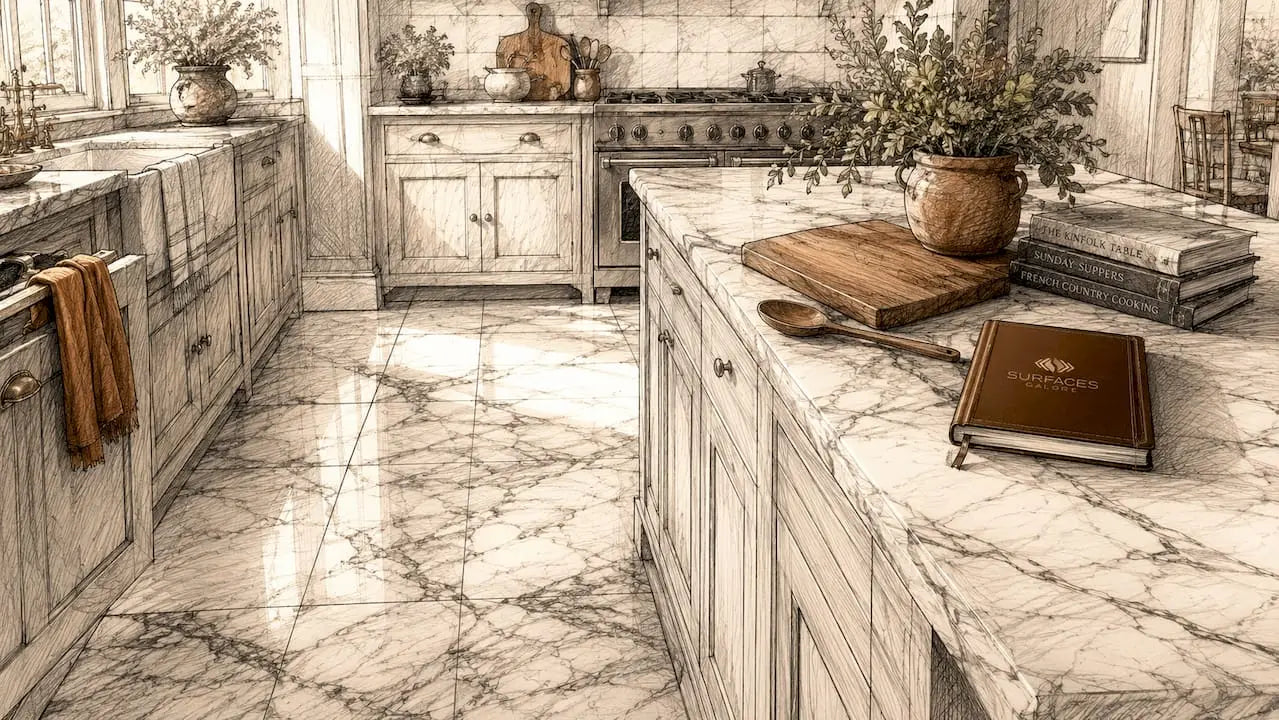
Natural marble, travertine, and limestone
Natural stone remains the gold standard for luxury bathroom tiles and kitchen floors. Marble delivers dramatic veining that no manufactured product fully replicates. Travertine offers warm, earthy tones with a textured surface that reads as both rustic and refined. Limestone provides a quieter, more uniform look that suits contemporary and transitional interiors equally well. All three materials age gracefully and increase perceived property value.
Large-format porcelain with 4D technology
Sapienstone produces Italian-made large-format porcelain slabs using 4D technology, which replicates natural stone veining and texture throughout the full tile thickness. That through-body realism eliminates the visual break you see when a tile chips or is cut, keeping the luxury appearance intact over time. Large-format slabs also reduce grout lines, which creates a cleaner, more expansive look in kitchens and bathrooms.
Hand-crafted mosaic tiles
Custom mosaic tiles offer unmatched personalization and artistic value, and designers treat them as long-term investments compared to mass-produced alternatives. A hand-cut marble mosaic backsplash or a bespoke floor medallion functions as a permanent art installation. The labor and material costs reflect that status.
Pro Tip: When mixing natural stone with large-format porcelain in the same space, match the finish level, matte with matte or polished with polished, to keep the visual language consistent.
- Marble: Best for countertops, feature walls, and shower surrounds. Requires sealing every 12–24 months.
- Travertine: Ideal for floors and outdoor-to-indoor transitions. Fill-treated versions resist staining better.
- Limestone: Works well in low-moisture areas and living spaces. Honed finishes hide wear better than polished.
- Large-format porcelain: Suited for floors, walls, and wet rooms. Near-zero maintenance.
- Hand-crafted mosaics: Best as focal points, backsplashes, and medallions. Grout selection is critical to the final look.
Designer collections like Ward + Gray’s Vestigia reach prices over $225 per square foot, which signals their status as collectible art pieces rather than commodity building materials. That price point also sets a useful benchmark: when you are spending at that level, every installation decision matters.
2. How can luxury tile inspire creative applications beyond floors and walls?
Architects increasingly advise viewing luxury tiles as small works of art that tell stories and enrich spaces through unconventional installation. The most memorable interiors use tile in places that surprise the eye and reward close inspection.
Fireplace surrounds
A marble or hand-painted ceramic surround turns a fireplace into the visual anchor of a living room. Calacatta marble with bold gray veining creates a formal, gallery-like effect. Zellige-inspired tiles in warm terracotta tones produce a more intimate, artisan atmosphere. The surround is a small surface area, which makes it one of the most cost-effective places to use a premium tile without a large quantity.
Stair risers
Tiled stair risers are one of the most underused applications in residential design. A repeating geometric pattern on each riser, alternating with plain stone treads, creates a rhythm that draws the eye upward through a home. Spanish-style encaustic cement tiles and Italian hand-painted ceramics both perform well here. The surface area per riser is minimal, so even the most expensive designer tiles remain budget-friendly for a standard staircase.
Furniture inlays and tabletops
Stone and mosaic tile inlays on coffee tables, console tables, and dining surfaces bring the same material language from the floor into the furniture layer. A travertine-topped dining table paired with travertine floor tiles creates a cohesive, material-forward interior. Custom mosaic inlays on a sideboard or bar cabinet function as conversation pieces.
Accent walls and architectural features
A single tiled accent wall in a bedroom or dining room delivers high visual impact without a full renovation. Textured stone tiles in a stacked or herringbone pattern add depth that paint cannot achieve. For a more graphic effect, large-format marble slabs with continuous veining, called book-matched panels, create a symmetrical pattern that looks like an open book across the wall surface.
- Choose a single focal surface per room to avoid visual competition between tile applications.
- Use the same grout color as the tile body to make patterns read as texture rather than geometry.
- Scale the tile size to the surface. Large-format slabs work on expansive walls; smaller mosaics suit niches and inlays.
- Repeat a material from the floor in a vertical application to create visual continuity.
- Consult creative mosaic tile uses for specific layout ideas before finalizing a design.
Pro Tip: For stair risers, use a porcelain tile with a DCOF rating above 0.42 on the tread surface. The riser itself is vertical and non-slip rated tiles are not required there, which gives you more freedom to use decorative options.
3. Which design trends define upscale tile choices in 2026?
The dominant direction in 2026 is quiet luxury tile design, which emphasizes subtle elegance, refined textures, and understated color palettes that create sophisticated environments without loud patterns. This trend favors warm whites, soft greiges, aged bronzes, and natural stone tones over high-contrast color combinations.
Quiet luxury and understated palettes
Quiet luxury does not mean boring. It means choosing a honed Bianco Carrara marble floor over a high-gloss white porcelain, or a brushed limestone wall tile over a stark painted surface. The texture does the work. Grout lines are kept tight and color-matched to disappear into the field tile. The result is a room that feels expensive without announcing itself.
Bold pattern as a counterpoint
A strong countertrend runs alongside quiet luxury. The Intarsi Vinci tile uses a Renaissance-inspired labyrinth pattern with a satin-touch finish, demonstrating that bold graphic design and technical performance can coexist. This tile also meets the DCOF safety standard of over 0.42, which proves that decorative complexity does not require a sacrifice in safety compliance. Designers use these statement tiles in powder rooms, entryways, and feature walls where the pattern has room to breathe.
Satin and matte finish innovations
Polished marble dominated luxury interiors for decades. The 2026 preference has shifted toward satin and honed finishes that reduce glare and feel more tactile underfoot and underhand. Satin-touch porcelain tiles, like those used in the Intarsi Vinci line, offer a middle ground between the reflectivity of polished stone and the flatness of a fully matte surface. That finish also hides fingerprints and water spots better than a high-gloss alternative.
Color and combination approaches
Warm neutrals are the dominant palette. Creamy travertine tones, soft sage greens, and dusty terracottas appear frequently in 2026 bathroom tile trends. Designers pair these with unlacquered brass or aged bronze fixtures to reinforce the warm, organic material story. For kitchens, a warm white marble backsplash against a sage green cabinet is the combination that appears most consistently across designer portfolios this year.
“The most enduring luxury interiors treat tile as a material with memory. The veining in a marble slab, the variation in a hand-cut mosaic, the slight irregularity in a zellige tile. These are the marks of authenticity that mass production cannot replicate.” — Allison Eden Studios
You can find a detailed breakdown of bathroom tile trends for 2025 and 2026 that covers finish options, color palettes, and material pairings in depth.
4. What technical considerations matter when choosing luxury tiles?
Aesthetic decisions and technical requirements must align for a luxury tile installation to perform over time. A tile that looks extraordinary but fails in a wet room or high-traffic corridor is not a luxury product. It is an expensive mistake.
Slip resistance and DCOF standards
Luxury porcelain tiles used in wet or high-traffic areas require a Dynamic Coefficient of Friction (DCOF) over 0.42 for safety compliance. That standard applies to residential wet rooms, pool surrounds, and commercial spaces. A tile with a DCOF below 0.42 is not appropriate for shower floors or pool decks, regardless of how beautiful it looks. Always request the DCOF rating from your supplier before specifying a tile for a wet application.
Material suitability for wet environments
Traditional clay-based zellige tiles are generally unsuitable for submerged applications like pools due to water absorption. Engineered mosaic systems replicate the zellige aesthetic while meeting modern durability and water-tightness requirements. This distinction matters for luxury pool surrounds and wet rooms where the visual appeal of zellige is desired but the material limitations are a real concern. Always verify water absorption ratings (ISO 10545-3) for any tile going into a pool or steam room.
Longevity and maintenance by material
| Material | Best application | Maintenance level | Lifespan |
|---|---|---|---|
| Marble | Walls, countertops, dry floors | Moderate (seal every 1–2 years) | 50+ years with care |
| Travertine | Floors, outdoor transitions | Moderate (fill and seal) | 40+ years |
| Limestone | Living areas, low-moisture floors | Low to moderate | 30–50 years |
| Large-format porcelain | Wet rooms, high-traffic floors | Very low | 25–50 years |
| Hand-crafted mosaic | Feature areas, backsplashes | Low (grout maintenance) | 30+ years |
Professional specification and installation
A luxury tile investment requires professional installation to protect its value. Improper substrate preparation is the leading cause of tile failure in high-end renovations. For large-format slabs, a flat substrate with no more than 1/8-inch variation over 10 feet is the industry standard. For natural stone, a qualified installer will also advise on the correct mortar type, since some stones react poorly to standard Portland cement-based adhesives.
Pro Tip: Always order 10–15% extra tile to account for cuts, breakage, and future repairs. Matching a discontinued natural stone tile years later is nearly impossible, since each quarry batch has unique veining and color variation.
If you are working with a luxury home builder in Southern California, coordinating tile specification early in the construction process prevents costly substrate corrections later.
Key takeaways
The most successful luxury tile projects combine authentic materials, technical compliance, and creative placement to produce spaces that are both beautiful and built to last.
| Point | Details |
|---|---|
| Material authenticity matters | Natural marble, travertine, and limestone deliver veining and texture that porcelain approximates but cannot fully replicate. |
| DCOF compliance is non-negotiable | Any tile in a wet or high-traffic area must carry a DCOF rating above 0.42 for safety. |
| Tile works beyond floors and walls | Fireplace surrounds, stair risers, and furniture inlays are high-impact, cost-effective applications for premium tile. |
| Quiet luxury leads 2026 trends | Honed finishes, warm neutrals, and tight grout lines define the dominant aesthetic direction this year. |
| Professional installation protects the investment | Substrate preparation and correct mortar selection are as critical as the tile itself for long-term performance. |
Why I think most homeowners underestimate tile as a design decision
Most renovation budgets treat tile as a line item to minimize. That is the wrong frame entirely. Tile is one of the few materials in a home that you touch, walk on, and see every single day for decades. A decision made to save $8 per square foot on a shower floor will be visible every morning for the next 20 years.
I have watched homeowners spend $15,000 on a sofa they will replace in seven years and then argue over upgrading from a $12 tile to a $28 travertine on a 60-square-foot bathroom floor. The math does not hold up. The travertine floor costs roughly $960 more. Spread over 20 years, that is $48 per year for a material that ages beautifully, adds resale value, and changes the entire feeling of the room.
The other thing I see consistently is that people treat tile selection as a purely visual exercise. They pick what looks good in a showroom under fluorescent light and then wonder why it feels flat in their finished bathroom. Finish, texture, and scale all behave differently under natural light, artificial light, and in combination with other surfaces. Always view samples in the actual space before committing.
Surfacesgalore’s approach to direct importing from natural stone quarries is the right model for serious renovations. When you source marble, travertine, or limestone through a direct importer, you get consistent batch quality, accurate material documentation, and pricing that reflects the actual cost of the stone rather than three layers of wholesale markup. For anyone planning an upscale renovation, that sourcing discipline is as important as the design decisions themselves.
The top luxury tile choices for kitchens and baths are not always the most expensive options. They are the ones chosen with full knowledge of the material, the application, and the long-term performance expectations.
— cihan
Discover premium natural stone at Surfacesgalore
Surfacesgalore is a direct importer of authentic marble, travertine, and limestone tiles, mosaics, and decorative stone pieces, shipping nationwide from Anaheim, California to designers, architects, contractors, and homeowners.
Every collection at Surfacesgalore is sourced for quality, consistency, and design range, from classic Carrara marble mosaics to warm travertine floor tiles suited for both indoor and outdoor applications. If you are planning a kitchen renovation, a luxury bathroom remodel, or a custom feature wall, browsing the natural stone tile collections at Surfacesgalore is the right starting point. You will find authentic materials, honest pricing, and the kind of selection that makes real design decisions possible. If you are working with a builder on a custom project, Blackbriar’s custom home building team can help coordinate tile specification from the ground up.
FAQ
What materials are considered true luxury tiles?
Natural marble, travertine, limestone, hand-crafted mosaics, and large-format porcelain with through-body stone replication are the materials most consistently associated with luxury tile design. Natural stone remains the benchmark because its veining and texture are genuinely unique to each slab.
How much do designer luxury tiles cost per square foot?
Premium designer tile collections reach prices over $225 per square foot at the top of the market. Mid-range luxury natural stone tiles typically run $15–$80 per square foot depending on material, origin, and finish.
What DCOF rating do I need for a luxury bathroom floor tile?
Any tile used in a wet residential area requires a DCOF rating above 0.42 for safety compliance. Always request this specification from your supplier before finalizing a tile for a shower floor or pool surround.
Can zellige tiles be used in a swimming pool?
Traditional clay-based zellige tiles are not suitable for submerged pool applications due to high water absorption rates. Engineered mosaic systems that replicate the zellige aesthetic are the correct choice for pools and fully wet environments.
What is the best way to source authentic luxury natural stone tiles?
Direct importers like Surfacesgalore provide consistent batch quality, accurate material documentation, and competitive pricing by eliminating wholesale intermediaries. Buying direct also gives you access to a wider range of stone origins and finishes than most retail showrooms carry.
Leave a comment