

Marble surface treatments: protect and enhance your space

TL;DR:
- Marble’s beauty and porosity require ongoing surface treatments and vigilant maintenance to prevent damage.
- Sealing protects against stains and moisture but does not prevent acid etching, which demands proper care practices.
Marble looks like it can handle anything. That polished, gleaming surface gives off an air of permanence and strength, which is why so many homeowners assume that a single sealing application is all they need to protect their investment. The reality is more nuanced, and for most people, the damage is already done by the time they realize that sealing marble is only one piece of a much larger puzzle. This guide breaks down every major surface treatment option, explains exactly what each one protects against, and shows you how to match the right product to your specific kitchen or bathroom setup.
Table of Contents
- Why marble needs special surface treatments
- Types of marble surface treatments explained
- Selecting the right treatment for your space
- Maintaining and troubleshooting treated marble surfaces
- What most homeowners get wrong about marble care
- Enhance and protect your marble with expert support
- Frequently asked questions
Key Takeaways
| Point | Details |
|---|---|
| Sealing is not enough | Impregnating sealers help with stains but do not stop acid etching, so daily care is essential. |
| Choose treatment by room | Select the right surface treatment depending on kitchen or bathroom use and exposure. |
| Consistent maintenance matters | Regular cleaning and re-sealing keep marble beautiful for years. |
| Avoid harsh chemicals | Only use cleaners designed for marble to prevent permanent surface damage. |
Why marble needs special surface treatments
Before diving into solutions, it is essential to understand why marble presents unique challenges in home environments.
Marble has earned its place as the most recognized luxury stone in American homes. From farmhouse kitchen countertops to spa-inspired master bathrooms, homeowners consistently choose it for its visual depth, cool temperature, and those signature veining patterns that no two slabs share. But that same beauty comes with a catch that too many people discover the hard way.
Marble is a metamorphic rock made almost entirely of calcium carbonate, and that composition is what makes it both stunning and sensitive. Its calcium carbonate base makes it vulnerable to acids and stains at a level that harder stones like quartzite or granite simply do not experience. Everyday kitchen and bathroom activities expose marble to exactly the substances it cannot tolerate.
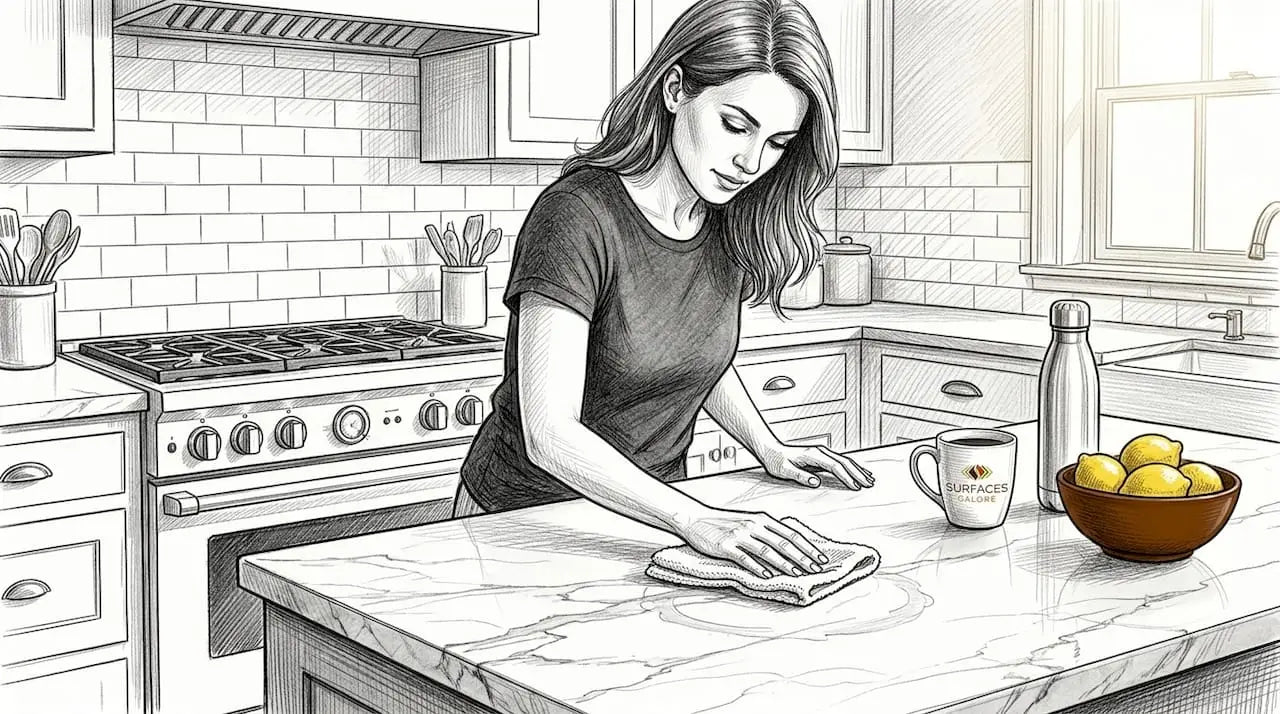
Think about what happens on a typical morning in a busy household. Coffee spills on the counter. Someone squeezes a lemon over a cutting board. Toothpaste drips onto the bathroom vanity. Hand lotion pools near the sink. Each of these seemingly minor events carries the potential to leave a permanent mark on untreated or poorly treated marble.
Considering using marble in wet areas like shower walls and bathroom floors adds another layer of complexity, because moisture infiltration over time can cause staining from mineral deposits, grout residue, and mold if the stone’s pores are not properly managed.
Here is what marble faces every day in a typical home:
- Citric acids from fruit juices, vinegar, and wine
- Oils from cooking, skin contact, and beauty products
- Hard water minerals that leave calcium deposits
- Soap scum and alkaline cleaning products
- Physical abrasion from grit, pots, and daily foot traffic
- Steam and humidity fluctuations in bathrooms
Without effective surface treatments, these everyday exposures lead to dull spots, ring stains, scratchy surfaces, and a marble that looks aged long before its time. The good news is that understanding the right treatment approach can prevent nearly all of it.
Types of marble surface treatments explained
With these challenges in mind, understanding the main types of treatments is the first step toward lasting protection.
When homeowners talk about “sealing marble,” they are usually referring to one specific product category, but the world of marble surface treatments is actually broader than that. There are three major categories: surface finishes applied at fabrication, penetrating sealers applied during installation and maintenance, and topical coatings used for specific protective or aesthetic purposes.
Understanding marble surface finishes is the starting point because the finish type you choose affects everything from how quickly the stone absorbs moisture to how visible scratches will be. A polished finish uses a buffed, mirror-like surface that is denser and slightly more resistant to water absorption, though it shows etching very visibly because the acid dulls the shine. A honed finish is matte and smooth, which hides etching better but tends to absorb stains more readily. Brushed and tumbled finishes are more textured and forgiving of surface imperfections, but their texture also traps dirt more easily.
The natural stone finishes guide offers expanded detail on each of these options, but for practical purposes, here is a direct comparison of the three main treatment categories:
| Treatment type | What it protects against | Does not protect against | How long it lasts |
|---|---|---|---|
| Impregnating sealer | Water, oils, most food stains | Acid etching, deep scratches | 1 to 3 years |
| Topical sealer or coating | Surface water, limited stains | Acid etching, abrasion | 6 to 18 months |
| Color enhancer sealer | Moisture, enhances natural color | Etching, heavy staining | 1 to 2 years |
| Polished finish (factory) | Mild surface water | Etching shows prominently | Permanent until refinished |
| Honed finish (factory) | Hides light etching visually | More vulnerable to oil stains | Permanent until refinished |
The single most important fact every marble owner should understand is that impregnating sealers repel water and oils but do not prevent acid etching. This distinction is where so many homeowners get confused. They seal their marble, feel confident it is protected, and then watch a lemon juice splash leave a dull mark within seconds. That mark is not a stain. It is a chemical reaction between the acid and the calcium carbonate in the stone, and no sealer on the market stops it.
Impregnating sealers work by penetrating below the stone’s surface and creating a hydrophobic barrier inside the pores. They are invisible and do not change the appearance of the stone. Topical sealers and coatings sit on top of the surface and can sometimes alter the sheen or color slightly. Topical options wear off faster and can peel or cloud with heavy use.
Pro Tip: If you are choosing between a honed and polished finish for a kitchen countertop, go with honed. It will still etch when exposed to acids, but the damage is far less visible on a matte surface than on a high-gloss polish.
The other category worth knowing is penetrating color enhancers. These are sealers formulated to deepen the natural color and veining of marble while also providing moisture resistance. They are especially popular in darker marbles or natural stone with dramatic veining patterns where homeowners want to intensify the visual contrast.
Selecting the right treatment for your space
Now that you know the treatment options, the next step is selecting the one that best matches how and where you use your marble.
Location and lifestyle matter enormously when choosing marble treatments. A polished marble floor in a low-traffic formal dining room needs very different protection than a Carrara countertop in a family kitchen where three people are cooking every night. Getting this match right is the difference between marble that looks beautiful for decades and marble that starts showing wear within a year.
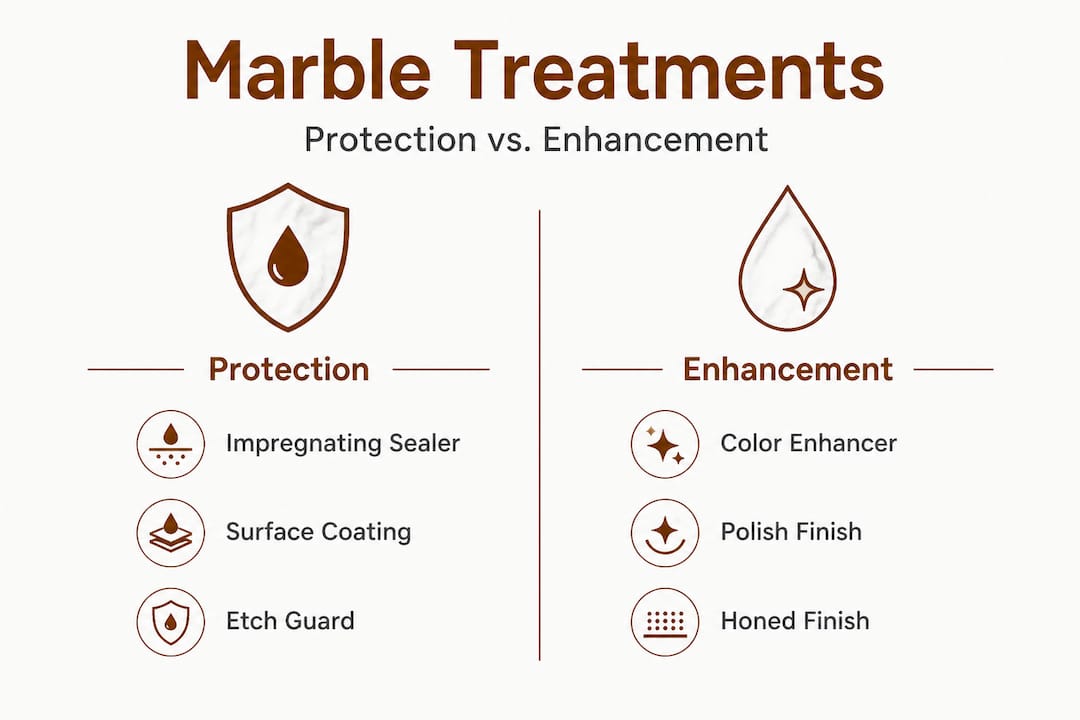
Penetrating sealers are most effective for repelling oils and water, making them the practical standard for kitchen countertops and bathrooms. They are the baseline protection that virtually every marble installation needs, regardless of what other treatments you layer on top.
Here is how to match your treatment to your space based on real household conditions:
- High-use kitchen countertops: Apply a penetrating impregnating sealer before first use and re-apply annually. Choose a honed finish to minimize visible etching. Keep a pH-neutral cleaner on hand for daily cleanup.
- Bathroom vanity tops: Apply a penetrating sealer with water and oil resistance. Reapply every 12 to 18 months. Watch for soap scum buildup and use a gentle stone cleaner weekly.
- Shower walls and floors: Use a penetrating sealer rated for wet applications. Reapply every 6 to 12 months because constant moisture exposure breaks down protection faster. Squeegee walls after each use to reduce mineral buildup.
- Marble floors in living areas: A penetrating sealer is sufficient, with an optional topical polish for shine maintenance. Reapply every 1 to 2 years depending on foot traffic.
- Outdoor marble (fountains, coping, exterior features): Use a breathable penetrating sealer rated for exterior use. UV exposure and freeze/thaw cycles require more frequent reapplication, often every 6 to 12 months.
The process of selecting natural stone for a specific room should always factor in the maintenance commitment you are realistically willing to keep. Some marbles, particularly whiter and lighter varieties, are more porous and will need more frequent sealing.
| Space | Recommended treatment | Reapplication schedule | Risk level |
|---|---|---|---|
| Kitchen countertop | Penetrating impregnating sealer | Every 12 months | High (acids, oils) |
| Bathroom vanity | Penetrating impregnating sealer | Every 12 to 18 months | Medium (soap, water) |
| Shower walls | Wet-rated penetrating sealer | Every 6 to 12 months | High (constant moisture) |
| Bathroom floor | Penetrating sealer | Every 12 to 18 months | Medium (foot traffic, water) |
| Living area floor | Penetrating sealer + topical finish | Every 18 to 24 months | Low to Medium |
Understanding the importance of sealing marble tiles before installation, especially for tile installations with grout joints, gives you a major advantage. Applying sealer before grouting prevents the grout from permanently staining the tile edges, and a second coat after grouting locks in that protection.
Pro Tip: To test whether your marble needs resealing, drop a few beads of water onto the surface and wait five minutes. If the water beads up, you still have sealer working. If the water soaks in and darkens the stone, it is time to reapply.
Maintaining and troubleshooting treated marble surfaces
Having chosen the right treatment, consistent care ensures your marble’s beauty and resilience.
The most beautifully sealed marble in the world will still look worn and neglected within a year if the daily care routine is not right. Sealing buys you time and protection from moisture and oils, but it does not replace good habits. Maintenance is where most homeowners lose ground.
Here is the step-by-step care routine that works for marble in both kitchens and bathrooms:
- Daily cleaning: Wipe surfaces with a soft microfiber cloth and a few drops of pH-neutral stone cleaner diluted in warm water. Avoid letting any liquid sit on the surface.
- Immediate spill response: Address spills instantly, especially anything acidic. Blot (do not wipe) acidic spills to prevent spreading. The faster you respond, the better your chances of avoiding etching.
- Weekly deeper clean: Use a pH-neutral cleaner made specifically for natural stone. Avoid spray bottles that deposit product on the surface and leave film.
- Monthly inspection: Check for any new staining, dull spots, or rough patches. Early identification lets you address small issues before they become permanent.
- Annual resealing: Clean the surface thoroughly and let it dry completely before applying a fresh coat of impregnating sealer. Follow the product’s specific dwell time and buffing instructions.
Marble does not forgive neglect, but it rewards consistency. The homeowners we work with who maintain their marble surfaces for ten, twenty, even thirty years are rarely the ones who used the most expensive products. They are the ones who wiped up spills right away, every single time.
The most troubling issue for marble owners is etching, and it is important to understand the distinction between an etch and a stain. A stain is a discoloration from a foreign substance absorbed into the stone. An etch is a physical surface change caused by acid dissolving the calcium carbonate. Stains can sometimes be drawn out with a poultice. Etching requires mechanical restoration.
Because sealers do not prevent acid etching, prompt cleanup and proper daily habits are the only real defense against etch marks. Once etching happens, your options depend on severity. For a complete walkthrough, the guide to marble etching covers identification, severity levels, and what homeowners can realistically address themselves versus what requires a professional stone restoration specialist.
The marble maintenance workflow we recommend for busy households combines prevention, quick response, and scheduled care to keep everything manageable without turning stone care into a second job.
Here is what to absolutely avoid on marble surfaces:
- Vinegar, lemon juice, or any citrus-based cleaners
- Bleach or products containing bleach
- Ammonia-based cleaners like many glass and multipurpose sprays
- Abrasive sponges, steel wool, or scouring pads
- Grout cleaners that are not specifically formulated for use with natural stone
- Wax products not designed for stone (they can trap dirt and cloud the surface)
Pro Tip: Keep a small spray bottle of diluted pH-neutral stone cleaner on your kitchen counter and another in your bathroom. Making the right cleaner the most convenient option is the single most effective behavior change you can make for your marble’s long-term health.
For oil-based stains specifically, a poultice made from baking soda and water or a commercial stone poultice can draw the oil out of the pores over 24 to 48 hours. For rust stains, you will need a specialized rust remover formulated for natural stone, because standard rust removers contain acids that will etch the surface. Biological stains like mold or mildew respond well to diluted hydrogen peroxide on lighter marbles, though testing in an inconspicuous area first is always smart.
What most homeowners get wrong about marble care
Here is the perspective that does not appear in most product guides or basic care articles: the marble care industry, including sealer manufacturers and cleaning product companies, has a natural incentive to make their products sound like complete solutions. Buy this sealer, apply it twice, and your marble is protected. That message is simple, marketable, and partially true. But it misses the larger point.
The marble surfaces that stay beautiful for decades in real homes are not the result of better products alone. They reflect a mindset. The homeowners who maintain those surfaces understand that marble requires ongoing vigilance, not a one-time fix. They wipe up spills immediately because they know that acids do not wait for a convenient moment. They use the right cleaners every time because they understand that the wrong product undoes everything the sealer accomplished.
We have seen this pattern consistently in the work we do at Surfaces Galore. A homeowner chooses a beautiful marble, gets it professionally sealed, and then watches it deteriorate within two years because the daily routine was not there. Another homeowner with the same marble, similar traffic, and similar conditions maintains a gorgeous surface for fifteen years. The variable is almost always the daily habits.
The conventional wisdom says “seal your marble and you are protected.” The more accurate version is “seal your marble, then protect that seal every single day with appropriate cleaning, immediate spill response, and an awareness of what marble can and cannot handle.”
Lasting marble maintenance is fundamentally about developing a relationship with your stone. You learn its patterns, notice when something looks off, and respond before small issues become expensive repairs. Marble ownership, done well, is closer to caring for a living thing than maintaining a countertop.
The homeowners who experience frustration with marble almost always fall into one of two camps. Either they expected it to behave like a virtually indestructible engineered stone, or they were told that sealing was all they needed and were never given the full picture. Neither group was set up to succeed. Giving you the complete picture from the beginning is exactly why we put this guide together.
Enhance and protect your marble with expert support
When you are ready for lasting results, expert guidance can make all the difference.
Choosing the right marble for your kitchen or bathroom is only the beginning of the journey. Knowing how to protect it, maintain it, and troubleshoot problems as they arise is what turns a beautiful installation into a lasting investment that adds genuine value to your home.
At Surfaces Galore, we work directly with homeowners, designers, and contractors across the country to match the right stone to the right application and provide the guidance needed to keep it looking exceptional for years. Our team of natural stone specialists can help you navigate sealer selection, finish choices, and maintenance planning based on your specific space, lifestyle, and goals. Explore our premium marble collections and connect with our team for personalized recommendations. Whether you are starting a new project or looking to restore the beauty of an existing installation, we are here to help you get it right from the start.
Frequently asked questions
Will sealing marble prevent all stains and damage?
No. Impregnating sealers repel water and oils but do not prevent acid etching, which is one of the most common forms of marble damage in kitchens and bathrooms.
How often should I reapply sealer on marble countertops?
Most marble countertops need resealing once per year, though heavily used surfaces or very porous marble varieties may benefit from reapplication every six to nine months.
What should I do if my marble surface becomes etched?
Light etching on polished marble can often be reduced with a marble polishing powder and gentle buffing, while deeper or more extensive etching requires professional stone restoration to refinish the surface properly.
Can I use regular household cleaners on marble?
Avoid most standard household cleaners because products containing vinegar, citrus, bleach, or ammonia will damage marble. Use only pH-neutral cleaners formulated specifically for natural stone surfaces.
Recommended
- Marble Maintenance for Lasting Luxury Surfaces– SurfacesGalore
- What is marble sealer? Protect your marble surfaces– SurfacesGalore
- Seal Marble Tiles to Protect Your Investment– SurfacesGalore
- Marble Polishing for Enhanced Durability and Shine– SurfacesGalore
- Multi-layer protection: 5 key benefits for cleaner finishes
Leave a comment