

Stone tile fireplace surround: stylish, safe options

TL;DR:
- Choosing a natural stone tile for your fireplace surround enhances safety, style, and home value, while meeting strict code standards. Stone options like marble, slate, travertine, limestone, and granite offer varied aesthetics, durability, and maintenance needs, making them suitable for diverse interior designs. Proper installation, including non-combustible substrates and temporary supports, is essential for safety and longevity, with professional help recommended for complex projects.
Your fireplace surround is one of the most visible surfaces in your home. It frames the fire, anchors the living room, and signals your design taste the moment someone walks through the door. Choosing the right material is not just about aesthetics, though. It directly affects safety, code compliance, and how much value your renovation adds when it comes time to sell. Stone tile checks every box: it is non-combustible, heat-resistant, and available in enough colors and textures to suit any home style from rustic farmhouse to sleek contemporary.
Table of Contents
- Core criteria for selecting a stone tile fireplace surround
- Popular stone tile options for fireplace surrounds
- Installation and code compliance: what you need to know
- Comparing stone tile options: performance, cost, and style
- How to choose the right stone tile for your fireplace surround
- Why stone tile fireplace surrounds are the smart choice for modern homes
- Upgrade your fireplace surround with expert guidance
- Frequently asked questions
Key Takeaways
| Point | Details |
|---|---|
| Safety first | Stone tile surrounds meet fire codes and provide lasting durability. |
| Design versatility | Marble, slate, travertine, limestone, and granite suit any style and budget. |
| Installation tips | Proper supports, code compliance, and expert advice are essential for success. |
| Value boost | Upgrading with stone tile can increase home value and buyer appeal. |
| Easy maintenance | Stone tile is straightforward to clean and maintain for years of performance. |
Core criteria for selecting a stone tile fireplace surround
Before you fall in love with a specific stone or pattern, it pays to understand what actually governs your material choices. Fireplace surrounds are not a free-for-all design decision. Safety, performance, and local building codes all play a role in narrowing your options.
Safety compliance comes first. The International Residential Code (IRC), specifically section R1001.11, requires non-combustible materials for fireplace surrounds. This means no wood paneling, no standard drywall finishes, and no combustible composites directly adjacent to the firebox. The code also mandates at least a 6-inch clearance from the firebox opening to any combustible material, with 12 inches required for projecting mantels. The hearth extension (the floor area in front of the firebox) must extend 16 to 20 inches out front depending on the firebox opening size.
Heat tolerance is the next filter. Surround surfaces typically experience temperatures in the range of 150 to 300°F depending on how close they are to the firebox opening and how frequently the fireplace is used. Stone tile handles this range without cracking, discoloring, or releasing harmful off-gases. That is a significant advantage over engineered materials.
Here is a quick checklist of criteria to evaluate before you shop:
- Non-combustible classification under IRC R1001.11
- Heat tolerance up to at least 300°F for surfaces near the firebox
- Aesthetic fit with your home’s existing architecture and color palette
- Ease of cleaning: does the stone require sealing, and how often?
- Budget: material cost per square foot plus estimated installation labor
- Availability in the size and format that fits your surround dimensions
Pro Tip: Before planning a tile project, measure your surround carefully and sketch out the layout. Knowing your square footage upfront prevents over-ordering or running short mid-install.
Maintenance is a factor most homeowners underestimate. Marble requires periodic sealing to resist staining. Slate and granite are denser and need less frequent attention. Travertine has natural pores that can trap soot if left unsealed. Understanding the upkeep each stone demands will save you frustration down the road.
Budget varies widely. Material costs can range from around $3 per square foot for basic slate to $20 or more for premium marble. Installation labor adds another $10 to $30 per square foot depending on complexity and your region. A realistic total for a mid-size surround runs $500 to $2,500, with higher-end projects easily exceeding that.
With these criteria established, let’s look at the most popular stone tile options and what each brings to your fireplace surround.
Popular stone tile options for fireplace surrounds
Natural stone is not a monolith. Each type brings a distinct personality to a fireplace surround, and understanding those differences helps you pick the one that genuinely fits your space rather than just looks good in a showroom.
Marble is the classic choice for formal living rooms and luxury interiors. Its veining patterns are unique to each slab, which means your fireplace surround is one of a kind. White Carrara marble creates a bright, airy feel, while darker options like Nero Marquina bring drama and depth. Marble is relatively easy to clean but does require sealing once or twice a year to prevent soot and smoke from penetrating the surface. You can explore more about marble for fireplaces to see specific styles that work best near heat sources.
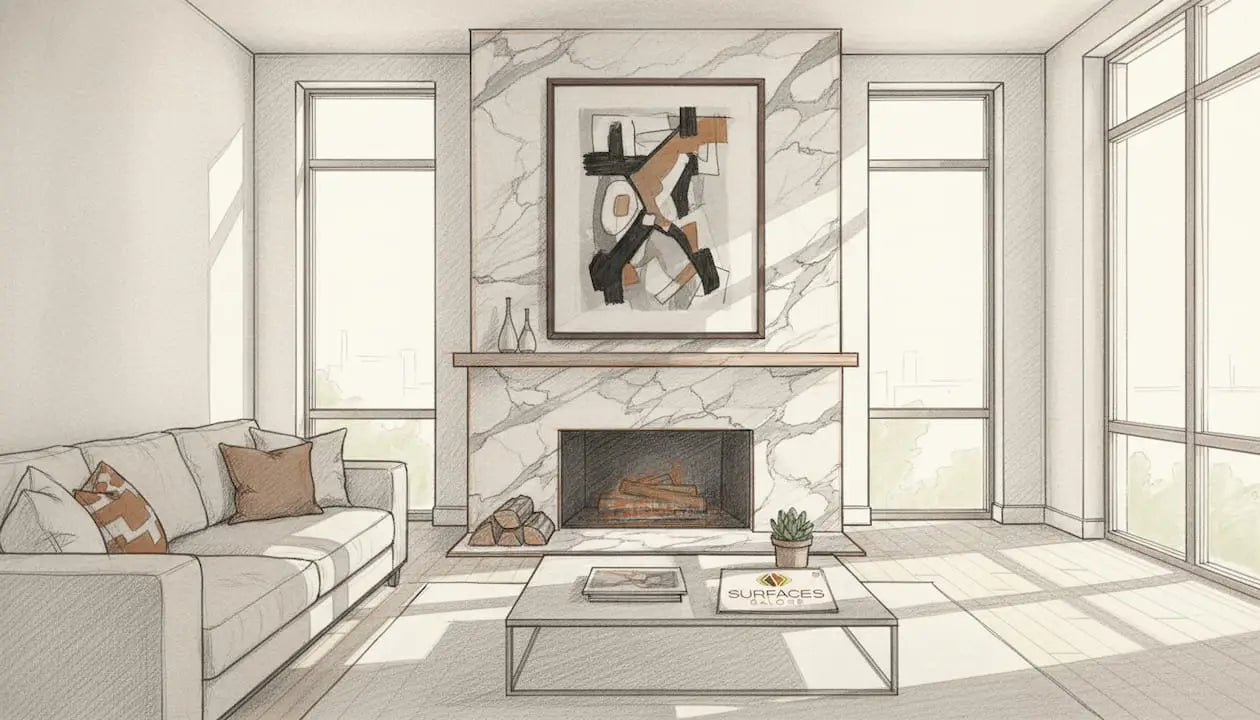
Slate offers a rougher, more textural look that fits modern, industrial, and rustic styles equally well. It is one of the hardest natural stones available and is naturally resistant to scratching and chipping. Slate comes in dark charcoal, green, and rust tones, making it a strong choice when you want contrast against a light-colored wall. It requires minimal maintenance and does not need frequent sealing.
Travertine has a warm, earthy quality that softens the look of a fireplace surround without losing its natural character. It comes in cream, walnut, and gold tones that complement both traditional and transitional interiors. The porous surface needs sealing before use near a fireplace, but once protected, it is surprisingly easy to wipe clean. The travertine tiling guide at Surfaces Galore walks through the sealing and installation process step by step.
Limestone is a quieter, more subdued stone that suits minimalist and Scandinavian-inspired spaces. Its soft gray and off-white tones do not compete with other design elements, making it a great background material that lets furniture and decor take center stage. It is slightly softer than marble or granite, so it benefits from a high-quality penetrating sealer.
Granite is the most durable option on this list. It resists scratching, staining, and heat better than any other common stone tile. If you have young children or a heavily used fireplace, granite gives you peace of mind without sacrificing style. It comes in an enormous range of colors and grain patterns, from subtle whites to bold blacks and greens.
All of these options meet code requirements because stone tiles withstand surround temperatures up to 300°F without damage or degradation. That is not the case for ceramic tiles with thin glazing or engineered products that can delaminate under sustained heat.
Here is a focused breakdown of what each stone does best:
- Marble: Elegant veining, formal appeal, needs annual sealing
- Slate: Maximum texture, low maintenance, great for bold contrast
- Travertine: Warm and inviting, traditional or transitional fit, seal before use
- Limestone: Subtle and clean, minimalist designs, moderate sealing needs
- Granite: Hardest and most durable, wide color range, nearly zero maintenance
Browsing a comprehensive natural stone renovation guide can help you visualize how these materials translate from sample chips to full-scale installations in real homes.
Having surveyed the most attractive stone tile types, it’s important to understand how code and installation impact your choices.
Installation and code compliance: what you need to know
Even the most beautiful stone tile installation can fail inspection or create safety hazards if the installation is not done correctly. Getting this right requires more than just good adhesive and level cuts.
Follow these key installation steps for a compliant surround:
- Verify the substrate (the surface behind the tile) is non-combustible. Cement backer board or a masonry wall are the standard choices.
- Maintain the 6-inch clearance between the firebox opening and any combustible materials including wood trim or drywall returns.
- Ensure the hearth extension tile extends at least 16 inches in front of the firebox for openings under 6 square feet. Larger openings require 20 inches.
- Use a heat-rated, polymer-modified thinset adhesive rather than standard thinset. Standard products can fail under repeated thermal cycling.
- Apply grout lines appropriate for the stone type. Larger grout joints are more forgiving for stones with slight thickness variation like travertine.
- Seal the stone before grouting where applicable, and re-seal as recommended by the manufacturer.
“Above the fireplace opening, you have an edge case: there is no bottom support for tile set above the opening, so temporary supports like 2x4s are needed to hold tiles in place while the adhesive cures.” Check your local Authority Having Jurisdiction, or AHJ, for any variances beyond the base
IRC installation standards.
That last point about temporary supports is something many first-time installers overlook entirely. Without support, tiles above the opening will sag or slide before the adhesive sets, leaving you with uneven grout lines and potential bond failure. The AHJ in your county or city may also require a permit for fireplace surround work, particularly if you are changing the firebox dimensions or modifying the hearth extension.
Pro Tip: Review the stone mosaic installation workflow if you plan to incorporate decorative mosaic borders into your surround. The mesh-backed mosaic format simplifies placement but still requires the same heat-rated adhesive as field tiles.
If you are removing an existing tile surround before starting fresh, the natural stone tile demo guide covers the process without damaging the substrate underneath. And once your new tile is in place, grouting stone tile correctly makes the difference between a polished finish and one that looks amateurish.
Once you understand installation and local compliance, comparing the features of stone tiles side-by-side can help you make the final selection.
Comparing stone tile options: performance, cost, and style
Sometimes the best way to make a decision is to put everything on a single page. The table below summarizes the five main stone tile options across all the criteria that matter for a fireplace surround project.
| Stone type | Heat resistance | Maintenance level | Avg. material cost/sq ft | Durability | Best style fit |
|---|---|---|---|---|---|
| Marble | Excellent (up to 300°F) | Moderate (seal annually) | $8 to $20 | High | Formal, traditional, transitional |
| Slate | Excellent (up to 300°F) | Low (rarely needs sealing) | $3 to $10 | Very high | Modern, rustic, industrial |
| Travertine | Excellent (up to 300°F) | Moderate (seal before use) | $5 to $15 | High | Traditional, transitional |
| Limestone | Excellent (up to 300°F) | Moderate (seal regularly) | $4 to $12 | Medium-high | Minimalist, Scandinavian |
| Granite | Excellent (up to 300°F) | Low (seal every 2-3 years) | $7 to $18 | Maximum | Contemporary, bold, eclectic |
A few important notes on reading this table: all five stone types meet IRC R1001.11 and are rated for surround temperatures up to 300°F. The cost ranges above reflect material only, not labor. Installation adds significantly to the total depending on tile size, pattern complexity, and the condition of your existing substrate.
Beyond cost and durability, here are the style-specific factors that often tip the decision:
- Large-format marble tiles (12x24 or bigger) create a seamless, gallery-like look that is popular in open-concept living spaces.
- Small slate tiles in a stacked pattern give a more artisan, handcrafted quality that suits older homes and cottages.
- Travertine in a French pattern (four different tile sizes arranged in a repeating layout) adds Old World warmth without looking busy.
- Limestone in a running bond pattern reads as clean and modern while still using a natural material.
- Granite in book-matched slabs (two mirror-image cuts placed side by side) creates a high-drama effect for buyers who want a statement piece.
Check out the latest tile renovation tips for layout ideas and professional finishing techniques that work across all these stone types.
With the facts laid out, let’s discuss practical recommendations for choosing the ideal stone tile for your space.
How to choose the right stone tile for your fireplace surround
Having all the information is useful. Knowing how to apply it to your specific situation is where the real decision happens. Here is a straightforward process for narrowing down to the right material.
Start with your home’s existing style. A Victorian row home with original woodwork and ornate trim calls for marble. A 1970s ranch with clean lines and neutral walls works beautifully with slate or limestone. A newly built craftsman-style home is a natural fit for travertine. Fighting your home’s architecture rarely produces results you love long term.
Balance safety, beauty, and function. Every stone on the list above is fire-safe, so that should not be the deciding factor alone. Think about how the fireplace gets used. A fireplace that runs nightly all winter needs a stone with the lowest possible maintenance. A gas fireplace used occasionally allows for more delicate options like honed marble.
Here is a practical decision checklist:
- Does the stone color coordinate with your existing flooring and wall color?
- Is the texture level appropriate for the room’s formality?
- Can you commit to the sealing and cleaning schedule the stone requires?
- Does your budget cover not just the material but also proper installation with heat-rated adhesive?
- Have you checked with your local AHJ about permit requirements?
Pro Tip: Look at the backsplash mosaic workflow for ideas on adding a decorative inset or border to your surround. A simple mosaic accent row in a contrasting stone can elevate a basic tile installation to something truly custom without adding significant cost.
Account for local code variations. The IRC sets the national baseline, but some jurisdictions have stricter standards. For example, hearth extension requirements can differ based on the exact size of the firebox opening: openings under 6 square feet need 16 inches of front extension, while larger openings require 20 inches. Your local building inspector can clarify what applies in your area before you start cutting tile.
Get professional input when the project is complex. If your surround involves reconfiguring the firebox opening, extending the hearth into adjacent flooring, or working with very large-format stone tiles that require precise back-buttering, a professional tile installer pays for themselves in avoided mistakes and failed inspections.
Now that you have a clear process for selection, here is our unique perspective that most articles overlook.
Why stone tile fireplace surrounds are the smart choice for modern homes
Most articles about fireplace surrounds focus on style trends and stop there. That misses a bigger picture that we see every day working with homeowners and remodelers across the country.
Stone tile fireplace surrounds are one of the highest-return investments you can make in a living space renovation. Real estate professionals consistently cite updated fireplaces as a feature that accelerates home sales and supports asking prices. A fireplace surround in natural marble or travertine signals quality to buyers in a way that painted drywall or wood trim simply cannot. It is a feature buyers can see and feel, which matters enormously during a home showing.
The misconception that stone is difficult to maintain has sent a lot of homeowners toward alternatives they later regret. Yes, marble needs annual sealing. But the actual time investment is about 20 minutes per year per the manufacturer’s instructions. Slate needs almost no sealing at all. Compare that to wood surrounds that chip, warp, and require repainting, or composite materials that eventually look dated. Natural stone does not go out of style because it is not a style. It is a material.
Here is the insight that surprises most of our customers: installation quality matters more than the specific stone you choose. A perfectly installed travertine surround outperforms a sloppily installed marble one every single time. The adhesive, the leveling, the grout selection, the sealing process, all of these factors determine how your surround ages. We always tell customers that a modest stone done right will outlast and outlook an expensive stone done carelessly.
Stone also adapts to a wider range of home styles than people expect. We have seen lasting value delivered through marble in everything from ultra-modern loft apartments to Colonial-era revivals. The difference is in the finish, the format, and the layout. Honed matte marble reads as contemporary. Polished marble reads as formal. The same stone, different result.
One more thing most homeowners do not factor in: code compliance is genuinely easier with stone tile than with almost any other surround material. Wood surrounds require careful engineering to meet clearance requirements. Painted drywall finishes often fail inspection outright. Stone tile passes by default because it is non-combustible by nature. That is one fewer headache during renovation and one fewer obstacle at final inspection.
Upgrade your fireplace surround with expert guidance
A well-chosen stone tile surround does not just change the look of your fireplace. It changes the entire feel of the room.
At Surfaces Galore, we import premium marble, limestone, travertine, and slate tiles directly from the source, which means you get authentic natural stone at prices that make sense for a real renovation budget. Our team ships nationwide and supports designers, contractors, and homeowners with material selection, layout planning, and installation resources. Whether you are drawn to the elegance of Carrara marble or the rugged appeal of dark slate, browse our stone tile collections to find the right match for your fireplace surround. We make it easier to get from inspiration to installation with confidence.
Frequently asked questions
What building codes must stone tile fireplace surrounds meet?
Stone tile surrounds must use non-combustible materials per IRC R1001.11 requirements, maintaining at least 6 inches of clearance from the firebox, 12 inches for projecting mantels, and a hearth extension of 16 to 20 inches depending on firebox size.
Which stone tile types are best for fireplace surrounds?
Marble, slate, travertine, limestone, and granite are all excellent choices because they are non-combustible and withstand 300°F temperatures typical of fireplace surround surfaces without degrading.
Do I need temporary supports for stone tile above a fireplace opening?
Yes. Because there is no bottom support above the firebox opening, you need temporary supports such as 2x4s to hold tiles while adhesive cures, as outlined in standard installation practices.
Can I install a stone tile fireplace surround myself?
DIY installation is possible if you follow code requirements and use heat-rated adhesive, but professional help is strongly advised for complex layouts, large-format tiles, or projects requiring permits.
What is the typical cost range for stone tile fireplace surrounds?
Material costs generally run from $3 to $20 per square foot depending on the stone type, with labor adding $10 to $30 per square foot, putting most mid-size surround projects between $500 and $2,500 total.
Recommended
- Inspiring Stone Tile Pattern Ideas for Stylish Kitchens– SurfacesGalore
- Best natural stone backsplash for timeless kitchens 2026– SurfacesGalore
- Types of tile edging: a detailed guide for professionals– SurfacesGalore
- Marble Fireplaces Timeless Beauty and Lasting Value– SurfacesGalore
- 5 Ways To Reduce Fire Risk In Your Home - Essential Tips!
Leave a comment