
Top travertine trends 2025: design guide for luxury

TL;DR:
- Travertine continues to define luxury interior design in 2025, emphasizing careful selection of fill, finish, and color. Its versatility allows for sophisticated mixing with other stones and creative edge detailing, enhancing both aesthetics and functionality. Proper specification and maintenance ensure long-lasting, sustainable, and timeless spaces that elevate modern architectural projects.
Travertine is having more than a moment. The top travertine trends 2025 confirm what seasoned designers already know: this stone ages into interiors rather than dating them. But selecting travertine correctly requires decisions that go far beyond choosing a color swatch. Filled or unfilled? Honed or leathered? Slab or mosaic? Each choice cascades into real consequences for aesthetics, maintenance, and longevity. Whether you are specifying a double-height hotel lobby or a private residence kitchen, this guide walks you through every consequential decision with the specificity luxury projects demand.
Table of Contents
- Understanding the most consequential travertine specification: filled vs. unfilled
- Discover the top finishes and color palettes shaping travertine design in luxury interiors
- Mixing stones and sculpting edges: achieving modern travertine sophistication
- Pricing and performance: budgeting travertine for residential and commercial luxury projects
- Showcasing travertine’s versatility: contemporary trends in upscale commercial and residential projects
- Why specifying travertine with precision unlocks enduring luxury and sustainability
- Explore premium travertine collections at Surfaces Galore
- Frequently asked questions
Understanding the most consequential travertine specification: filled vs. unfilled
Every travertine discussion starts here, and for good reason. The filled/unfilled decision is the most consequential travertine specification choice affecting both appearance and hygiene. Get this wrong and you will spend years managing a material that is working against the space rather than for it.
Filled travertine has its natural voids packed with either resin or grout before finishing. The result is a smooth, consistent surface that resists moisture infiltration and bacteria accumulation. This makes filled travertine the correct call for:
- Wet areas such as showers, steam rooms, and pool surrounds
- Kitchen countertops and backsplashes where food contact occurs
- High-traffic commercial flooring where debris can collect in open pores
- Any application where a cleaner visual plane is preferred
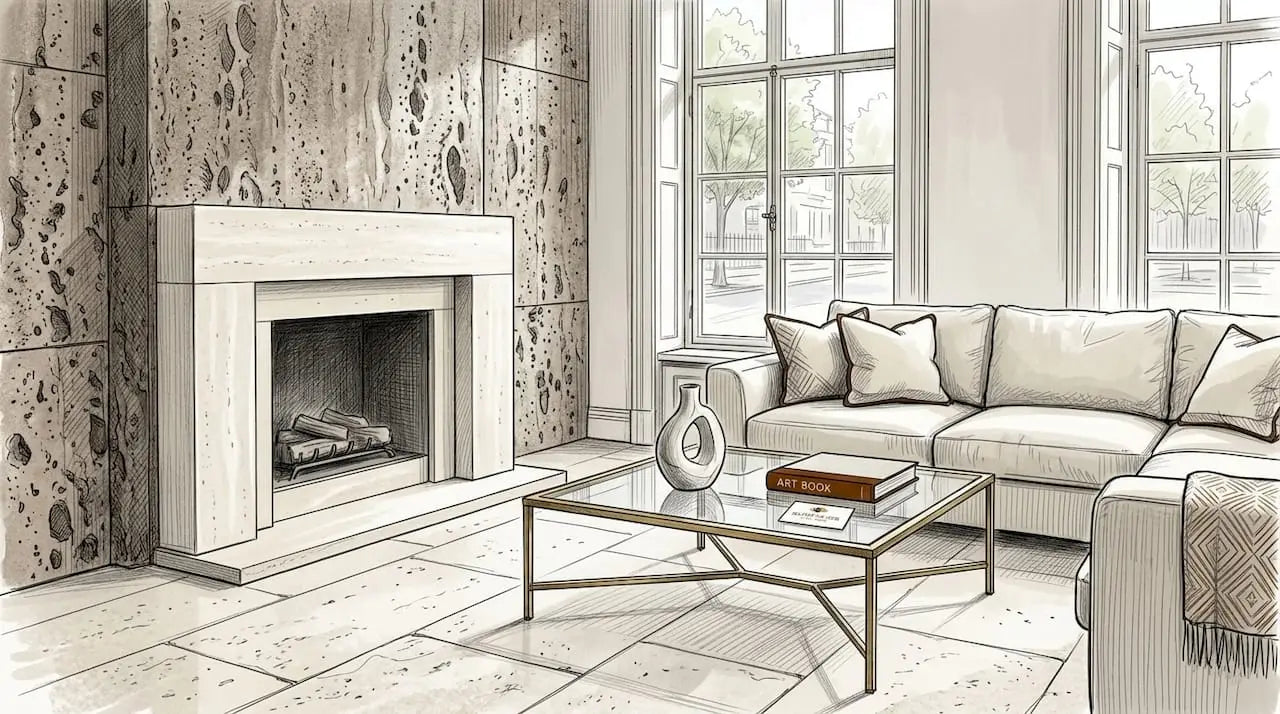
Unfilled travertine retains those natural pores and channels intact. The surface reads as textured, directional, and alive in a way that filled travertine simply cannot replicate. Run your hand across unfilled travertine and you feel the material’s geological story. That quality is irreplaceable in decorative wall panels, fireplace surrounds, and feature elements where tactile richness matters more than hygiene.
“Choosing between filled and unfilled travertine is not an aesthetic preference alone. It defines the cleaning protocol, the sealing schedule, and ultimately the user experience for the life of the installation.”
The downside of unfilled travertine is real. Open pores collect dust in dry climates, require more frequent sealing, and demand a more attentive cleaning routine. For a private residential library wall or a hotel corridor feature panel, that trade-off is worth it. For a busy restaurant floor, it is not.
Pro Tip: Mixing filled and unfilled travertine within a single project is a sophisticated move. Use filled tiles on the floor and unfilled panels on the adjacent wall to get both the practicality and the texture in the same space without compromise. For a deeper look at how the travertine fill benefits compare across applications, the product specs matter as much as the visual sample.
Discover the top finishes and color palettes shaping travertine design in luxury interiors
Once the filled/unfilled decision is locked in, finish selection becomes the primary driver of how travertine reads in a space. The current direction in luxury design is clear. Honed and matte finishes are favored over polished for a warmer, more architectural stone feel. High-gloss polished travertine now reads as dated in elevated residential and hospitality contexts.
Here is what makes honed and leathered finishes the dominant choice among travertine design ideas 2025:
- Honed finish: Matte surface with a slight sheen, revealing natural veining without mirror reflection. Forgiving under raking light, which is critical in spaces with large windows or cove lighting.
- Leathered finish: A slight texture applied after honing that adds grip and dimension. The stone feels warmer to the touch and appears more dimensional than honed alone.
- Brushed finish: Surface is mechanically brushed to raise the texture and accentuate pore depth. Popular for outdoor applications and rustic-luxury interiors.
- Tumbled finish: Edges and faces are rounded to create an aged, worn appearance. Used in mosaic applications and Mediterranean-influenced design schemes.
On the color side, the travertine color trends 2025 are grounded in warmth rather than cool neutrality. The four tones defining current luxury interiors are:
- Ivory and cream: Cleanest, most versatile. Works in Scandinavian-influenced and transitional luxury schemes.
- Warm gold: The most dramatic. Catches light in ways that white marble cannot. Used in statement flooring and kitchen islands.
- Walnut brown: Richest and deepest. Pairs with dark wood millwork and bronze hardware for a study or library feel.
- Classic beige: The workhorse of the palette. Grounds any luxury space without competing with art or furnishings.
One of the strongest travertine decor trends 2025 is the deliberate pairing of two travertine tones within a single space. Ivory field tiles with a walnut border, for example, creates a formal, considered composition without introducing a second stone species. This is a more restrained approach than stone mixing, but it is highly effective in residential dining rooms and hospitality corridors.
Pro Tip: Warm-temperature lighting is not optional in honed travertine spaces. It is load-bearing for the design. A travertine tile finishes guide will show you sample photography, but always view physical samples under the actual fixture type you plan to install before committing. LED strips at 2700K to 3000K are the gold standard for honed stone interiors.
Understanding what travertine actually is at a geological level also helps in client communication. When clients understand that the variation in pore distribution and veining is a function of how the stone formed in hot spring deposits, they stop asking for the “most uniform” piece and start appreciating the variation as intrinsic quality.
Mixing stones and sculpting edges: achieving modern travertine sophistication
The most significant shift in the best travertine styles 2025 is the move away from single-stone interiors toward curated stone programs. Designers mix stones with intention to create layered and confident spaces by pairing travertine with marble, quartzite, or soapstone, avoiding the uniformity of matching stone packages.
The reasoning is architectural. When every surface in a bathroom is the same Navona travertine, the room reads as an undifferentiated stone box. When the floor is travertine, the vanity top is Calacatta marble, and the accent niche is a honed absolute black, the room has hierarchy. It has depth. It tells you where to look.
Effective stone pairing combinations currently in use:
- Ivory travertine floor with Statuario marble feature wall in master bathrooms
- Warm gold travertine kitchen island with quartzite perimeter countertops in the same warm-white family
- Walnut travertine reception desk surround with white limestone wall cladding in commercial lobbies
- Unfilled classic beige travertine floor with polished onyx accents in powder rooms
Beyond stone pairing, trending travertine patterns and edge details are where specification becomes genuinely sculptural. Follow this sequence when specifying edge treatments for contemporary travertine applications:
- Determine slab thickness first. A 2 cm slab reads lighter and more European. A 3 cm slab has mass and gravitas, appropriate for kitchen islands or monumental stairs.
- Select the profile. Mitered edges on countertops eliminate the visible substrate line and give the illusion of a solid stone block. Eased edges on flooring prevent chipping in high-traffic corridors.
- Consider curved returns. Wrapping travertine around a curved wall or column base transforms a flat material into an architectural gesture.
- Specify fluted panels intentionally. Fluted travertine panels on a reception desk or wardrobe surround add vertical rhythm and shadow lines that change as light moves through the day.
- Control grout joint width. Tight 1/16-inch joints on honed travertine floors maximize the stone’s visual dominance. Wider joints on tumbled mosaics read more artisanal and relaxed.
Pro Tip: A common specification mistake is selecting the stone correctly but defaulting to a builder-grade edge profile. The designer guide to travertine luxury spaces details how edge and thickness decisions impact the installed cost, giving you a clear framework for client budget conversations before fabrication begins.
Pricing and performance: budgeting travertine for residential and commercial luxury projects
Modern travertine applications span a wide price range depending on format, finish, and installation complexity. Here is the realistic breakdown for luxury-grade material.
| Application | Material cost (per sq ft) | Installed cost estimate | Notes |
|---|---|---|---|
| Interior flooring (honed, filled) | $5 to $10 | $12 to $20 per sq ft | Add sealing and underlayment |
| Interior wall cladding (honed) | $6 to $12 | $15 to $25 per sq ft | Larger format = higher labor |
| Kitchen countertop (honed, 3 cm) | $55 to $95 per linear ft | $90 to $140 installed | Includes edge work |
| Outdoor pool deck pavers | $8 to $15 | $12 to $25 per sq ft | Requires proper bedding |
| Mosaic accent tile | $18 to $45 | $30 to $65 per sq ft | High labor due to small format |
For a typical 200-square-foot entry foyer with premium honed and filled travertine, the total installed cost typically runs $2,400 to $5,000 including materials, installation, and sealing. That range is wide because the variables matter: subfloor preparation, local labor rates, and whether you are using standard 18x18-inch tiles or large-format 24x48-inch slabs.
Outdoor travertine pool decks are among the most cost-justified travertine applications. The stone stays cool underfoot in direct sun, has natural slip resistance, and a properly installed travertine pool deck lasts 30 to 50 years with minimal maintenance.
Performance considerations that affect budget over time:
- Sealing frequency: Unfilled travertine in a high-use area may need resealing annually. Filled and honed travertine in a low-traffic guest bath may only need sealing every 3 to 5 years.
- Replacement cost avoidance: Travertine does not require full replacement when damaged. Individual tiles can be pulled and replaced with matching stock, which is why sourcing from a consistent supplier and storing a small quantity of spare material is standard practice on luxury projects.
- Long-term sustainability: Natural travertine has a carbon footprint dominated by extraction and transport. Once installed, the material requires no manufacturing inputs for its entire lifespan, which can span generations in well-maintained applications.
Showcasing travertine’s versatility: contemporary trends in upscale commercial and residential projects
The range of modern travertine applications in 2025 is broader than at any point in recent memory. The material is appearing in contexts that would have seemed unlikely five years ago, driven by a broader shift toward authentic natural materials in both residential and commercial design.
On the commercial side, large projects employ travertine in statement architectural elements including lobbies, benches, and reception desks, integrating art and materiality cohesively. One notable application type: double-height lobby walls clad in large-format travertine slabs, backlit with linear LED strips to animate the stone’s natural pore structure. The result is an architectural installation that reads as art while functioning as a durable surface.
“The difference between travertine used as a finish material and travertine used as an architectural element is the difference between covering a surface and building a room.”
In residential design, the strongest travertine design ideas 2025 center on these applications:
- Kitchen: Travertine on the floor, backsplash, and range hood surround creates a fully integrated stone environment. Using the same material across all three planes but varying the format (large slab for the hood, brick-pattern tile for the backsplash) prevents monotony while maintaining cohesion.
- Primary bathroom: Honed travertine on the floor with leathered travertine on the shower walls gives the room two distinct textures that still read as a unified material story.
- Feature walls in living rooms: Unfilled travertine panels framing a fireplace or flanking a media unit bring warmth and geological texture to a space dominated by upholstery and wood.
- Stair treads: Travertine stair treads in a foyer are one of the highest-impact applications per square foot in residential design. The material underfoot communicates quality to anyone entering the home.
The format diversity available today also expands creative options. Mosaics, custom-cut geometric patterns, oversized slabs, and thin-panel cladding formats all use the same material family but create entirely different spatial experiences.
Why specifying travertine with precision unlocks enduring luxury and sustainability
Here is something worth saying plainly: most design problems with travertine are specification problems, not material problems. We have seen beautiful travertine look terrible within two years because the wrong specification choice was made at the start, and we have seen modest-budget travertine look extraordinary 20 years later because every decision aligned with how the space would actually be used.
The filled/unfilled choice affects maintenance burden, longevity, and environmental impact in ways that extend far beyond the installation day. Designers who make this decision casually, based on what photographed well in a reference image, create maintenance burdens for their clients and potential liability for themselves.
The sustainability argument for travertine is also underplayed in most design conversations. Natural travertine, correctly specified and properly maintained, lasts longer than most engineered stone alternatives. A travertine floor installed in 1980 and properly sealed is still a functional, beautiful surface today. An engineered quartz countertop from that era would have been replaced at least twice. Fewer replacements means less manufacturing waste, less transportation, and less installation labor over the life of a building.
Lighting and material layering are the other variables that separate travertine done well from travertine done adequately. The travertine selection criteria matter enormously, but so does the environment the stone inhabits. Warm light activates the mineral variation in travertine in a way that cool or neutral light flattens. Paired materials, whether wood, plaster, or bronze, give travertine a foil that allows its character to read more clearly.
The takeaway for precision specifying: match the travertine type to the use case, pair it with materials and light that amplify its character, and treat the maintenance schedule as part of the design document rather than an afterthought.
Explore premium travertine collections at Surfaces Galore
If these trends have shifted how you are thinking about your next project, the next step is seeing the material itself. At Surfaces Galore, we source authentic natural travertine directly, which means you get consistent quality, honest specifications, and access to collections that reflect exactly the color trends and finish preferences driving luxury design right now.
Our team works directly with designers, architects, and contractors across the country to match the right travertine format, finish, and color to each project’s specific demands. From honed ivory field tiles to large-format walnut slabs and handcrafted mosaics, our natural stone collections are built for the kind of projects this guide describes. Browse our travertine inventory today and bring authentic, lasting luxury to your next residential or commercial space.
Frequently asked questions
What is the difference between filled and unfilled travertine?
Filled travertine has its natural pores filled with resin or grout, creating a smoother surface ideal for wet or food-prep areas, while unfilled travertine retains open pores for a textured look better suited for dry decorative applications. The filled/unfilled choice affects both visual texture and real-world hygiene and performance over the life of the installation.
Which travertine finish is most popular for luxury interiors in 2025?
Honed and matte finishes lead current luxury specifications because they deliver a warmer, softer feel and reveal natural stone depth without the glare of high-gloss polishing. Designers favor honed or leathered finishes for a softer, warmer, and more architectural stone character.
How much does it cost to install travertine flooring in a typical upscale foyer?
For a 200-square-foot foyer with premium honed and filled travertine, total costs typically range from $2,400 to $5,000 including materials, installation, and sealing fees, depending on slab format and local labor rates.
Can travertine be used outdoors, such as on pool decks?
Yes. Travertine pavers are among the most practical outdoor stone choices, with fully installed costs for premium outdoor pool deck applications typically running $12 to $25 per square foot. The stone stays cool underfoot in sun and provides natural slip resistance.
Why is mixing stones a current trend in travertine design?
Mixing travertine with other natural stones creates layered, dynamic interiors with contrasting textures and colors rather than uniform stone packages. Designers pair travertine with marble, quartzite, or soapstone to give spaces visual hierarchy and architectural depth.

Leave a comment