
What Does Honed Tile Mean? A Guide for Homeowners

TL;DR:
- Honed tile is natural stone that has been ground to a smooth, matte finish before reaching high gloss. It offers slip resistance, hides scratches, and presents a natural, understated look suitable for kitchens and bathrooms. Proper sealing every few months ensures durability, making honed tile a practical choice for real-life home conditions.
Honed tile is defined as natural stone tile that has been ground to a smooth, matte or satin finish by stopping the polishing process before it reaches a high gloss. The surface feels flat and even under your hand, but it carries none of the mirror-like shine you see on polished stone. This finish is achieved by halting the grinding process at 400–800 grit, well short of the 3,000+ grit required for a polished result. For homeowners and designers planning kitchen or bathroom renovations, understanding what honed tile means shapes every decision from stone selection to long-term care.
What does honed tile mean, and how is it made?
Honed tile is the result of a controlled grinding process that stops at a mid-grit stage. Honing is not a separate process from polishing. It is a checkpoint within polishing, where fabricators stop at 400–800 grit to achieve matte smoothness rather than continuing to a reflective shine. The result is a surface that is smooth to the touch but visually quiet.
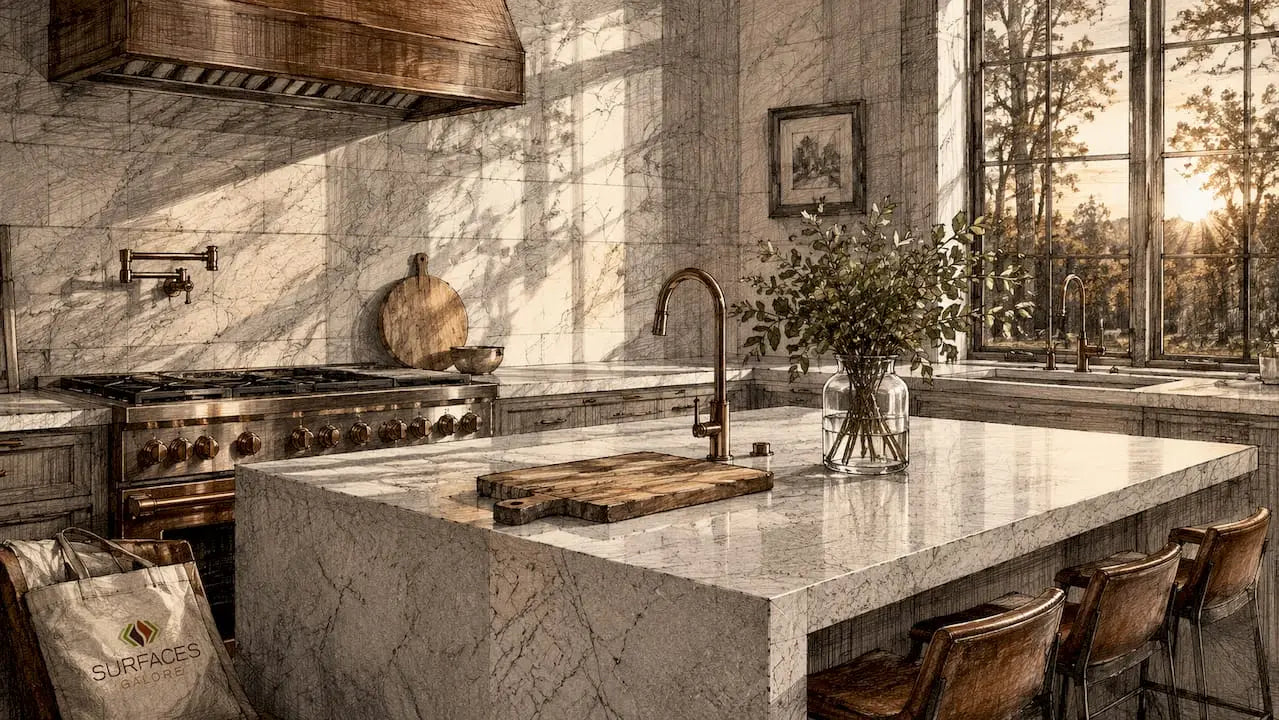
The industry term for this category is “honed finish,” and it sits between rough-sawn and fully polished on the stone fabrication spectrum. Polished finishes continue past 3,000 grit and then receive buffing to produce a mirror-like gloss. Honed finishes stop short of that stage, which is exactly what gives them their soft, natural appearance.
Two other finishes often get confused with honed: leathered and brushed. Both of those create surface texture through mechanical wire brushing or acid treatment. Honed tile remains smooth. That distinction matters when you are specifying tile for a shower wall or kitchen floor, where texture affects both feel and cleaning effort.
How honed compares to other stone finishes
| Finish | Grit range | Surface texture | Appearance |
|---|---|---|---|
| Honed | 400–800 grit | Smooth, flat | Matte or satin |
| Polished | 3,000+ grit | Smooth, reflective | High gloss |
| Leathered | Variable | Textured, uneven | Rustic, dimensional |
| Brushed | Variable | Lightly textured | Soft, aged |
Pro Tip: If you want the look of natural stone without the glare of a polished surface, honed is the finish to specify. It reads as refined without demanding a perfectly lit showroom to look good.
What are the benefits of honed tile in kitchens and bathrooms?
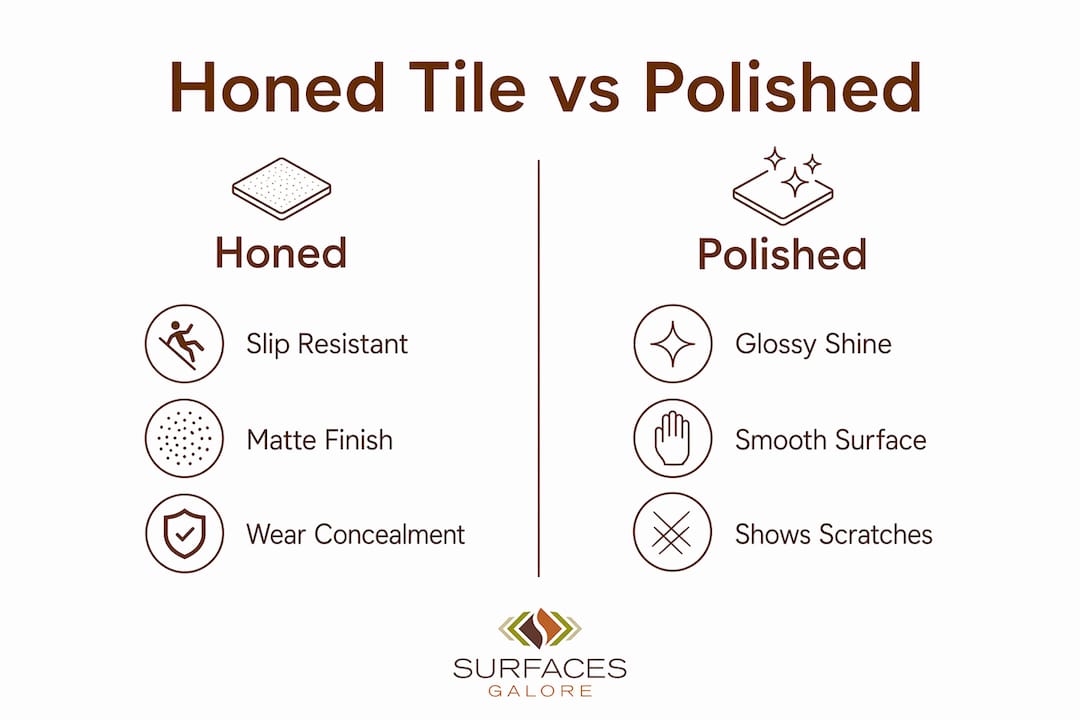
Honed tile delivers practical advantages that polished tile cannot match in wet, high-traffic spaces. The most important is slip resistance. Honed floors provide better traction when wet compared to polished surfaces, reducing slip hazards in bathrooms and kitchens. The industry standard for wet-area flooring is a Dynamic Coefficient of Friction (DCOF) of 0.42 or higher. Honed tile meets or exceeds DCOF ≥0.42, while polished tiles often fall below that threshold.
The second major advantage is wear concealment. Scratches on polished granite appear as bright lines against the reflective surface. On honed stone, those same scratches blend into the matte background and become nearly invisible. This makes honed tile the smarter choice for kitchen floors, bathroom vanities, and any surface that sees daily contact.
Honed finishes also reveal the stone’s natural color more accurately. Honed black granite appears charcoal-matte; honed white marble shows its veining without the reflection washing it out. Designers working on spa-like bathrooms or contemporary kitchens consistently favor this quality.
Key benefits at a glance
- Slip resistance: Meets DCOF ≥0.42 for safer wet-area flooring
- Wear concealment: Hides scratches and etch marks better than polished tile
- Glare reduction: Matte surface eliminates harsh reflections in bright rooms
- Natural color accuracy: Shows true stone color without the distortion of high gloss
- Versatility: Works on marble, limestone, and travertine in kitchens, baths, and showers
- Timeless aesthetic: Complements both contemporary and traditional design styles
About 90% of marble kitchen installations use a honed finish to manage etching visibility, according to fabricator data. That figure reflects a real shift in how designers and homeowners think about natural stone in working kitchens.
How do you clean and maintain honed tile?
Maintenance for honed stone is not easier than polished. It is different, and it demands more attention in one specific area: sealing. Honed stone requires sealing every 3–9 months, compared to polished stone, which typically needs resealing every 6–12 months. The more open pore structure of honed stone absorbs liquids faster, which is why the sealing interval is shorter.
Sealing protects the stone from staining, but it does not stop etching. Etching is a chemical reaction caused by acids like lemon juice, vinegar, or certain cleaning products. A sealer cannot block that reaction. The good news is that honed finishes visually minimize etch marks far better than polished surfaces, so the damage is less obvious even when it occurs.
For daily cleaning, pH-neutral cleaners protect honed stone from damage and staining. Avoid anything acidic or abrasive. Harsh cleaners degrade the finish over time and open the stone’s pores to permanent staining. A simple spray of pH-neutral stone cleaner and a soft cloth is all you need for routine care.
Maintenance steps for honed tile
- Clean daily with a pH-neutral stone cleaner. Wipe up spills immediately, especially acidic liquids like citrus juice, wine, or coffee.
- Perform the water bead test regularly. Drop a small amount of water on the surface. If it soaks in and darkens the stone, reseal immediately.
- Reseal on a schedule of every 3–9 months. High-traffic areas and hard-water regions need resealing more often than low-use surfaces.
- Apply a penetrating stone sealer, not a topical coating. Penetrating sealers bond within the stone’s pores without changing the matte appearance.
- Avoid acidic or abrasive products. No vinegar, lemon-based sprays, or scouring pads. These strip the sealer and etch the stone.
Pro Tip: The water bead test is more reliable than any fixed calendar schedule. When water stops beading and starts soaking in, your stone is telling you it needs attention. Do not wait for a stain to confirm it.
For a full walkthrough of the sealing process, Surfacesgalore’s guide on sealing natural stone covers every step from product selection to application technique.
Where should you use honed tile in your renovation?
Honed tile fits naturally into any space where safety, understated style, and durability matter more than visual drama. Kitchen floors are the strongest use case. The combination of slip resistance and wear concealment makes honed marble, limestone, or travertine a practical choice that still looks refined. Polished tile on a kitchen floor shows every scuff and becomes dangerously slick when wet.
Bathroom floors and shower walls are the second major application. The DCOF advantage is critical in showers, where wet feet and smooth surfaces create real fall risk. Honed tile on a marble shower floor delivers the luxury look of natural stone without the safety compromise of a polished finish.
Bathroom vanity tops and kitchen counters also benefit from honed finishes. On a countertop, the matte surface hides daily scratches from utensils and cutting boards. Etching from food acids still occurs, but it blends into the surface rather than standing out as a bright spot.
Recommended applications by room and stone type
| Room | Application | Best stone types | Why honed works |
|---|---|---|---|
| Kitchen | Floor, countertop | Marble, limestone, travertine | Slip resistance, wear concealment |
| Bathroom | Floor, vanity top | Marble, travertine | DCOF compliance, etch concealment |
| Shower | Wall, floor | Marble, limestone | Safety, spa aesthetic |
| Entryway | Floor | Travertine, limestone | Durability, hides foot traffic wear |
| Living area | Floor | Marble, limestone | Understated elegance, low glare |
Honed finishes align with the dominant 2026 interior design direction: natural materials with quiet, tactile surfaces rather than high-gloss statements. Designers working on spa-inspired bathrooms and Japandi-influenced kitchens consistently specify honed stone because it reads as grounded and authentic rather than flashy.
When choosing between stone types, marble offers the most dramatic veining at a honed finish. Limestone delivers a more uniform, earthy tone. Travertine brings natural pitting and variation that pairs well with the matte surface. Surfacesgalore carries all three in honed finishes, and the team can help you match the right stone to your specific room conditions and design goals. You can also explore the full range of tile finishes by room to compare options before committing.
Key Takeaways
Honed tile is the most practical natural stone finish for kitchens and bathrooms because it combines slip resistance, wear concealment, and a timeless matte aesthetic that polished tile cannot match in real-life conditions.
| Point | Details |
|---|---|
| Honed tile definition | Natural stone ground to 400–800 grit for a smooth, matte, non-reflective surface. |
| Slip resistance advantage | Honed tile meets DCOF ≥0.42, making it safer than polished tile on wet floors. |
| Wear concealment | Scratches and etch marks blend into the matte surface and stay nearly invisible. |
| Sealing frequency | Reseal every 3–9 months; use the water bead test to confirm when resealing is needed. |
| Best applications | Kitchen floors, bathroom floors, shower walls, and vanity tops in marble, limestone, or travertine. |
Why honed tile is the finish I recommend most
Most homeowners come to me asking about polished marble because it photographs beautifully. My honest answer is that polished tile is a finish designed for showrooms, not for homes where people actually cook, shower, and walk around barefoot.
Honed tile is the finish I recommend most consistently, and the reason is simple. It performs better in the conditions real homes create. A polished marble kitchen floor shows every footprint, every scuff, and every water splash. A honed marble floor in the same kitchen looks just as elegant on day one and still looks good two years later. The matte surface does not hide neglect, but it forgives the ordinary wear that no homeowner can prevent.
The one thing I want every homeowner to understand is that honed stone is not low-maintenance. It is differently maintained. The sealing schedule is more frequent than polished stone, and you need to be consistent about it. Skipping a sealing cycle on a honed limestone floor is how you end up with a stain that no amount of cleaning will remove. The water bead test takes thirty seconds and tells you exactly where you stand.
What I find underrated about honed finishes is their ability to age gracefully. Polished stone looks worse over time as scratches accumulate and the gloss becomes uneven. Honed stone develops a patina that actually improves its character. A ten-year-old honed travertine floor in a well-maintained kitchen looks lived-in and warm. A ten-year-old polished floor in the same kitchen looks tired.
If you are designing a kitchen or bathroom and you want natural stone that holds up to real life while still looking like a deliberate design choice, honed is the answer. Pair it with a consistent sealing routine and pH-neutral cleaning, and you have a surface that will outlast every trend.
— cihan
Natural stone with a honed finish, available at Surfacesgalore
Surfacesgalore is a direct importer of premium marble, limestone, and travertine tiles, and honed finishes are available across the full collection.
Whether you are tiling a kitchen floor, a bathroom vanity, or a full shower surround, Surfacesgalore ships nationwide from Anaheim, California, to homeowners, designers, and contractors. The team specializes in helping you match the right stone and finish to your specific project conditions. Browse the natural stone tile collection and find honed marble, limestone, and travertine options ready to ship. For guidance on protecting your investment after installation, the Surfacesgalore resource on why sealing matters in kitchens and baths is a practical next step.
FAQ
What is honed tile, exactly?
Honed tile is natural stone that has been ground to a smooth, matte finish by stopping the polishing process at 400–800 grit. The surface is flat and even but carries no gloss or reflection.
Is honed tile safer than polished tile on wet floors?
Honed tile meets the DCOF ≥0.42 standard for wet-area flooring, while polished tile often falls below that threshold. This makes honed tile the safer choice for bathroom floors, shower floors, and kitchen floors.
How often does honed tile need to be sealed?
Honed stone requires sealing every 3–9 months, more frequently than polished stone, which typically needs resealing every 6–12 months. Use the water bead test to confirm when resealing is needed rather than relying on a fixed schedule.
Does sealing honed tile prevent etching?
Sealing protects honed stone from staining but does not prevent etching. Etching is a chemical reaction caused by acids like lemon juice or vinegar, and no sealer blocks it. Honed finishes do hide etch marks better than polished surfaces, so the visual impact is reduced.
What stones work best with a honed finish?
Marble, limestone, and travertine all work well with a honed finish. Marble shows dramatic veining at a matte tone, limestone delivers a uniform earthy look, and travertine brings natural variation that pairs naturally with the non-reflective surface.

Leave a comment