

What is marble dust? Essential guide for homeowners 2026

Polishing a single marble countertop can generate over 5 pounds of ultra-fine dust particles, many invisible to the naked eye yet capable of traveling throughout your home. This surprising reality catches most homeowners off guard during renovation projects. Marble dust isn’t just a cleanup nuisance, it’s a material with specific properties, health considerations, and surprisingly valuable applications in both artistic work and sustainable construction. Understanding what marble dust is, how it behaves, and how to manage it safely transforms a potential hazard into an opportunity for informed, effective home improvement.
Table of Contents
- What Is Marble Dust? Composition And Characteristics
- Health And Safety Considerations When Working With Marble Dust
- Practical Uses Of Marble Dust In Art And Home Renovation
- Marble Dust In Concrete: Benefits And Sustainability
- Explore Expert Marble Products And Support At Surfaces Galore
Key takeaways
| Point | Details |
|---|---|
| Composition and size | Marble dust consists of calcium carbonate particles typically 1-10 microns, fine enough to remain airborne and pose inhalation risks. |
| Health protection | Wet polishing methods and HEPA filtration systems capture 90-95% of airborne particles, dramatically reducing respiratory exposure. |
| Artistic applications | Ultra-fine marble dust creates texture in paintings and realistic faux marble effects when mixed with epoxy resin. |
| Concrete enhancement | Replacing 10-20% of cement with marble dust improves compressive strength by approximately 11.8% while reducing environmental impact. |
| Safety essentials | Plastic sheeting barriers, protective masks, and proper ventilation are non-negotiable when working with marble in enclosed spaces. |
What is marble dust? Composition and characteristics
After summarizing the main points, let’s clarify exactly what marble dust is at a material level. Marble dust is a fine powder derived from marble, a metamorphic rock composed of recrystallized calcite (calcium carbonate). When you grind, sand, or polish marble surfaces during home renovation, you’re essentially breaking down this dense stone into microscopic particles.
The particle size matters enormously for both safety and application. Most marble dust falls in the 1-10 micron range, which is ultra-fine grade. To put this in perspective, a human hair is about 70 microns wide, meaning these particles are 7 to 70 times smaller. This microscopic size allows marble dust to remain suspended in air for extended periods, traveling far beyond the immediate work area.
Marble’s density and hardness come from its metamorphic origin. Heat and pressure transform limestone into marble, creating interlocking calcite grains that make the stone harder and more durable than its sedimentary parent rock. This same density means that grinding marble requires significant force, generating substantial amounts of dust in the process. Understanding marble origins helps explain why the dust behaves differently than softer stone powders.
Key characteristics of marble dust include:
- Pure white color when derived from white marble varieties, making it valuable for artistic applications
- High calcium carbonate content, typically 95-98% in pure marble
- Low oil absorption properties, allowing it to blend well with various binders
- Alkaline pH due to calcium carbonate composition
- Excellent adhesion qualities when mixed with resins or plasters
The chemical composition directly influences how marble dust performs in different applications. Calcium carbonate reacts with acids, which matters for both cleaning and artistic techniques. The fine particle structure provides excellent coverage and smooth texture when used as an additive. These properties make marble dust simultaneously a challenge to manage safely and a valuable material for creative and construction applications.
Health and safety considerations when working with marble dust
With marble dust defined, it’s crucial to understand the health risks involved when this dust is created during home projects. The primary concern centers on respiratory exposure. Marble dust can irritate eyes, nose, and throat if inhaled, and silica content in some marble types creates serious health hazards. While pure marble contains minimal crystalline silica, many commercial marble varieties include quartz veins or other minerals that do contain this hazardous substance.
Traditional dry polishing creates visible dust clouds that can fill entire rooms within minutes. A single pass with a dry grinder generates thousands of airborne particles per cubic foot of air. Modern wet polishing methods dramatically reduce this hazard by using water to capture particles before they become airborne, creating a slurry instead of dust. Professional contractors understand this difference and invest in proper equipment.
Professional dust control measures include several layers of protection. Contractors seal work areas with plastic sheeting, creating physical barriers between the work zone and living spaces. Industrial dust collection systems equipped with HEPA filters capture 90-95% of airborne particles at the source. These systems attach directly to grinding and polishing tools, removing dust before it disperses.
Homeowners often underestimate both the volume of dust generated and the inadequacy of consumer-grade equipment. Rental floor polishers rarely include effective dust collection systems. A weekend DIY marble polishing project without proper controls can deposit fine dust throughout your home’s HVAC system, requiring professional duct cleaning to fully remediate.
“The difference between professional and amateur marble work often comes down to dust management. Proper containment protects not just the workers but the entire home environment from contamination that can persist for months.”
Best practices for safe marble dust management:
- Seal the work area completely with 6-mil plastic sheeting, taping all seams and doorways
- Turn off HVAC systems to prevent dust circulation through ductwork
- Use wet methods whenever possible, keeping surfaces damp during grinding and polishing
- Wear N95 or P100 respirators rated for fine particulates, not basic dust masks
- Protect eyes with sealed safety goggles, as particles can cause corneal irritation
- Set up negative air pressure with a window fan exhausting outward
- Clean with HEPA-filtered vacuums only, never sweep dry dust
Pro Tip: Always set up plastic sheeting barriers to confine dust and avoid contamination of adjacent rooms, a step often missed by DIYers who focus only on floor protection. Vertical barriers matter more than horizontal ones for controlling airborne particles.
The health implications extend beyond immediate irritation. Repeated exposure to fine particulates contributes to chronic respiratory conditions. Proper marble polishing techniques emphasize wet methods not just for finish quality but for worker safety. If you’re planning marble shower installation or other projects involving cutting and grinding, factor dust control into your budget and timeline. The investment in proper safety measures costs far less than the medical and remediation expenses from inadequate protection.
Regular marble maintenance generates minimal dust compared to initial installation or restoration work, but even routine care requires awareness. Understanding these risks helps you make informed decisions about DIY versus professional work and ensures any marble project proceeds safely.
Practical uses of marble dust in art and home renovation
Beyond safety concerns, marble dust serves as a valuable material in artistic and renovation projects. Artists have used marble dust for centuries, valuing its brilliant white color and unique textural properties. Marble dust creates brilliant white grounds and adds texture to paint, making it ideal for oil painting, acrylics, and mixed media work.
The ultra-fine grade preserves particle structure when mixed into grounds and gesso, creating a surface that’s both absorbent and stable. Unlike chalk or other white fillers, marble dust has low oil absorption, meaning it doesn’t pull excessive medium from paint layers. This quality allows colors to remain vibrant while still providing tooth for subsequent layers. Artists working in encaustic particularly value marble dust for adding body to wax without compromising translucency.
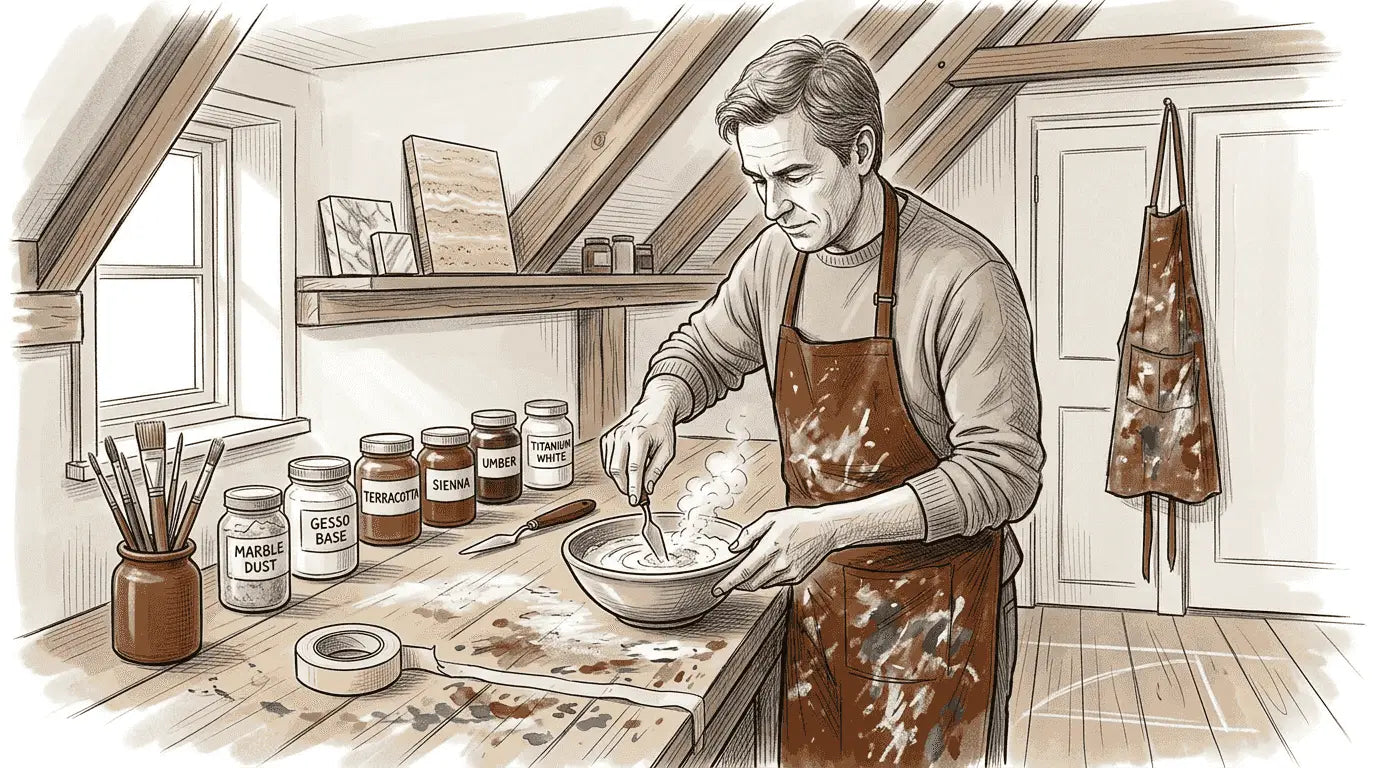
In home renovation, marble dust has found a modern application in creating faux marble surfaces. Marble dust mixed with epoxy resin creates realistic faux marble effects, offering homeowners an affordable alternative to solid stone. The typical ratio ranges from 1:1 to 2:1 marble dust to epoxy by volume, depending on desired thickness and opacity.
The traditional artisanal technique called Scagliola represents the historical precedent for these modern applications. Scagliola imitates marble using plaster, pigments, and other materials, creating convincing marble replicas for architectural elements. Craftsmen have used this technique since the Renaissance for columns, tabletops, and decorative panels where solid marble was impractical or unaffordable.
| Aspect | Traditional Scagliola | Modern Epoxy Faux Marble |
|---|---|---|
| Primary binder | Gypsum plaster and animal glue | Two-part epoxy resin |
| Working time | 30-60 minutes before setting | 45-90 minutes pot life |
| Curing time | 2-4 weeks full cure | 24-72 hours to handle |
| Durability | Moderate, requires sealing | High, waterproof when cured |
| Skill level | Advanced, requires training | Intermediate, learnable |
| Color depth | Surface veining only | Full-depth color possible |
| Cost | Labor-intensive, expensive | Material costs moderate |
Creating a successful marble dust epoxy project requires careful technique. Here’s the process:
- Calculate total epoxy needed for your surface area at desired thickness, typically 1/8 to 1/4 inch.
- Mix epoxy resin and hardener according to manufacturer ratios in a clean container.
- Add marble dust gradually while stirring continuously to prevent clumping, achieving desired consistency.
- Incorporate pigments or mica powders for veining effects, keeping amounts under 5% by weight.
- Pour mixed material onto prepared surface, spreading evenly with a notched trowel.
- Use a heat gun on low setting to remove surface bubbles, moving constantly to avoid overheating.
- Create veining by dragging pigmented resin through the base layer with a thin tool.
- Allow to cure undisturbed for minimum 24 hours before light handling.
- Sand surface progressively from 220 to 600 grit after full cure for smooth finish.
- Apply clear epoxy topcoat for depth and protection, following same bubble-removal process.
Pro Tip: Use a heat gun or vacuum chamber to remove air bubbles when mixing marble dust epoxy for smooth finishes. Bubbles trapped in the thick mixture will mar the final surface if not eliminated during the working time.
The versatility of marble dust extends to other renovation applications. Mixed with marble filler compounds, it repairs chips and cracks in existing marble surfaces. Some homeowners incorporate it into decorative plasters for textured wall finishes. When planning marble in kitchens, understanding these alternative applications helps you maximize material use and minimize waste.
The key to success lies in understanding ratios and working within the material’s limitations. Too much marble dust creates a brittle, weak composite. Too little fails to achieve the desired opacity and weight. Experimentation on small test pieces before tackling large surfaces saves both materials and frustration. These modern marble uses demonstrate how traditional materials adapt to contemporary techniques.
Marble dust in concrete: benefits and sustainability
Complementing artistic uses, marble dust has a growing role in sustainable construction and concrete enhancement. The construction industry generates enormous amounts of marble waste during quarrying and fabrication. Rather than landfilling this material, researchers and builders have discovered that marble dust enhances concrete properties while reducing environmental impact.
The sustainability benefits operate on multiple levels. Cement production accounts for approximately 8% of global carbon dioxide emissions. Substituting even a portion of cement with marble dust reduces this footprint significantly. Additionally, diverting marble waste from landfills addresses a disposal problem while creating value from what was previously considered scrap.
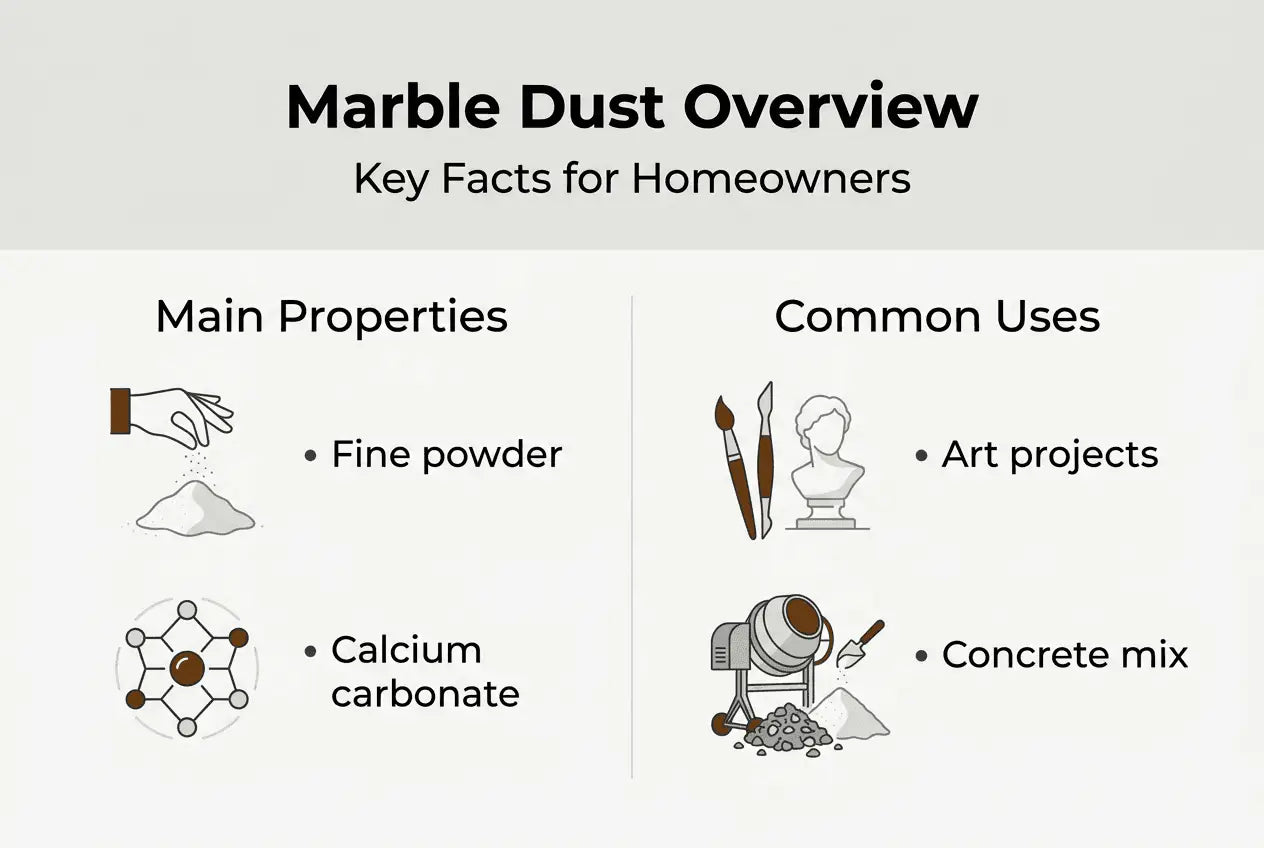
Recent studies demonstrate measurable improvements in concrete performance. Replacing 10-20% of cement with marble dust improves compressive strength, with optimal results around 10% replacement when combined with polypropylene fibers. The calcium carbonate in marble dust participates in hydration reactions, contributing to the concrete matrix rather than acting as inert filler.
| Property | Control Mix | 10% Marble Dust + Fiber |
|---|---|---|
| Compressive strength (28 days) | 3200 psi | 3580 psi (11.8% increase) |
| Tensile strength | 285 psi | 310 psi (8.8% increase) |
| Flexural strength | 425 psi | 465 psi (9.4% increase) |
| Water absorption | 6.2% | 4.8% (22.6% reduction) |
| Permeability | 8.5 x 10^-12 m/s | 6.2 x 10^-12 m/s (27% reduction) |
The improvements in water absorption and permeability particularly enhance durability. Lower permeability means less moisture penetration, reducing freeze-thaw damage in cold climates and corrosion of embedded reinforcement. These benefits extend concrete service life, further improving the environmental profile through reduced replacement frequency.
However, proportions matter critically. Exceeding 20% marble dust replacement typically reduces strength as the cement content becomes insufficient for complete hydration. The particle size distribution of the marble dust also affects results, with finer grades generally performing better. Proper mix design requires testing to optimize the specific marble dust source with local aggregates and cement.
“Incorporating industrial waste materials like marble dust into concrete represents a win-win for construction sustainability. We reduce landfill burden, lower cement consumption and carbon emissions, and often improve the final product’s performance. The challenge lies in standardizing specifications and quality control.”
Machine learning models now help optimize these complex interactions. Researchers input variables like marble dust percentage, particle size, fiber content, and curing conditions to predict mechanical properties. This approach accelerates mix design development and helps identify optimal combinations for specific applications.
For DIYers considering marble dust concrete, several factors deserve attention:
- Source consistency matters; marble dust composition varies by quarry and processing method
- Thorough mixing is essential to distribute fine particles evenly throughout the concrete
- Water-cement ratio requires adjustment as marble dust affects workability
- Curing becomes more critical with supplementary cementitious materials
- Small test batches verify performance before committing to large pours
- Building code compliance may require engineering approval for structural applications
The concrete application connects back to renovation work. If you’re planning marble shower installation or other projects generating marble waste, consider partnering with local concrete suppliers who can use the material productively. This closes the loop on marble dust, transforming a disposal challenge into a sustainability solution.
Explore expert marble products and support at Surfaces Galore
Having explored what marble dust is and how it can be used, consider how professional guidance enhances your marble projects. Whether you’re managing dust during renovation, sourcing materials for artistic applications, or selecting marble surfaces that minimize future maintenance challenges, expert support makes the difference between frustration and success.

Surfaces Galore specializes in premium natural stone products perfect for homeowners and DIY enthusiasts ready to work with marble confidently. Our Anaheim showroom and nationwide shipping bring authentic marble tiles, mosaics, and decorative pieces directly to your project. Beyond products, our team provides practical advice on installation techniques, maintenance strategies, and material selection tailored to your specific application.
From understanding which marble varieties generate less problematic dust to recommending sealers and care products that preserve your investment, Surfaces Galore bridges the gap between theoretical knowledge and practical execution. Our direct import model delivers quality natural stone at accessible prices, making professional-grade materials available for ambitious DIY projects.
Pro Tip: Contact Surfaces Galore’s experts for personalized guidance to safely and effectively use marble dust in your projects, whether you’re creating faux finishes, planning installations, or exploring artistic applications.
What is marble dust? Frequently asked questions
What causes marble dust during home projects?
Grinding, sanding, and polishing marble surfaces breaks down the stone into fine particles. Any mechanical abrasion of marble generates dust, with dry methods producing significantly more airborne particles than wet techniques.
Is marble dust harmful to breathe in?
Yes, inhaling marble dust irritates respiratory passages and can cause serious health issues with repeated exposure. Some marble contains crystalline silica, which poses severe long-term lung disease risks. Always use proper respiratory protection.
How can I safely clean marble dust after polishing?
Use HEPA-filtered vacuums exclusively, never sweep or use standard vacuums that recirculate fine particles. Damp mop hard surfaces and wipe down all horizontal surfaces. Change HVAC filters immediately after dust-generating work.
Can I buy marble dust for art or DIY projects?
Yes, art supply stores and online retailers sell refined marble dust in various grades. Ultra-fine grades work best for painting grounds and epoxy mixtures. Ensure you purchase clean, processed marble dust rather than contaminated waste material.
What is the difference between marble dust and marble filler?
Marble dust is pure ground marble powder, while marble filler is a prepared compound mixing marble dust with resins or binders ready for application. Filler is formulated for repairs, while pure dust serves as a raw ingredient for various applications.
How much marble dust should I add to epoxy resin?
Start with a 1:1 ratio by volume of marble dust to mixed epoxy, adjusting based on desired thickness and opacity. Ratios up to 2:1 work for thicker applications, but higher ratios risk brittleness and poor adhesion.
Leave a comment