
Why seal natural stone: essential benefits for kitchens and baths

TL;DR:
- Natural stone is porous and requires sealing to prevent stains and bacterial buildup.
- Proper sealing fills internal pores, making liquids bead and easier to clean.
- Regular water tests help determine when resealing is needed for durability and hygiene.
Natural stone carries a reputation for toughness that it only partially deserves. A slab of marble or travertine looks like it could survive anything—and homeowners often assume that means it will. The reality is more complicated. Kitchen countertops face daily acid exposure from citrus, wine, and cleaning products. bathroom surfaces deal with humidity, soap scum, and mineral-rich water around the clock. Without proper sealing, even the most expensive stone absorbs those threats at the microscopic level. This guide breaks down the science behind sealing, identifies which stones need it most, and gives you clear steps to protect your investment before damage becomes visible.
Table of Contents
- What makes natural stone vulnerable in kitchens and baths
- How sealing protects and extends natural stone’s lifespan
- Which stones require sealing—and how to test your surface
- Common pitfalls and best practices for sealing natural stone
- Health, safety, and compliance: An overlooked reason to seal
- Our take: What most experts overlook about sealing natural stone
- Ready to protect your investment? Get trusted expertise
- frequently asked questions
Key Takeaways
| Point | Details |
|---|---|
| Sealing protects porosity | Natural stone is porous and sealing helps block stains, bacteria, and water damage. |
| Right sealer type matters | Impregnating sealers work best in kitchens and baths, while topical options often underperform. |
| Testing and regular maintenance | Test your stone’s absorbency and reseal as needed for lasting durability and beauty. |
| Sealing supports health | FDA guidance confirms that sealed stone is easier to clean and more hygienic in food or bath areas. |
What makes natural stone vulnerable in kitchens and baths
Premium stone is not maintenance-free. That idea sells tiles but fails homeowners. What makes marble, travertine, and even granite beautiful—their crystalline structure and natural variation—is the same thing that makes them porous. At a microscopic level, natural stone contains tiny channels and pores that allow liquids, bacteria, and airborne particles to work their way inside. In a kitchen or bathroom, that porosity is a liability.
Porosity varies significantly from one stone type to another, and even from one slab to the next of the same material. A piece of travertine pulled from one quarry may absorb three times as much liquid as a visually similar piece from a neighboring vein. That variability means you cannot assume your stone is safe just because someone tells you “granite doesn’t stain.” It might. It depends on the individual slab.
Here are some of the most common misconceptions homeowners carry into renovations, along with the real risks behind each:
- “Natural stone is basically a rock—it’s indestructible.” The reality is that stone absorbs oils, wine, coffee, and acidic cleaners that permanently discolor pores over time.
- “My stone has a polished finish, so it’s protected.” A polished surface looks dense, but polishing does not close the pores. It only smooths the outer layer.
- “I wipe it down every day, so bacteria can’t survive.” Surface wiping doesn’t reach inside pores. In an unsealed kitchen counter, bacteria can colonize deep enough that standard cleaning products miss them entirely.
- “My contractor said I don’t need to seal it.” Some contractors skip sealing to reduce project time. That decision costs homeowners far more in repairs and refinishing later.
The science behind how marble sealer benefits work comes down to one core mechanism. liquid absorption drops significantly when impregnating sealers fill capillary walls and pores before liquids can enter.
“The key to effective stone protection is understanding that sealing doesn’t just coat the surface—it fills or lines the capillary structure inside the stone, making liquid penetration far more difficult and giving homeowners a critical extra window to clean up spills before they cause permanent damage.”
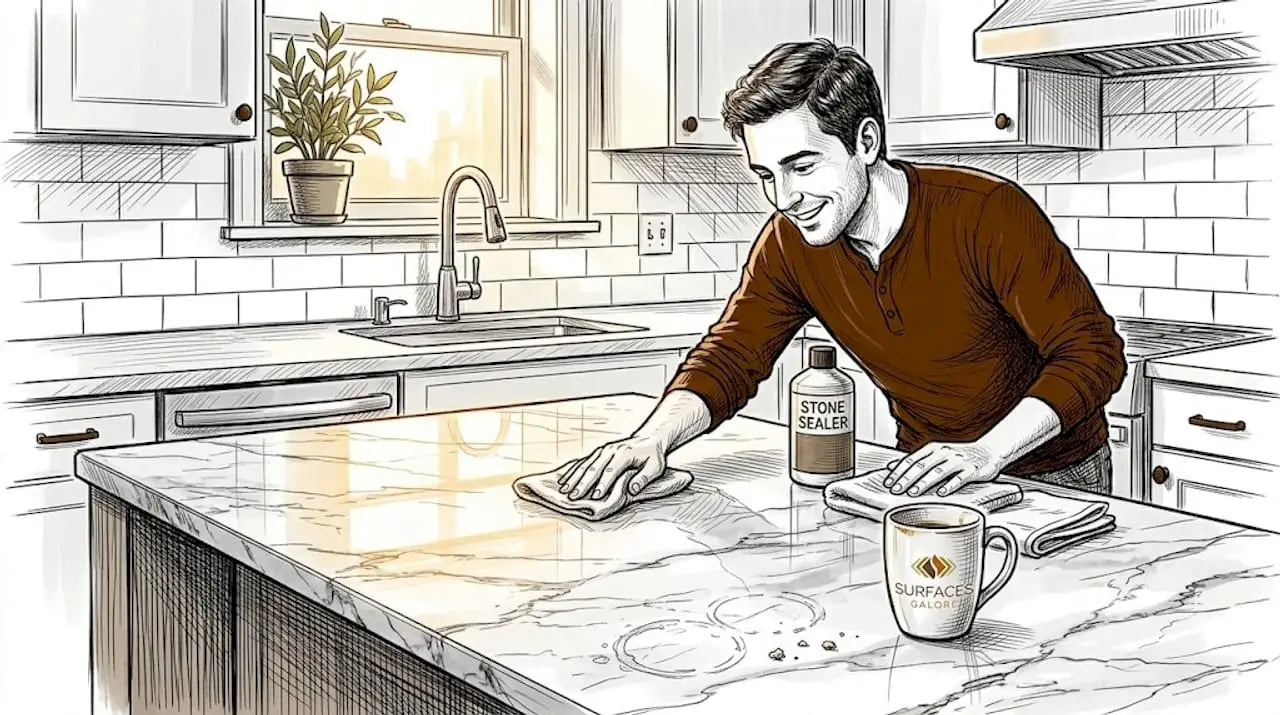
This is why sealing marble tiles matters from day one. Whether your stone is newly installed or several years old, every day without a sealer is a day when something in your kitchen or bathroom could leave a permanent mark.
How sealing protects and extends natural stone’s lifespan
Now that you understand why natural stone is at risk, let’s examine what a quality sealer actually does inside your stone and why that translates into real, measurable benefits.
Here is a simple three-step view of how an impregnating sealer works:
- The sealer absorbs into the stone. Unlike surface coatings that sit on top and peel over time, penetrating sealers soak into the pores and capillary channels of the stone. They become part of the material itself.
- It repels liquids without trapping vapor. Once cured, the sealer creates a hydrophobic (water-repelling) barrier inside the stone that pushes liquids away. But it still allows water vapor to pass through, which prevents pressure buildup that could cause cracking in humid spaces like showers.
- The surface stays breathable and stable. This balance between repelling liquid water and allowing vapor movement is what makes impregnating sealers superior to topical coatings in kitchens and baths, where humidity and heat fluctuate daily.
The results of proper sealing are backed by data. sealed granite lasts 50% longer in high-traffic kitchen environments, according to research from the Natural Stone Institute.
The practical benefits you’ll notice day to day include:
- Far fewer stains. Coffee, red wine, and cooking oils bead up on the surface instead of soaking in, giving you time to wipe them away.
- Much easier routine cleaning. A sealed surface requires less scrubbing because contaminants can’t embed in open pores.
- Better bacterial resistance. Without accessible pores, bacteria have fewer places to hide between cleanings.
- A finish that looks newer, longer. The stone retains its original color depth and polish instead of becoming dull or discolored from absorbed liquids.
For high-moisture areas like showers and tub surrounds, travertine sealer benefits are especially important because travertine’s naturally open, vein-filled structure makes it one of the most absorbent decorative stones available. Following solid marble maintenance tips gives you a structured framework for keeping your stone looking its best year after year, not just in the first months after installation.
Which stones require sealing—and how to test your surface
Understanding the benefits of sealing leads to the natural question: does your stone actually need sealing, and how do you know for sure?
The gold standard in the industry is the absorption benchmark per standards set by the **American Society for Testing and Materials (commonly known as the absorption benchmark per standards set by the **American Society for Testing and Materials)—specifically the absorption benchmark set by the **American Society for Testing and Materials (commonly known as the absorption benchmark set by the American Society for Testing and Materials (commonly known as the test benchmarks). Under the absorption measurement framework, stones with water absorption above 0.20% need sealing, those in the 0.05-0.20% range are optional candidates, and surfaces below 0.05% typically don’t need it.
Here is how common stones compare in practice:
| Stone type | Average absorption rate | Should you seal? | Real-world risk without sealing? Yes or no? | Notes for kitchens or baths? Yes or no? | Real-world risk without sealing? | Kitchen or bath notes?
Let me restructure this table cleanly:
| Stone type | Average absorption | Should you seal? | Real-world risk | Kitchen or bath note?
| Stone type | Average water absorption | Should you seal it? | Real-world risk if unsealed |
|---|---|---|---|
| White marble | 0.50% or higher | Yes, always | High stain and bacteria risk in kitchens |
| travertine | 0.40% or higher | Yes, always | Open veins trap moisture and mold in baths |
| granite | 0.05% to 0.30% | Usually yes | Risk varies heavily by slab and color |
| quartzite | 0.10% to 0.40% | Yes | Often confused with quartz but is fully natural and porous |
| engineered quartz | Less than 0.01% | No | Non-porous; no sealing needed |
| slate and soapstone | Low to moderate | Sometimes | Check individual slabs; manufacturer guides vary |
The quartzite vs. quartz distinction trips up a lot of homeowners. Natural quartzite is a metamorphic rock that forms when sandstone is subjected to heat and pressure. It’s beautiful, durable, and porous. engineered quartz is a manufactured product made mostly from ground quartz bound with resins. It’s non-porous by design and needs no sealing. They sound the same but behave very differently, so always clarify with your supplier which product you’re actually buying.
For a quick at-home check, the DIY water test takes about 15 minutes and tells you a lot. Place a few drops of water on your clean, dry stone surface. If the stone darkens within 10 to 15 minutes, the water is absorbing in and resealing is due. If the water beads up and stays on the surface, your sealer is still doing its job. Understanding how surface preparation connects to sealer performance is also covered well in guides about natural stone finishes and how they affect absorption rates.
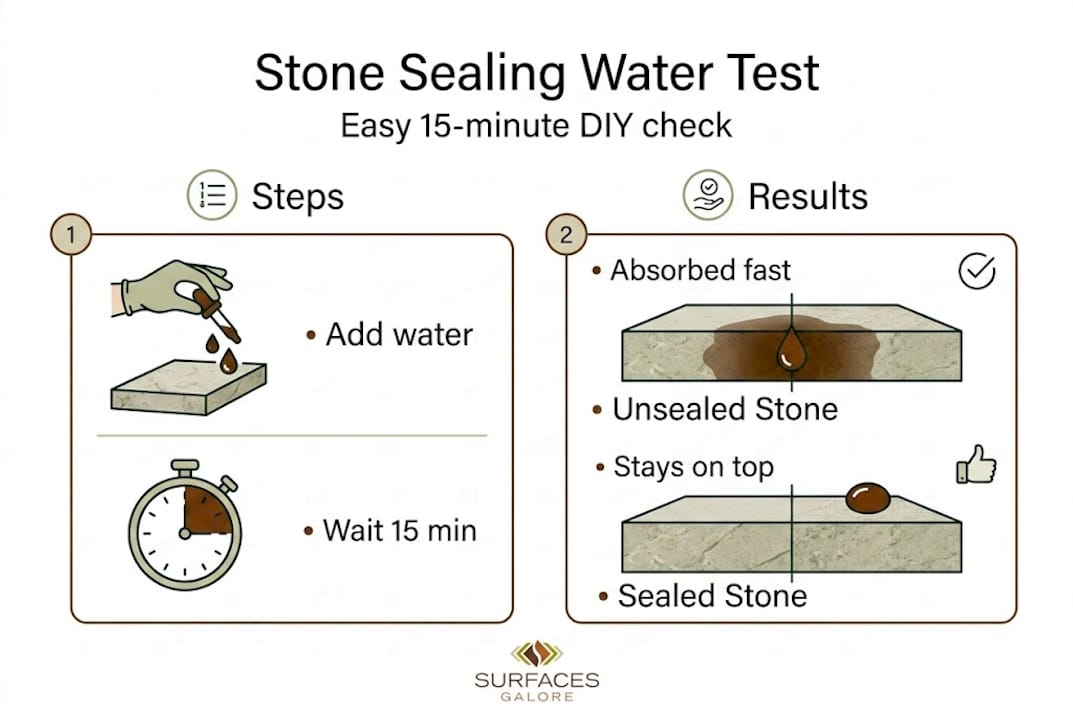
Pro tip: Do not just test one spot on a slab. Test the edges, the center, and near any veining. High-absorption areas often cluster near natural fissures and color variations within the same tile. One result from one spot is not the full picture.
Common pitfalls and best practices for sealing natural stone
Knowing if your stone needs sealing is the first step. The next step is making sure you don’t undermine your own effort with avoidable mistakes.
Here are the most common errors homeowners make when sealing or maintaining natural stone:
- Using topical (surface-only) sealers in wet areas. These coatings sit on top of the stone and look great initially, but they peel, cloud, and trap moisture underneath over time. In showers and near sinks, topical sealers typically fail within one year.
- Using harsh or acidic cleaners. This one is critical. sealers don’t prevent etching from acid damage on marble and limestone. A bleach-based cleaner or vinegar solution will chemically burn the surface of your marble, sealed or not. The sealer protects against liquid absorption, not chemical reactions.
- Not cleaning the surface before sealing. If you apply sealer over a surface with existing soap residue, oil film, or mineral deposits, the sealer bonds to the residue instead of the stone. The result looks fine at first but fails quickly.
- Over-applying sealer. More is not better. Too much sealer on a dense stone creates a hazy film that’s difficult to remove and makes the surface feel sticky or look cloudy.
- Setting and forgetting. A sealer is not a permanent solution. It degrades over time, especially in high-use areas around kitchen sinks and stove surrounds.
PH-neutral cleaners designed specifically for natural stone are not optional. They are the only safe option for day-to-day maintenance, especially on marble, limestone, and travertine. A dedicated tile renovation aftercare plan saves you from the most common damage that happens in the first year after installation.
Pro tip: Run the water test on high-use kitchen and bath areas every six months. Don’t wait for staining to tell you the sealer has failed. A quick test every spring and fall keeps you ahead of the problem, and catching it early means a simple reapplication instead of a costly refinishing job. Building a routine around marble maintenance workflow makes this less of a chore and more of a predictable schedule you can stick to.
Health, safety, and compliance: An overlooked reason to seal
Stone’s appearance is only half the story. In kitchens and baths, hygiene is not a secondary concern. It is the whole point.
When stone surfaces go unsealed in food prep areas, the pores act like tiny reservoirs for bacteria, yeast, and mold spores. You clean the surface, but the microorganisms tucked inside the pores survive. They reproduce. They migrate back to the surface. Standard kitchen wipes and spray cleaners don’t penetrate deep enough to eliminate what’s living inside an open-pored stone.
Here is a direct comparison of sealed vs. unsealed stone across key health and safety metrics:
| Health or safety factor | sealed stone | unsealed stone |
|---|---|---|
| bacterial accumulation | Low; pores blocked by sealer | High; pores provide habitat for bacteria |
| stain resistance | Strong; most liquids bead and wipe off | Poor; oils and pigments absorb in minutes |
| mold risk in baths | Low; water repelled from stone structure | High; constant moisture feeds mold growth |
| ease of daily cleaning | High; smooth, non-porous surface wipes clean | Low; residue builds up in open pores |
| FDA food code compliance | Generally compliant for food contact surfaces | Not compliant in most food service contexts |
| allergen control | Better; fewer trapped particles | Lower; particles and residues embed more easily |
The FDA food safety guidelines for surfaces that contact food require cleanability as a core standard. sealing complies with FDA food codes by reducing bacterial accumulation in pores and improving the surface’s ability to be cleaned to a hygienic standard.
“A properly sealed stone surface in a kitchen meets the practical requirements of FDA guidance on cleanable food contact surfaces—unsealed stone, regardless of how often it’s wiped down, cannot reliably meet those standards because its pore structure inherently traps contaminants.”
This is especially relevant in homes with young children, elderly family members, or anyone with food allergies or compromised immune systems. The benefits extend beyond the countertop. A complete guide to natural stone backsplash care covers how to apply the same principles to vertical surfaces that catch grease and moisture around the stove and sink.
Our take: What most experts overlook about sealing natural stone
Here is what fifteen years of supplying stone to real homes across the country has taught us at sustainable stone practices and beyond: the biggest gap in stone sealing advice is not about chemistry. It’s about mindset.
Most guides tell you to seal once, maybe twice, and move on. What they don’t tell you is that your kitchen counter near the sink will degrade its sealer two to three times faster than the counter near the window. High-use zones need individualized attention, not blanket resealing schedules.
We’ve also seen homeowners invest in premium stone and then hand-pick a sealer based on price alone. That’s a mismatch. A budget sealer on a $4,000 marble island is like putting bargain tires on a luxury car. The stone deserves a sealer that matches its porosity level and intended use, not whatever is on sale at the hardware store.
No two slabs are identical. We say this to every homeowner who walks through our door: test your specific slab, not the species category. The water test is free, takes fifteen minutes, and tells you more than any product description.
DIY sealing works well for smaller surfaces and routine maintenance. But for large kitchen islands, full shower surrounds, and any surface where inconsistent application could mean obvious patchy results, professional application gives you far more consistent coverage and peace of mind. Running a simple water test every six months removes all the guesswork and puts you in control of your stone’s health for the long term.
Ready to protect your investment? Get trusted expertise
You don’t have to tackle your sealing questions alone. At surfaces galore, we’ve spent years helping homeowners and professionals choose the right products and approaches for natural stone in kitchens and baths across the country.
Whether you’re choosing your first sealer, figuring out the right maintenance schedule for your marble countertops, or planning a full renovation with travertine tile throughout, our team is here to help. We carry a curated selection of premium natural stone, and our care guides are built from real installation experience, not just product brochures. Browse our collection, read our maintenance resources, or reach out directly for personalized guidance. Your stone is a long-term investment, and protecting it should never be guesswork.
frequently asked questions
How often should I reseal my kitchen or bathroom natural stone?
Most kitchens and bathrooms need resealing every one to three years, but high-traffic zones and lighter stones often benefit from an annual water test to catch early degradation. For new installs or large areas, professional resealing frequency guidance recommends professional application to ensure even coverage.
Can sealing natural stone prevent all stains and etching?
No. A quality sealer stops most liquid-based stains, but sealers don’t prevent etching from acidic substances on marble or limestone. Clean up spills immediately and use only pH-neutral cleaners.
Do I need to seal engineered quartz surfaces?
No. engineered quartz is non-porous by design and doesn’t require sealing, while true natural quartzite is a porous stone that typically does need regular sealing.
How do I test if my countertop needs sealing?
Apply a few drops of water to a clean, dry surface. If the stone darkens within 10 to 15 minutes, the water is absorbing in and it’s time to reseal. The absorption test per standards backs this as a reliable at-home method between professional assessments.

Leave a comment