
Marble Tile Absorption Rates: What You Need to Know

TL;DR:
- Marble’s water absorption rates vary widely, affecting its durability, staining susceptibility, and suitable locations. Testing with a simple water drop method provides accurate sealing needs, which should be maintained with proper sealing strategies based on absorption levels. Proper management, including informed selection and regular testing, minimizes long-term damage and maintenance costs.
Marble has a reputation for elegance, but its relationship with water is more complicated than most renovation guides admit. Marble tile absorption rates vary dramatically across species, quarry locations, and even individual slabs, and choosing the wrong variety for a moisture-prone space can mean staining, structural damage, and expensive repairs within just a few years. This article walks you through what absorption rates actually measure, how different marble types compare, how to test your tiles before committing to a sealing schedule, and what all of it means for your maintenance decisions.
Table of Contents
- Key takeaways
- Understanding marble tile absorption rates
- Marble types compared by absorption
- How to test tile absorption accurately
- Sealing strategies based on absorption levels
- My take on absorption testing in renovation
- Find marble that fits your project at Surfacesgalore
- FAQ
Key takeaways
| Point | Details |
|---|---|
| Absorption rates vary widely | Marble ranges from 0.1% to 3% absorption, and that spectrum changes everything about care and placement. |
| Crystalline density matters most | Tightly interlocking calcite crystals lower absorption and improve durability in wet, high-traffic areas. |
| Test before you seal | The water drop test tells you exactly when marble needs sealing, better than any calendar schedule. |
| Penetrating sealers win | Impregnating sealers protect without trapping moisture; topical sealers create more problems than they solve. |
| Match marble to the location | Denser varieties like Thassos and Nero Marquina belong in bathrooms and kitchens; more porous types need extra care. |
Understanding marble tile absorption rates
When people talk about marble tile absorption rates, they are referring to how much liquid the stone draws in when exposed to water. This is directly tied to porosity, which describes the percentage of open space within the stone’s internal structure. Higher porosity means more open channels for water to enter. Lower porosity means the crystals are packed tightly enough to limit that movement.
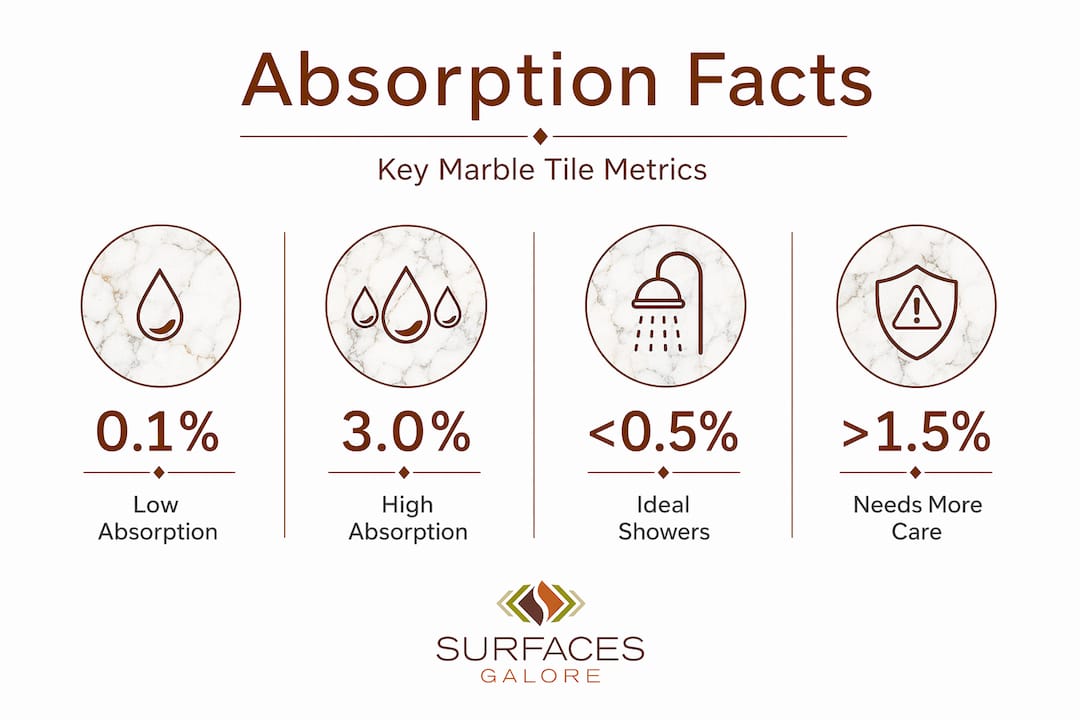
Marble absorption rates span a wider range than most buyers expect. Dense varieties like Emperador and Nero Marquina sit around 0.1% to 0.3%, while some Carrara and Crema Marfil marbles can reach up to 3%. That is not a small difference. A tile absorbing 3% moisture is fundamentally different material from one absorbing 0.1%, even if both look similar in a showroom.
How stone classification works
The tile and stone industry generally classifies stones into three absorption categories:
- Dense or impervious: Below 0.5% absorption. These stones resist most spills without immediate sealing and perform well in wet environments.
- Moderately porous: Between 0.5% and 1.5%. These require sealing and benefit from more frequent maintenance checks.
- Open porous: Above 1.5%. These stones absorb liquid rapidly and need aggressive sealing protocols, particularly in kitchens and bathrooms.
Understanding where your marble falls on this spectrum shapes every decision that follows, from the sealer you choose to how often you need to reapply it.
Absorption does not just affect staining. It also determines how marble handles freeze-thaw cycles outdoors, how quickly efflorescence develops, and how vulnerable the stone is to internal cracking when trapped moisture expands.
The connection between absorption and stain risk is direct. Stones below 0.20% absorption resist most stains if spills are cleaned promptly, while stones above 0.50% are at genuine risk of permanent discoloration without immediate attention and proper sealing. In practical terms, this means a Nero Marquina tile left unsealed but wiped quickly after a coffee spill will likely survive. The same spill on unsealed Crema Marfil may leave a permanent shadow in the stone.
The crystal structure driving these numbers is worth understanding. Marbles with tightly interlocking calcite crystals show lower absorption and better durability in high-traffic and moisture-prone areas. The calcite grain size and how densely those grains are packed determines not just absorption, but also resistance to surface wear and how well the stone holds a polish over time.
Marble types compared by absorption
Not all marble absorbs moisture the same way, and knowing how popular varieties compare helps you make smarter placement decisions before you order a single tile. The table below reflects absorption ranges, typical porosity behavior, and where each type performs best.
| Marble type | Absorption range | Porosity level | Best use case |
|---|---|---|---|
| Thassos | 0.1–0.2% | Very low | Shower walls, wet areas, pools |
| Nero Marquina | 0.1–0.3% | Very low | Bathroom floors, feature walls |
| Emperador Dark | 0.2–0.4% | Low | Kitchen floors, high-traffic areas |
| Carrara | 0.5–1.5% | Moderate | Living areas, sealed bathroom walls |
| Calacatta | 0.5–1.8% | Moderate | Countertops with diligent sealing |
| Crema Marfil | 1.5–3.0% | Higher | Lower-moisture areas or sealed floors |
Carrara and Calacatta are two of the most specced marbles in residential renovation. Both are beautiful, and both sit in the moderate absorption range. This means they are workable in kitchens and bathrooms with proper sealing, but they reward diligence. A designer who selects Calacatta for a kitchen countertop and educates the client about acid sensitivity and sealing schedules will see a great outcome. One who skips that conversation will get callbacks about etching and staining within six months.
Crema Marfil is a different situation. Its warmer tone makes it popular for floors and spa-style bathrooms, but its higher absorption level demands more from the property owner. It needs sealing before installation, again after grouting, and then regular testing to confirm protection is holding.
Pro Tip: If you are speccing marble for a shower floor where bare feet and daily water exposure are the norm, filter your selection to marbles with absorption rates below 0.5%. Thassos and Nero Marquina are your safest choices for minimal long-term maintenance.
One factor that does not show up in absorption tables but matters considerably is how crystalline density influences durability beyond just moisture resistance. Crystalline density is arguably the single most important factor when selecting marble for moisture resistance, more telling than an absorption percentage alone because it speaks to how the stone will hold up structurally over years of thermal cycling and cleaning.
Etching is a separate issue from absorption, and it trips up even experienced designers. Sealing does address staining from oil and water-based liquids. But even sealed marble etches from acidic contact, such as lemon juice or vinegar, within minutes. The clients who are most satisfied with their marble selections are the ones who understood this distinction before the tile was laid.
How to test tile absorption accurately
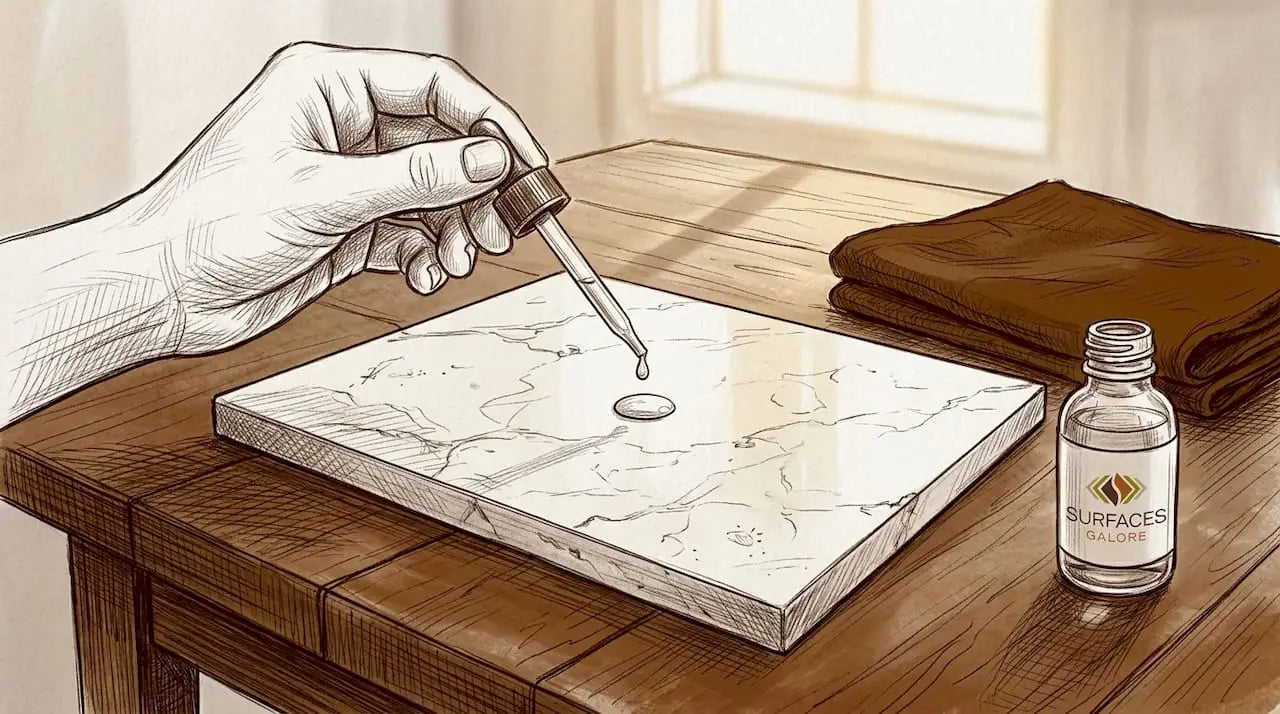
The water drop test is the most reliable method for evaluating how much protection your marble currently has, and it costs nothing. You do not need lab equipment, a professional, or a manufacturer’s schedule. You just need water and a few minutes of attention.
Here is how to run it correctly:
- Clean the surface first. Wipe the tile with a damp cloth and let it dry completely, at least 30 minutes. Testing on a dirty or damp surface gives you a false reading.
- Drop a small amount of water. A quarter-sized pool placed directly on the stone surface is enough. Do not spread it around.
- Watch the clock. Observe what happens over 5 to 15 minutes without wiping or disturbing the water.
- Read the result. If the water beads and stays on the surface, your sealer is still doing its job. If the water darkens the stone beneath it, the sealer has degraded and reapplication is needed immediately.
- Test multiple spots. High-traffic zones, areas near the sink or shower drain, and any spots that see frequent cleaning product contact should each be tested separately. Protection wears unevenly.
The reason the water drop test outperforms calendar-based sealing schedules is simple: it measures actual current conditions rather than an estimate. A marble floor in a household that uses pH-neutral cleaners and sees moderate foot traffic may hold its seal for two years. The same marble in a commercial bathroom with harsh cleaning chemicals may need resealing every four months. No printed schedule captures that variability. The test does.
Pro Tip: Run the water drop test on a new tile before installation, before you apply any sealer. This tells you the baseline absorption level of the specific slab you received, which may differ from published figures for that marble type. Some quarry batches run more porous than others.
Common mistakes when interpreting results include testing too soon after cleaning (surface moisture skews the reading), testing only the most visible area (edges and grout-adjacent zones absorb faster), and assuming a slow darkening means sealing can wait. If you see any darkening within 15 minutes, treat it as an immediate signal rather than a warning you can defer.
Selecting the right sealer type for your absorption reading matters as much as the test itself. Marble with very low absorption rates below 0.3% may actually repel standard sealers, requiring a solvent-based impregnator rather than water-based products. Marble with higher absorption rates drinks in penetrating sealers readily and may benefit from two applications before the stone reaches saturation.
Sealing strategies based on absorption levels
Getting your sealing strategy right is where absorption knowledge translates into real-world protection. The single most important decision is choosing a penetrating impregnating sealer over a topical one. Topical sealers sit on the stone’s surface like a film, which creates three problems: they scratch, they trap moisture beneath the surface when that film breaks, and they cause peeling that is difficult to reverse. A penetrating impregnating sealer absorbs into the stone’s pores, repelling liquid from within rather than creating a barrier on top.
For sealing frequency, the absorption rate and the installation location together determine your schedule:
- Kitchen countertops: Seal every 6 to 12 months regardless of marble type, because daily exposure to food acids and oils accelerates sealer breakdown. Kitchen surfaces see far more chemical stress than floors.
- Bathroom floors: Seal every 12 months for moderate-absorption marble, and every 6 months for high-absorption varieties like Crema Marfil. Constant wet-dry cycling degrades sealers faster than most people expect.
- Living room floors: Seal every 18 to 24 months for low-absorption marble in lower-traffic residential areas.
- Shower walls: Seal before installation and test quarterly. Continuous water exposure is the most demanding condition marble faces indoors.
The biggest mistake property owners make is treating sealing as a one-time task. Marble is a living material in the sense that its relationship with moisture changes based on use, cleaning products, and environmental humidity. A sealing schedule is ongoing, not a box you check at installation.
Humidity cycles also affect marble longevity in ways that go beyond staining. Marble in high-humidity environments like steam showers expands and contracts with temperature shifts. Lower-absorption marble handles these cycles better because less moisture penetrates the crystal structure in the first place. For marble in wet areas, this makes the case for specifying denser varieties even stronger.
One area where property owners frequently go wrong involves sealing over an already-degraded surface without cleaning and stripping old sealer residue first. Layering fresh sealer on top of a broken-down film does not restore protection. It creates an uneven surface that looks cloudy and seals inconsistently. Strip, clean, and start fresh. The marble maintenance routine that actually protects your investment is built on testing first, sealing second, and repeating that cycle based on what the test tells you, not what the calendar says.
Understanding how calcite crystal structure influences sealer penetration also matters here. High-crystallinity marble may need a solvent-based sealer for the product to penetrate effectively. Lower-crystallinity marble, with its more open pore structure, accepts water-based sealers more readily. Matching sealer chemistry to stone type is a step most homeowners skip, but it is what separates a seal job that lasts 18 months from one that lasts six.
My take on absorption testing in renovation
Cihan here, and I want to say something that most marble guides will not: the damage I have seen from absorption mismanagement almost always came from skipped testing, not from choosing the “wrong” marble.
I have watched beautiful Calacatta installations turn into client complaints within a year, not because the stone failed, but because nobody ran a single water drop test after installation. The sealer degraded in the first two months from cleaning product exposure, and by month four the stone was drinking in oil from cooking. The marble was fine. The process broke down.
What surprises me most is how few designers build absorption testing into their post-installation handoff. A five-minute test demonstration at project completion changes the entire client relationship. Property owners who understand what the water drop test tells them feel in control of their investment. They test every few months, reseal when the result calls for it, and they almost never call back with damage claims.
The other thing I have learned is that proper marble selection based on absorption and crystallinity genuinely reduces long-term maintenance costs. Specifying Thassos for a client’s steam shower rather than their first-choice Carrara is a harder conversation upfront, but it saves them from years of quarterly sealing and the risk of water intrusion behind the tile. That conversation, grounded in actual absorption data, is what distinguishes an informed recommendation from a beautiful one that fails.
Test the stone. Know the numbers. Make the call with real information.
— cihan
Find marble that fits your project at Surfacesgalore
At Surfacesgalore, every marble tile in our catalog comes from direct import sources, so you know exactly what you are getting. Whether you need a low-absorption Thassos for a wet-area shower floor or a Calacatta for a kitchen countertop you plan to seal diligently, our collections are organized to help you match the stone to the space. Explore our natural stone tile collections and browse resources covering sealing, maintenance, and marble care. If you want expert sealing guidance alongside your tile selection, that information is ready for you too. Shop with confidence knowing Surfacesgalore ships nationwide to homeowners, designers, and contractors.
FAQ
What is a good water absorption rate for marble tiles?
Marble tiles with absorption rates below 0.5% are well suited for wet and high-traffic areas. Rates between 0.5% and 1.5% are workable with regular sealing, and anything above 1.5% requires careful placement and aggressive maintenance.
How do I test my marble tile’s absorption at home?
Place a small drop of water on a clean, dry tile and watch it for 5 to 15 minutes. If the stone darkens where the water sits, sealing is needed immediately. If the water beads, your current sealer is holding.
How often should marble tiles be sealed?
Kitchen countertops generally need sealing every 6 to 12 months, while floors need sealing every 1 to 2 years depending on traffic and marble type. The water drop test gives you the most accurate timing rather than any fixed schedule.
Does sealing marble prevent etching?
No. Sealing addresses staining from liquid absorption, but etching is a chemical reaction between acids and the calcite in marble. Lemon juice, vinegar, and other acids etch sealed marble just as they would unsealed stone.
Which marble type is best for bathrooms and showers?
Thassos and Nero Marquina are among the best choices for wet areas because of their very low absorption rates and high crystalline density. Both require sealing but hold up well under constant moisture exposure.

Leave a comment