
Choose the Right Marble Tile: Understanding the Hardness Scale

TL;DR:
- Marble’s durability varies based on its mineral composition and Mohs hardness scale.
- Softer marbles (Mohs 3-3.5) are suitable for decorative spaces, while harder ones (Mohs 4-4.5) perform better in high-traffic areas.
- Proper selection, sealing, and maintenance are essential for maximizing marble tile longevity.
Not all marble tiles are created equal, and assuming they are is one of the most expensive mistakes a homeowner or designer can make. Marble is a natural stone, and its durability varies significantly depending on its mineral composition. The marble tile hardness scale is the single most practical tool for predicting how a tile will perform in your specific space. Whether you’re planning a kitchen renovation, a bathroom remodel, or a grand entryway, knowing where your chosen marble falls on this scale helps you avoid costly replacements and disappointing results. This guide will walk you through what the scale means, how popular marble varieties compare, and how to match hardness to your project needs.
Table of Contents
- What is the marble tile hardness scale?
- How do different marble types compare on the hardness scale?
- Why hardness matters: Practical impacts on durability and use
- Marble tile hardness vs other materials: Making the right choice
- Tips for selecting and maintaining marble tiles by hardness
- The overlooked truth about marble tile hardness
- Explore premium marble tile options with Surfaces Galore
- Frequently asked questions
Key Takeaways
| Point | Details |
|---|---|
| Mohs scale basics | The Mohs scale rates marble tiles’ scratch resistance, typically 3 to 5 for most varieties. |
| Type matters | Different marble types vary in hardness, affecting their ideal use in your home. |
| Consider maintenance | Softer marbles require more care, but proper maintenance extends their beauty and life. |
| Marble vs. alternatives | Marble is softer than granite and some ceramics, influencing durability in busy areas. |
| Smart selection | Choose marble tile hardness based on where and how it will be used for the best long-term results. |
What is the marble tile hardness scale?
The marble tile hardness scale refers primarily to the Mohs hardness scale, a system developed by German mineralogist Friedrich Mohs in 1812. It ranks minerals from 1 to 10 based on their resistance to being scratched. A mineral with a higher number can scratch any mineral below it. Talc sits at 1 (the softest), while diamond sits at 10 (the hardest).
The Mohs scale classifies minerals by their resistance to scratching, which is exactly why it’s the go-to reference for tile buyers and architects. Marble, being a metamorphic rock made largely of calcite, typically falls between 3 and 5 on this scale. That puts it in the mid-low range, softer than granite but harder than limestone.
Here’s a quick reference table to put marble in context:
| Mineral / Material | Mohs Hardness |
|---|---|
| Talc | 1 |
| Gypsum | 2 |
| Marble (typical range) | 3 to 5 |
| Feldspar | 6 |
| Quartz | 7 |
| Topaz | 8 |
| Diamond | 10 |
To check a tile’s hardness rating before purchasing, follow these steps:
- Ask your supplier for the specific Mohs rating of the marble variety you’re considering.
- Cross-reference the marble type with known ratings in published stone guides.
- Request a physical sample and test it with a steel knife blade (Mohs 5.5) to see if it scratches easily.
- Check the finish: polished surfaces show scratches more than honed or brushed finishes.
- Confirm the rating matches your intended use case (high traffic vs. decorative).
Understanding these numbers is the foundation for every smart marble purchase. A tile that looks stunning in a showroom can underperform badly in a busy kitchen if the hardness isn’t right for that environment.
How do different marble types compare on the hardness scale?
Now that you know how the scale works, let’s compare some popular marble types you might encounter. Not all white marbles are the same, and the differences go well beyond appearance.
Different marbles have varying Mohs ratings; for example, Carrara is softer than Calacatta, a fact that surprises many first-time buyers who assume both are interchangeable.
Here’s how some of the most popular varieties stack up:
| Marble Type | Mohs Hardness | Best Use |
|---|---|---|
| Carrara | 3 to 3.5 | Bathrooms, low-traffic areas |
| Calacatta | 3.5 to 4 | Feature walls, countertops |
| Statuario | 3.5 to 4 | Accent walls, decorative use |
| Crema Marfil | 3 to 4 | Flooring, residential spaces |
| Nero Marquina | 4 to 4.5 | Kitchens, higher-traffic floors |
When exploring the best marble varieties for your project, it helps to think about traffic levels first and aesthetics second. Nero Marquina, for instance, is one of the more durable options because of its denser mineral composition.
For a full marble types guide, there are dozens of varieties with distinct characteristics worth reviewing before you commit.
Here’s a quick breakdown of hardness considerations:
- Softer marbles (3 to 3.5): Beautiful veining, but require sealing and gentle cleaning. Best for walls, powder rooms, and decorative accents.
- Mid-range marbles (3.5 to 4): Good balance of beauty and function. Suitable for residential floors and countertops with regular maintenance.
- Harder marbles (4 to 4.5): More resistant to everyday wear. Better candidates for kitchen floors and entry areas.
Softer marble is not a bad choice. In spa-style bathrooms or feature walls where aesthetics rule and foot traffic is minimal, a softer, more dramatically veined marble can be the star of the entire design.
Why hardness matters: Practical impacts on durability and use
After comparing marbles, it’s critical to understand how hardness truly impacts everyday performance. A tile that rates a 3 on the Mohs scale will behave very differently under a busy kitchen than one that rates a 4.5.
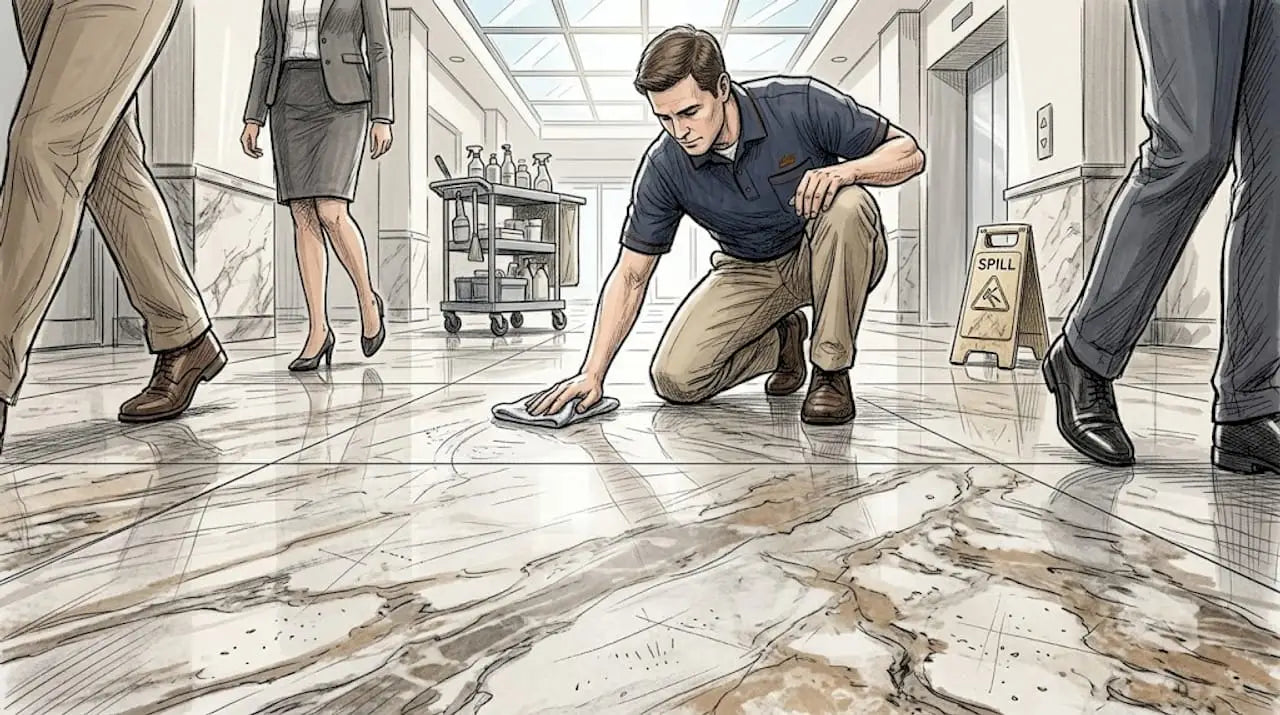
Marble hardness affects maintenance and longevity in both homes and commercial applications. Softer marble scratches more easily from grit tracked in on shoes, furniture legs, and even the drag of a heavy pot across a countertop.
Before choosing a hardness rating, weigh these factors:
- Traffic volume: Entryways and kitchens see the most wear. Choose harder marble or plan for frequent resealing.
- Moisture exposure: Bathrooms and wet areas require sealing regardless of hardness.
- Cleaning habits: Acidic cleaners damage marble at any hardness. Neutral pH products are non-negotiable.
- Subfloor stability: A flexing subfloor causes cracks in any marble, regardless of hardness.
- Finish type: Honed finishes hide scratches better than polished surfaces on softer marble.
“The beauty of marble is inseparable from its care. The harder the marble, the more forgiving it is to daily life. But no marble is maintenance-free.”
For real inspiration on how hardness plays out in actual spaces, look at real-world marble installations to see how professionals manage softer marbles successfully through thoughtful design choices.
Pro Tip: Seal all marble tiles before use and reseal annually in high-traffic or wet areas. For softer marbles (Mohs 3 to 3.5), consider a penetrating sealer for deeper protection. Reliable cleaning marble tips can also help you avoid the most common surface damage mistakes.
Marble tile hardness vs other materials: Making the right choice
If you’re considering alternatives or mixed materials, here’s how marble stacks up. The comparison often surprises people because the differences are more nuanced than “hard is better.”
Compared to ceramic and granite, marble falls in the midrange of the Mohs scale, affecting its suitability for high-traffic zones in ways that matter deeply for practical planning.
| Material | Mohs Hardness | Scratch Resistance | Aesthetic Flexibility |
|---|---|---|---|
| Marble | 3 to 5 | Moderate | Very high |
| Ceramic | 5 to 7 | High | High |
| Porcelain | 6 to 7 | Very high | High |
| Granite | 6 to 7 | Very high | Moderate |
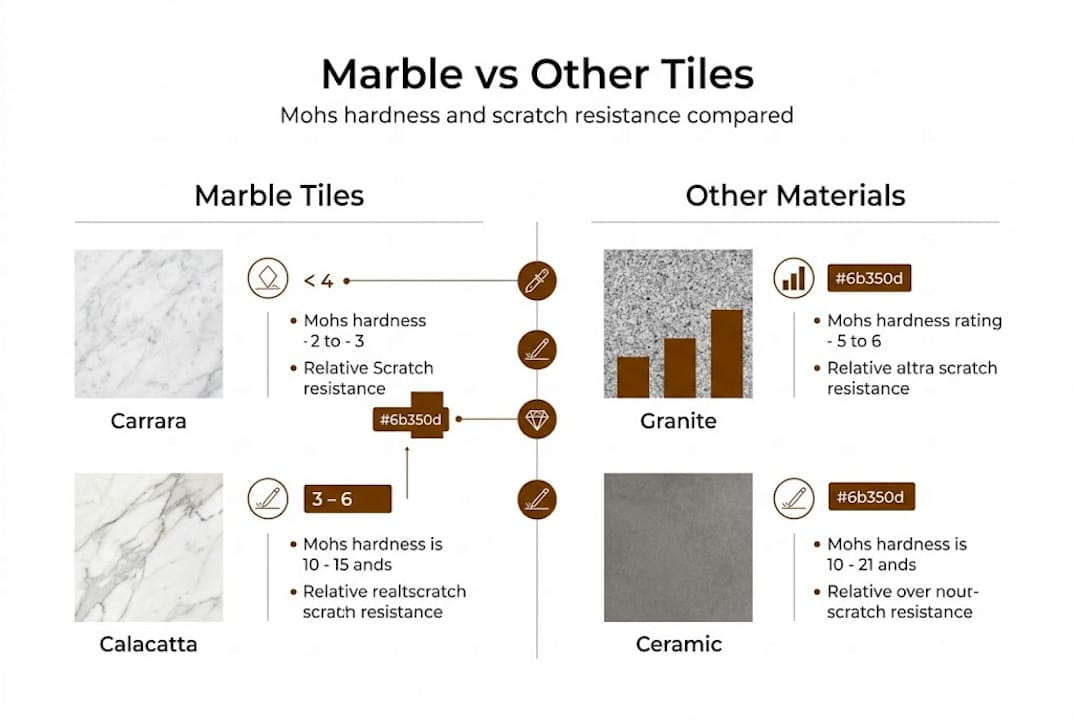
For other surface choices beyond the basics, there’s a wide world of materials worth exploring depending on your project goals.
Here’s when to choose each:
- Choose marble when aesthetics, uniqueness, and warmth are top priorities in lower-traffic spaces.
- Choose porcelain or ceramic when durability and low maintenance in busy areas matter most.
- Choose granite for kitchen countertops where both hardness and heat resistance are needed.
- Mix marble and ceramic in a bathroom where marble tiles cover walls and a harder ceramic covers the shower floor.
Pro Tip: For marble in luxury kitchens, use marble as a backsplash or island top rather than the main floor tile. You get the aesthetic impact of marble where it shines without exposing it to the harshest foot traffic. For budget-conscious buyers, check out affordable marble tiles to find options that balance cost and hardness.
Tips for selecting and maintaining marble tiles by hardness
To wrap up, here’s how you can confidently select and care for marble based on its hardness. This is where knowledge becomes action.
Proper maintenance extends the life of marble, especially based on its hardness rating. A soft marble that’s well-maintained will outlast a harder marble that’s neglected.
Follow these steps when selecting your marble:
- Define your space first: Is it a bathroom, kitchen, or decorative wall? Traffic level drives your hardness minimum.
- Request hardness data: Any reputable supplier can tell you the Mohs rating of a specific tile.
- Match finish to hardness: Softer marble works better with a honed finish to disguise everyday wear.
- Plan your maintenance budget: Softer tiles need more frequent sealing and gentler products.
- Test before committing: Get a sample, live with it in the actual space for a few days under real lighting.
For marble installed in wet environments, specific guidance on marble in wet areas can help you select the right variety and finish to prevent slipping and water damage.
Pro Tip: For floors, reseal softer marble every 6 to 12 months. For walls and low-touch surfaces, every 2 to 3 years is usually enough. Learning how to clean marble floors properly is just as important as choosing the right tile in the first place. Never use vinegar, lemon juice, or any acidic cleaner on marble at any hardness level. These will etch the surface and dull the finish permanently.
The overlooked truth about marble tile hardness
Here’s what most guides won’t tell you: obsessing over hardness scores alone can lead you to the wrong marble for your project. We’ve seen homeowners pass up genuinely beautiful, perfectly appropriate marble because it rated a 3.5 instead of a 4. That’s like choosing a car based on engine specs while ignoring whether it fits in your garage.
Experienced designers often prioritize look, feel, and maintenance compatibility over raw hardness numbers. A Carrara marble bathroom that’s sealed properly and cleaned with the right products will look stunning for decades. Meanwhile, a harder marble installed with poor grout choices and acidic cleaners will degrade faster than anyone expected.
The real skill in marble selection is understanding the full picture. Hardness is one input, not the only input. Budget, lifestyle, cleaning habits, and the aesthetic vision for the space all weigh equally. If you’ve ever seen truly elegant marble installations in design magazines, most of them use softer marbles chosen for their dramatic veining and managed beautifully through consistent care. Let the hardness scale inform your decision, not make it for you.
Explore premium marble tile options with Surfaces Galore
Putting this knowledge into practice starts with having access to the right stone. At Surfaces Galore, we work directly with quarries to bring you premium natural marble at prices that make quality accessible, whether you’re a homeowner planning a single bathroom or a designer outfitting an entire residence.
Our team understands the marble tile hardness scale inside and out, and we’re here to help you match the right variety to your specific project. Browse our premium marble tile selection and connect with our stone specialists for personalized guidance. We ship nationwide from Anaheim, California, so your perfect tile is never out of reach. Start your project with confidence.
Frequently asked questions
What is the standard Mohs hardness rating for marble tiles?
Most marble tiles have a Mohs rating of 3 to 5, making them moderately resistant to scratching compared to harder stones like granite.
Is a higher hardness rating always better for marble tiles?
Not necessarily. Choosing the right hardness depends on room usage and design priorities, and softer marbles are perfectly suitable for low-traffic or decorative spaces with proper care.
How does marble hardness compare to ceramic or granite tiles?
Granite and some ceramics have higher Mohs hardness than most marbles, which means marble requires more mindful placement and maintenance in very busy areas.
Can sealing marble tiles improve their hardness?
Sealing protects marble surfaces from stains and minor damage, but it does not increase the tile’s actual Mohs hardness rating.

Leave a comment