
What Is Bullnose Edge? A Homeowner's Design Guide

TL;DR:
- A bullnose edge is a rounded, convex profile applied to tiles or countertops to eliminate sharp corners and enhance durability. It comes in full and half variants, with the former rounding both edges and the latter only the top, suited for most countertop applications. The profile adds a classic, warm aesthetic ideal for traditional or transitional designs while improving safety and longevity in wet or high-traffic areas.
A bullnose edge is a rounded, convex profile applied to the exposed edge of a tile or countertop surface, creating a smooth, semicircular curve that eliminates sharp 90-degree corners. You will find this finish on kitchen countertops, bathroom vanities, shower niches, and backsplash terminations where a raw tile edge would otherwise be left exposed. The profile serves two purposes at once: it protects against chipping and injury, and it delivers a clean, finished appearance that reads as intentional rather than incomplete. Natural stone materials like marble, travertine, and limestone are especially well-suited to this treatment because their density holds the curve without fracturing.
What is bullnose edge, and what are the main types?
The bullnose edge definition, in both tile and countertop fabrication, refers to a profile where the exposed edge is shaped into a smooth, continuous curve rather than left as a flat, angular cut. The term comes from the construction world, where bullnose describes any broad convex radius applied to a building material. In tile work, it most often refers to a purpose-made trim tile with one factory-finished rounded edge, while in countertop fabrication it describes a profile cut directly into the stone slab.
Understanding the types matters because the wrong choice creates a visual mismatch that is difficult to correct after installation.
Full bullnose vs. half bullnose
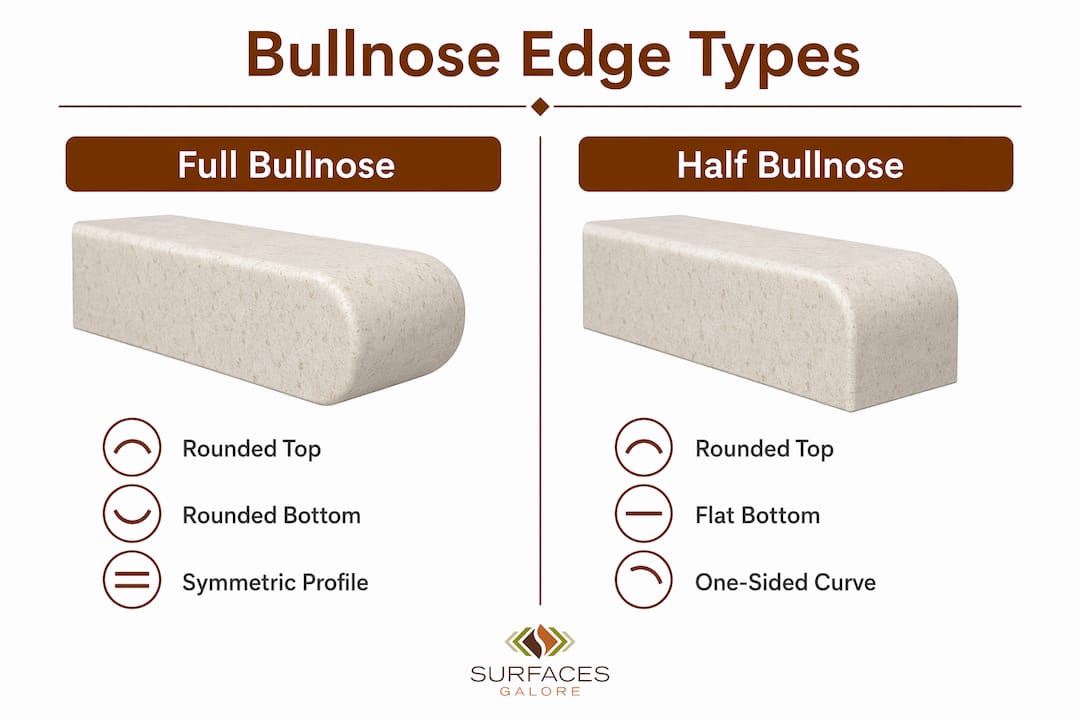
The two primary variants are full bullnose and half bullnose. A full bullnose rounds both the top and bottom edges of the slab, producing a symmetrical half-circle profile when viewed from the side. This creates a softer, more sculpted look but requires more material removal during fabrication, which adds to labor cost. A half bullnose rounds only the top edge while leaving the bottom flat or slightly eased. It is the more common choice for kitchen countertops because it sits cleanly against cabinet faces and costs less to produce.
For tile work, the distinction plays out differently. A surface bullnose tile has a glazed, rounded edge on one side and is used to cap the end of a tile run. A corner bullnose, sometimes called an L-shaped corner piece, wraps around an outside corner so both visible faces are finished. Renovators must identify exact profile variants such as quarter bullnose or radius bullnose when matching existing installations, because even a slight difference in curve radius creates a visible seam.
Pro Tip: Before ordering bullnose trim tiles, bring a sample of your field tile to the supplier. Glaze batches vary between production runs, and a color match on screen is rarely accurate enough for grout-line-level precision.
| Edge type | Profile shape | Best application |
|---|---|---|
| Full bullnose | Rounded top and bottom, symmetrical half-circle | Freestanding countertop islands, furniture-style vanities |
| Half bullnose | Rounded top, flat bottom | Standard kitchen countertops against cabinetry |
| Surface bullnose tile | One factory-rounded glazed edge | Backsplash terminations, shower niche edges |
| Corner bullnose tile | Two finished faces, L-shaped | Outside wall corners, step nosings |
| Quarter bullnose | Subtle quarter-round curve | Transitional profiles, thinner tile applications |
How does bullnose edge appearance shape kitchen and bathroom design?
The visual effect of a bullnose edge is softer and more traditional than most other profiles. Bullnose’s convex shape creates a continuous curve that visually softens the edge line, giving surfaces a more approachable, classic feel that designers associate with transitional and traditional home styles. If your kitchen leans toward Shaker cabinetry, subway tile, or warm natural stone, a bullnose edge reinforces that language. If your bathroom features clean-line fixtures and large-format porcelain, a bullnose may feel out of place.
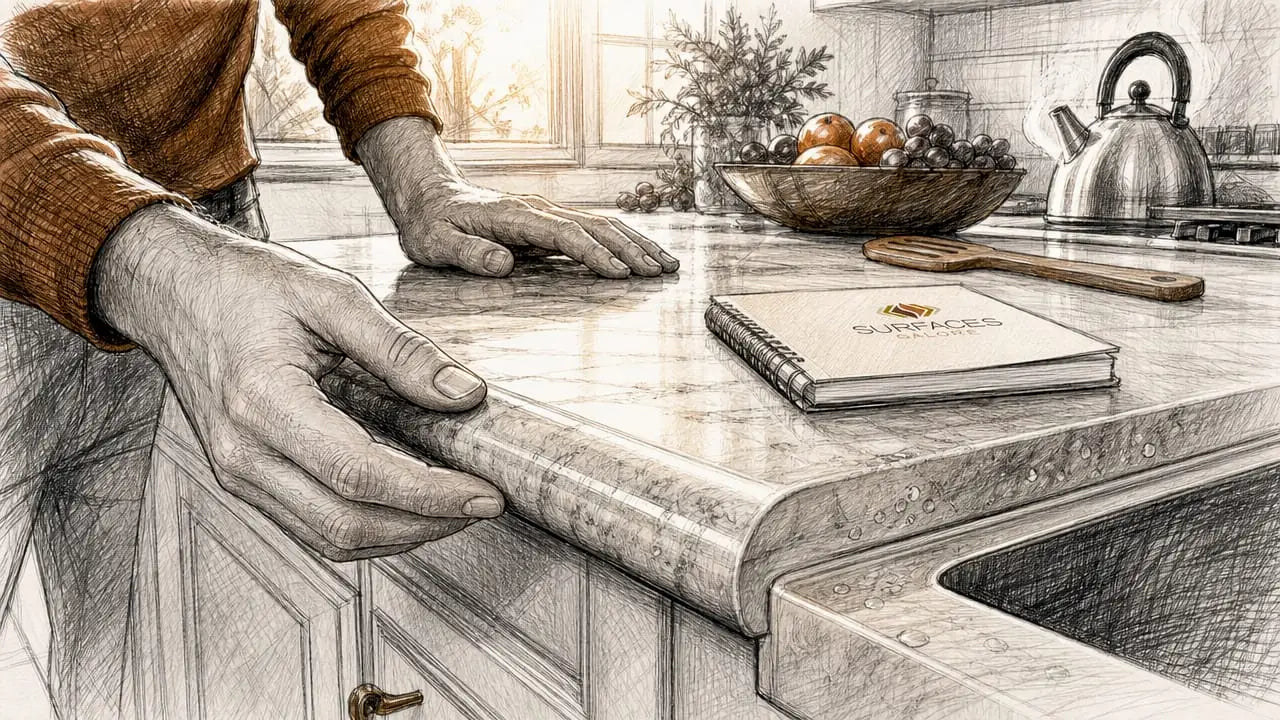
Light behavior is one of the most underappreciated aspects of edge selection. A full bullnose produces a softer, more diffused reflection along the curve, while an eased or square edge shows a sharper shadow line. In a kitchen with under-cabinet lighting or a bathroom with wall sconces, that difference becomes visible every day. The bullnose curve scatters light gently, which makes marble veining and travertine texture read as warmer and more organic.
Here is how the bullnose edge appearance compares with other common profiles in practical design terms:
- Bullnose vs. eased edge: An eased edge keeps a square body with a slight round-over to reduce chipping. It reads as modern and minimal. Bullnose has a more pronounced arc that reads as classic and warm.
- Bullnose vs. square edge: A square edge is the sharpest and most contemporary option. It suits ultra-modern kitchens but chips more easily on natural stone and poses a greater safety risk.
- Bullnose vs. ogee or dupont: Ogee and dupont profiles are more ornate, with S-curves or stepped details. Bullnose sits between the minimal eased edge and the decorative ogee in terms of visual complexity.
- Bullnose on natural stone: Marble and limestone carry the bullnose profile particularly well because their crystalline surfaces catch diffused light along the curve. Travertine’s natural pitting adds texture that makes the rounded edge feel handcrafted rather than machined.
Choosing a bullnose edge aligns better with traditional or transitional home designs compared to modern, minimal eased edges. That is not a limitation. It is a design signal. If your renovation goal is warmth, approachability, and timeless character, the bullnose edge delivers that consistently.
What are the practical benefits of a bullnose edge for tiles and countertops?
The safety argument for bullnose edges is straightforward. Rounded profiles reduce sharpness relative to square 90-degree edges, which matters in kitchens where you brush past countertops dozens of times a day and in bathrooms where wet surfaces increase the risk of a stumble. Families with young children consistently prioritize this profile for exactly that reason.
Beyond safety, the practical benefits of a bullnose edge extend to durability and maintenance.
- Reduced corner chipping. Sharp square corners on natural stone are the first point of failure. A rounded profile distributes impact force across a broader surface area, so a bump from a pot or a dropped item is far less likely to fracture the edge.
- Easier cleaning. Grout lines and dirt accumulate in corners and crevices. The smooth curve of a bullnose edge gives bacteria and grime fewer places to hide, which matters in both kitchen food-prep zones and bathroom wet areas.
- Protection of raw tile ends. Bullnose tile trims protect exposed cut edges from moisture infiltration and mechanical damage at transitions like countertop edges, backsplash terminations, and shower niches. An unfinished tile edge in a wet area will eventually delaminate or crack.
- Longer installation lifespan. Bullnose trims are not only decorative. They increase installation longevity by protecting vulnerable edges from chipping and damage, which reduces the frequency of costly repairs.
- Comfort in daily use. A rounded edge simply feels better under your hands and forearms when you lean against a countertop. Over years of daily use, that tactile difference is not trivial.
Pro Tip: In shower installations, always use a factory-finished bullnose tile trim rather than a field-cut edge. A cut edge in a wet area, even when sealed, is a long-term moisture risk. The factory glaze on a bullnose trim tile is continuous and impermeable.
The benefits of bullnose edge profiles are most pronounced in high-traffic areas. A kitchen island that seats four people, a master bathroom vanity used twice daily, or a hallway with a tiled wainscot all see enough contact to make edge durability a real financial consideration, not just an aesthetic one.
How to select and install bullnose trims for your renovation
Selecting the right bullnose trim starts with your field tile. The trim must match the field tile in thickness, color, finish, and ideally in production batch. Natural stone tiles from the same quarry lot will have consistent veining and tone. Ceramic and porcelain tiles from the same manufacturer line will share glaze chemistry. Mixing sources is the most common mistake DIYers make, and it produces a finish line that looks like an afterthought.
Here is a practical framework for selecting and coordinating bullnose edges in a home renovation:
- Match thickness first. A bullnose trim that is thicker or thinner than your field tile creates a ledge at the transition. For natural stone, this is especially visible because the material is often 3/8 inch to 3/4 inch thick depending on the cut.
- Confirm the profile radius. Not all bullnose curves are the same. A tight quarter-round and a full half-circle are both called bullnose in common usage, but they look different side by side. Ask your supplier for a physical sample.
- Consider the substrate. Bullnose tile trims provide a clean finish at transitions, but the substrate behind the edge must be solid. A hollow or unsupported edge will flex and crack the grout line over time regardless of how good the trim tile is.
- Choose finish consistently. A honed marble field tile paired with a polished marble bullnose trim will catch light differently and look mismatched. Match finish to finish: honed to honed, polished to polished.
- Plan for outside corners. If your installation has an outside corner, you need a corner bullnose piece, not just a standard surface bullnose. Order these pieces before installation begins because they are often a special-order item with a longer lead time.
For selecting tile trims that deliver long-term results, the material choice matters as much as the profile. Ceramic bullnose trims are affordable and widely available but chip more easily than porcelain or natural stone equivalents. Porcelain bullnose trims offer excellent hardness and are suitable for floor applications. Natural stone bullnose trims, particularly marble and travertine, provide the most cohesive result when used with natural stone field tiles because the veining and texture continue across the edge rather than stopping abruptly.
| Material | Durability | Best use case | Cost range |
|---|---|---|---|
| Ceramic | Moderate | Backsplash, low-traffic walls | Low |
| Porcelain | High | Floors, countertops, wet areas | Moderate |
| Marble | High | Vanities, feature walls, countertops | Moderate to high |
| Travertine | High | Shower niches, flooring transitions | Moderate to high |
| Limestone | Moderate to high | Bathroom walls, decorative edges | Moderate |
When to hire a professional is a question worth answering directly. DIY installation of bullnose tile trims on a backsplash is manageable for anyone with basic tiling experience. Fabricating a bullnose edge on a natural stone countertop slab requires a wet saw with a profile bit, a steady hand, and experience with stone behavior. If you are working with marble or travertine countertops, professional fabrication is the right call. The material cost alone makes the risk of a DIY error too high.
For a deeper look at how edge profiles fit into a full tile design plan, the bathroom tile design workflow guide at Surfacesgalore walks through edge selection as part of a complete renovation sequence.
Key takeaways
A bullnose edge is the most practical and visually forgiving edge profile for natural stone tile and countertop installations in traditional and transitional home designs.
| Point | Details |
|---|---|
| Bullnose edge definition | A rounded, convex semicircular profile that eliminates sharp corners on tiles and countertops. |
| Two primary types | Full bullnose rounds both edges symmetrically; half bullnose rounds the top only and suits most countertop applications. |
| Design alignment | Bullnose profiles suit traditional and transitional styles; eased or square edges suit modern, minimal interiors. |
| Safety and durability | Rounded edges reduce injury risk, resist chipping, and protect raw tile ends from moisture damage in wet areas. |
| Selection rule | Match trim to field tile in thickness, finish, and production batch to avoid visible mismatches at the edge line. |
Why bullnose edges still earn their place in 2026 renovations
I have seen a lot of edge profiles come in and out of favor over the years, and the bullnose is the one that keeps returning. Right now, in 2026, there is a strong pull toward warmer, more tactile interiors after a decade of cold minimalism. Homeowners are choosing honed marble over polished, travertine over porcelain, and warm wood tones over lacquered white. The bullnose edge fits that direction perfectly. It is the edge profile that says “this was made with care” rather than “this was cut to spec.”
What I find most interesting is how often people underestimate the edge as a design decision. They spend weeks selecting the right tile and then treat the edge as an afterthought. The edge is the last thing you see when you look at a countertop or a tiled wall. It is the detail that separates a finished renovation from a professional one.
One misconception I encounter regularly is that bullnose edges are only for traditional kitchens. That is not accurate. A honed Calacatta marble countertop with a half bullnose edge reads as quietly refined in a transitional kitchen. The curve does not have to announce itself. When the radius is subtle and the material is high quality, the bullnose edge simply looks like the surface was finished properly.
My honest advice: if you are working with natural stone and you are not sure which edge to choose, start with a half bullnose. It is the most forgiving profile across style directions, the most practical for countertop-to-cabinet transitions, and the easiest to maintain. You can always move toward a more decorative profile on a future project once you have lived with the result.
For anyone exploring marble bullnose edges specifically, the durability advantages in bathroom settings are worth understanding before you commit to a profile.
— cihan
Discover natural stone bullnose tiles at Surfacesgalore
Surfacesgalore specializes in premium marble, limestone, and travertine tiles with matching bullnose trim pieces that coordinate perfectly with field tiles from the same natural stone collections.

Whether you are finishing a kitchen countertop, capping a backsplash, or detailing a shower niche, Surfacesgalore carries the profiles and materials to complete the job with the quality that natural stone deserves. Browse the full range of natural stone tile edging options, or shop the 2026 collections directly at Surfacesgalore to find marble, travertine, and limestone bullnose trims shipped nationwide from Anaheim, California.
FAQ
What is a bullnose edge in simple terms?
A bullnose edge is a smooth, rounded edge profile applied to tiles or countertops that curves from the top surface down to eliminate a sharp corner. It is used to finish exposed edges cleanly and safely.
What is the difference between full bullnose and half bullnose?
A full bullnose rounds both the top and bottom of the edge into a symmetrical half-circle, while a half bullnose rounds only the top edge and leaves the bottom flat. Half bullnose is more common for kitchen countertops because it sits flush against cabinet faces.
Is a bullnose edge suitable for natural stone tiles?
Yes. Natural stone materials like marble, travertine, and limestone hold a bullnose curve well due to their density, and the rounded profile shows off veining and texture along the edge. Factory-finished bullnose trim tiles in natural stone are the most durable option for wet areas.
How does a bullnose edge compare to an eased edge?
A bullnose has a more pronounced, full rounded arc that reads as classic and warm. An eased edge keeps a square body with only a slight corner softening, which reads as modern and minimal. The choice depends on your overall interior style direction.
Can a DIYer install bullnose tile trims?
Installing bullnose trim tiles on a backsplash or wall is manageable for an experienced DIYer. Fabricating a bullnose profile on a natural stone countertop slab requires professional equipment and experience, and the cost of the material makes professional fabrication the safer choice.

Leave a comment