
What Is Engineered Marble? Design Impact Explained

Selecting the right marble material can make or break a luxury project in cities like Los Angeles and San Francisco. For designers and architects meeting California clients’ demands for lasting beauty, understanding the difference between engineered and natural marble is vital. Engineered marble stands out as a composite material made of crushed stone bound together by resin, offering uniform aesthetics and impressive durability. This guide helps you navigate key features, design benefits, and practical considerations for luxury residential and commercial spaces.
Table of Contents
- Engineered Marble Defined And Debunked
- Composition, Manufacturing, And Key Qualities
- Types Of Engineered Marble Surfaces
- Primary Applications In Luxury Design
- Engineered Vs Natural Marble: Costs And Care
Key Takeaways
| Point | Details |
|---|---|
| Engineered Marble Composition | Engineered marble consists of over 90% crushed stone and 7-10% resin, offering durability and consistency but lacking natural stone’s uniqueness. |
| Cost and Maintenance Advantages | Engineered marble generally has lower upfront costs and requires no sealing, while natural marble faces higher maintenance demands. |
| Visual Consistency vs. Authenticity | Engineered marble provides a uniform look, appealing for modern designs, but might not satisfy clients seeking the authenticity of natural stone. |
| Health and Safety Considerations | Silica dust exposure during the fabrication of engineered marble poses respiratory risks, highlighting the importance of understanding the supply chain. |
Engineered Marble Defined and Debunked
Engineered marble is not marble at all in the traditional sense. It’s a composite material made of crushed stone bound together by resin to create a uniform, factory-produced surface. Unlike natural marble quarried from the earth, engineered marble gets manufactured in controlled settings, then cut and polished by fabricators for specific applications.
The composition matters for your projects. Engineered stone contains over 90% silica mixed with polymer resin as the binding agent. Some newer formulations use cement-based adhesives instead. This creates a consistent product that looks similar to natural stone but behaves quite differently in real-world conditions.
Here’s what sets engineered marble apart from authentic natural stone:
- Uniformity: Every slab looks nearly identical, eliminating natural variation
- Scratch resistance: The resin binding provides better scratch performance than soft natural marble
- Stain resistance: Less porous than natural marble, reducing absorption and staining
- No sealing required: Unlike natural marble, engineered versions don’t need regular resealing
- Lower cost: Manufacturing standardization keeps prices significantly lower
Engineered marble offers design consistency and durability that natural marble cannot match, but it sacrifices the authentic character and uniqueness that luxury projects demand.
Where this matters for California designers: engineered marble works well for high-traffic commercial applications, modern residential spaces prioritizing practicality, and budget-conscious projects. However, the resin composition creates a plastic-like appearance that discerning clients often reject for luxury work.
The critical drawback is authenticity. When your clients invest in a premium kitchen or bathroom, they expect real stone with geological history and natural variation. Engineered marble looks artificial under close inspection, particularly in natural light. Architects designing high-end residential projects in Malibu, Beverly Hills, or San Francisco typically choose authentic natural marble despite higher maintenance demands.
There’s also a health consideration during fabrication. Silica dust exposure during the manufacturing and cutting process poses respiratory risks. This affects your fabricators more than your clients, but it’s worth understanding the supply chain you’re working with.
The distinction between engineered and natural marble directly impacts your design credibility with discerning California clients.
For your projects, consider engineered marble only when durability and budget constraints outweigh the need for authentic luxury appeal. Natural marble from premium sources offers superior design impact and maintains value in high-end residential markets where California architects build their reputation.
Pro tip: When presenting material options to clients, be transparent about what engineered marble actually is. Educated clients respect honesty about composition and will choose natural marble for luxury projects once they understand the aesthetic and value differences.
Composition, Manufacturing, and Key Qualities
Engineered marble’s makeup determines how it performs in your design projects. The material consists of 90-93% crushed stone by weight—typically quartz or marble fragments—mixed with 7-10% polyester resin as the binding agent. This ratio creates a composite that mimics natural stone appearance while delivering superior consistency across every slab.
The stone-to-resin ratio by volume shifts the balance differently. The material contains approximately 66% quartz by volume and 34% resin, with catalysts and colorants added for color stability. Manufacturing processes apply heat, pressure, and vacuum curing to compact the mixture into solid slabs, resulting in low porosity and exceptional durability.
Here’s how engineered marble gets made:
- Mix aggregates with resin - Crushed stone fragments combine with polyester resin, catalysts, and color pigments
- Heat and compact - The mixture heats under controlled temperatures to activate resin bonding
- Apply vacuum pressure - Pressing removes air pockets and creates density
- Cure fully - Extended curing time ensures the resin hardens completely
- Finish and polish - Fabricators cut slabs to size and polish surfaces to desired sheen
Designers often ask why engineered marble looks so uniform. UV inhibitors get added during manufacturing to prevent discoloration over time. This chemical addition explains why engineered surfaces resist fading better than natural stone in direct sunlight—a critical advantage for California projects with intense UV exposure.
Compare this to natural marble composition. Natural marble consists of calcite or dolomite crystals formed through geological recrystallization of limestone, containing calcium carbonate with mineral impurities that create unique veins and color variation. No two slabs match because geology doesn’t manufacture uniformity.
The engineered manufacturing process eliminates natural variation entirely, creating predictable aesthetics that appeal to designers prioritizing uniformity over authenticity.
Key qualities that result from this composition:
- Low porosity: Resin fills stone pores, preventing liquid absorption
- High durability: Engineered marble resists chipping better than soft natural marble
- UV stability: Color inhibitors prevent fading in bright California light
- Consistent appearance: Manufacturing controls create identical slabs batch to batch
- Non-porous surface: Bacteria and stains struggle to penetrate the resin barrier
For your luxury residential projects, understanding these qualities matters when managing client expectations. Clients expecting natural stone character will be disappointed by engineered marble’s plastic appearance and artificial uniformity, even though the material performs exceptionally well functionally.
Pro tip: Request samples showing multiple slabs side by side when evaluating engineered marble—the lack of variation becomes immediately obvious compared to natural stone, helping clients understand what they’re choosing.
Types of Engineered Marble Surfaces
Engineered marble comes in multiple surface variations designed to mimic natural stone aesthetics while offering the durability your California projects demand. Manufacturers produce these surfaces in different finishes and textures, each suited to specific design applications and performance requirements.
The primary engineered marble finishes available include polished, honed, and textured options. Polished surfaces deliver a high-gloss reflective finish that brightens spaces and emphasizes color depth. Honed finishes provide a matte appearance with subtle sheen, creating a more understated luxury aesthetic. Textured surfaces replicate natural stone’s tactile character while maintaining engineered marble’s durability advantages.
Here’s what you’ll encounter when specifying engineered marble:
- Polished: Glass-like reflective surface, highest light reflection, shows fingerprints easily
- Honed: Flat matte finish, softer appearance, hides water spots and dust
- Leathered: Slightly textured finish with subtle bumps mimicking natural stone
- Brushed: Directional grain appearance created through mechanical finishing
- Flamed or textured: Heavy texture for slip resistance and dramatic visual impact
Color and pattern replication vary significantly across engineered marble types. Manufacturers attempt to recreate popular natural marble varieties like Carrara and Calacatta aesthetics through careful pigmentation and aggregate selection. However, engineered marble surfaces emulate natural aesthetics while maintaining perfect consistency—each slab matches identically to every other slab in the batch.
The engineered approach eliminates natural variation, which designers either celebrate for modern minimalism or reject for luxury authenticity.
Applications drive your finish selection. High-traffic commercial spaces benefit from textured or honed finishes that hide dust and fingerprints. Luxury residential kitchens favor polished surfaces that showcase marble’s visual depth. Bathrooms often use honed or brushed finishes to reduce slipping hazards while maintaining elegance.
For California luxury projects, consider how each finish performs under intense natural light. Polished surfaces amplify sunlight, creating brilliant interiors but also revealing every dust particle and fingerprint. Honed finishes offer a more forgiving, sophisticated appearance that photographs beautifully without requiring constant maintenance.
Marble surface finishes for high-end spaces involve specific fabrication techniques that impact both aesthetics and function. Engineered marble’s consistent composition allows manufacturers to achieve uniform finishes across large production runs, something difficult with natural stone.
When evaluating engineered marble options for your projects, request physical samples in your proposed finish. Observe how light interacts with each surface type throughout the day. This reveals whether the finish supports your design vision better than alternatives.
Pro tip: Specify engineered marble finishes by requesting samples in actual lighting conditions of your project space—artificial showroom lighting often misrepresents how finishes perform in natural California daylight.
Here’s a summary of engineered marble surface finish options to guide your selection:
| Finish Type | Visual Effect | Recommended Placement |
|---|---|---|
| Polished | High-gloss, reflective | Kitchens, foyer floors |
| Honed | Matte, subtle sheen | Bathrooms, bedrooms |
| Leathered | Textured, tactile | Accent walls, columns |
| Brushed | Linear grain, soft feel | Feature panels, retail spaces |
Primary Applications in Luxury Design
Engineered marble transforms California luxury interiors through strategic application in spaces where durability meets aesthetic ambition. Unlike engineered quartz confined primarily to countertops, engineered marble excels in indoor flooring and wall surfaces where design impact demands visual sophistication alongside functional performance.
Your luxury residential and commercial projects benefit from engineered marble’s targeted applications. The material performs exceptionally where natural marble struggles—high-traffic zones requiring minimal maintenance while preserving polished elegance.
Common applications in luxury California design include:
- Flooring: Grand entryways, living spaces, and commercial lobbies showcasing reflective surfaces
- Wall cladding: Feature walls, accent panels, and architectural backdrops
- Bathroom vanities: Polished surfaces complementing fixture hardware and lighting
- Fireplace surrounds: Heat-resistant applications with dramatic visual presence
- Shower walls: Engineered marble’s water-resistance outperforms soft natural marble
- Feature columns: Custom-fabricated architectural elements in atriums and foyers
Why engineered marble wins in these spaces: It delivers marble’s luxury aesthetic across counters, floors, and decorative elements while eliminating natural stone’s maintenance burden. Clients appreciate polished surfaces that resist etching from acidic substances—a critical advantage in kitchens and bathrooms where natural marble requires constant vigilance.
Engineered marble solves the design paradox: achieving luxury marble aesthetics without the fragility that undermines natural stone in functional spaces.
Floor applications dominate engineered marble specifications in California luxury homes. Architects specify polished finishes in primary living areas where light amplification enhances spatial perception. Honed finishes suit secondary spaces reducing maintenance anxiety while maintaining sophisticated appearance.
Wall applications leverage engineered marble’s consistency for dramatic effect. Large-format panels spanning full wall heights showcase uniform color without natural variation disrupting linear composition. This consistency appeals to contemporary luxury design while frustrating purists seeking authentic geological character.
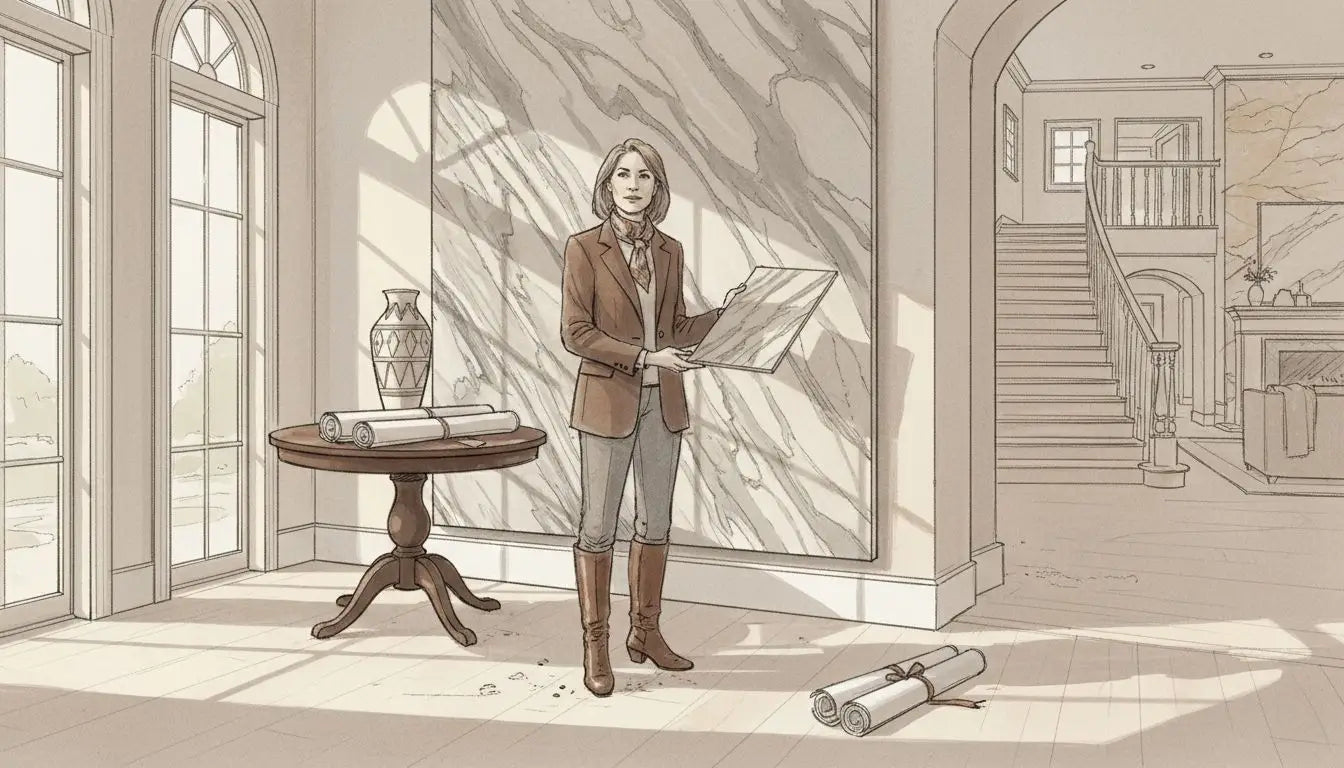
Bathroom applications particularly favor engineered marble over natural stone. Shower enclosures benefit from non-porous surfaces resisting mold colonization. Vanity tops withstand daily moisture exposure without developing etching or staining that plagues natural marble.
Marble’s role in luxury interiors extends beyond surfaces into fabricated architectural elements. Custom moldings, thresholds, and trim pieces manufactured from engineered marble provide design continuity while maintaining durability specifications natural marble cannot sustain.
Commercial luxury applications leverage engineered marble’s consistency for branding coherence. Hotel lobbies, high-end retail spaces, and corporate headquarters utilize polished engineered marble flooring that photographs consistently and maintains appearance across multiple installations.
Pro tip: Specify engineered marble for functional spaces where clients desire marble aesthetics but require minimal maintenance—bathrooms, kitchens, and high-traffic floors where natural marble’s fragility would compromise your design credibility.
Engineered vs Natural Marble: Costs and Care
The choice between engineered and natural marble shapes both your project budget and long-term client satisfaction. Understanding cost and maintenance differences helps you position the right material for each design scenario.
Natural marble carries significantly higher upfront costs. Quarrying, transportation, and labor-intensive fabrication drive expenses substantially higher than engineered alternatives. Grade variations and origin add unpredictability to pricing—premium Italian Carrara costs exponentially more than domestic varieties. Installation timelines extend due to site-specific fabrication requirements, increasing labor overhead.
Engineered marble offers more predictable pricing and lower installation costs. Factory-standardized production eliminates grade surprises. Consistent material properties mean fabricators work faster with fewer complications, reducing labor expenses on your projects.
Here’s where costs diverge:
- Natural marble: Premium material costs, variable by quarry and grade
- Natural marble: Complex fabrication requiring specialized craftspeople
- Engineered marble: Lower cost installation with predictable pricing
- Engineered marble: Factory-cut slabs requiring minimal site fabrication
- Natural marble: Long lead times from quarry to installation
- Engineered marble: Rapid availability from stock or short-run manufacturing
Maintenance separates the two materials dramatically. Natural marble requires regular sealing and careful cleaning to protect against acidic substances and staining. Clients must commit to resealing every one to three years depending on traffic levels. Acidic foods, wine, and common household cleaners pose constant etching risks.
Natural marble demands lifestyle changes; engineered marble tolerates normal residential habits without special care protocols.
Engineered marble maintenance shifts dramatically downward. No sealing required. Non-porous surfaces resist staining from typical household substances. Clients simply clean with mild, non-abrasive products—nothing specialized needed. This simplicity appeals powerfully to busy California professionals managing multiple properties.
Heat sensitivity differs meaningfully between materials. Natural marble tolerates heat better, making it suitable for fireplace surrounds and kitchen applications near cooking zones. Engineered marble can degrade from direct heat exposure, requiring trivets or protective barriers near heat sources.
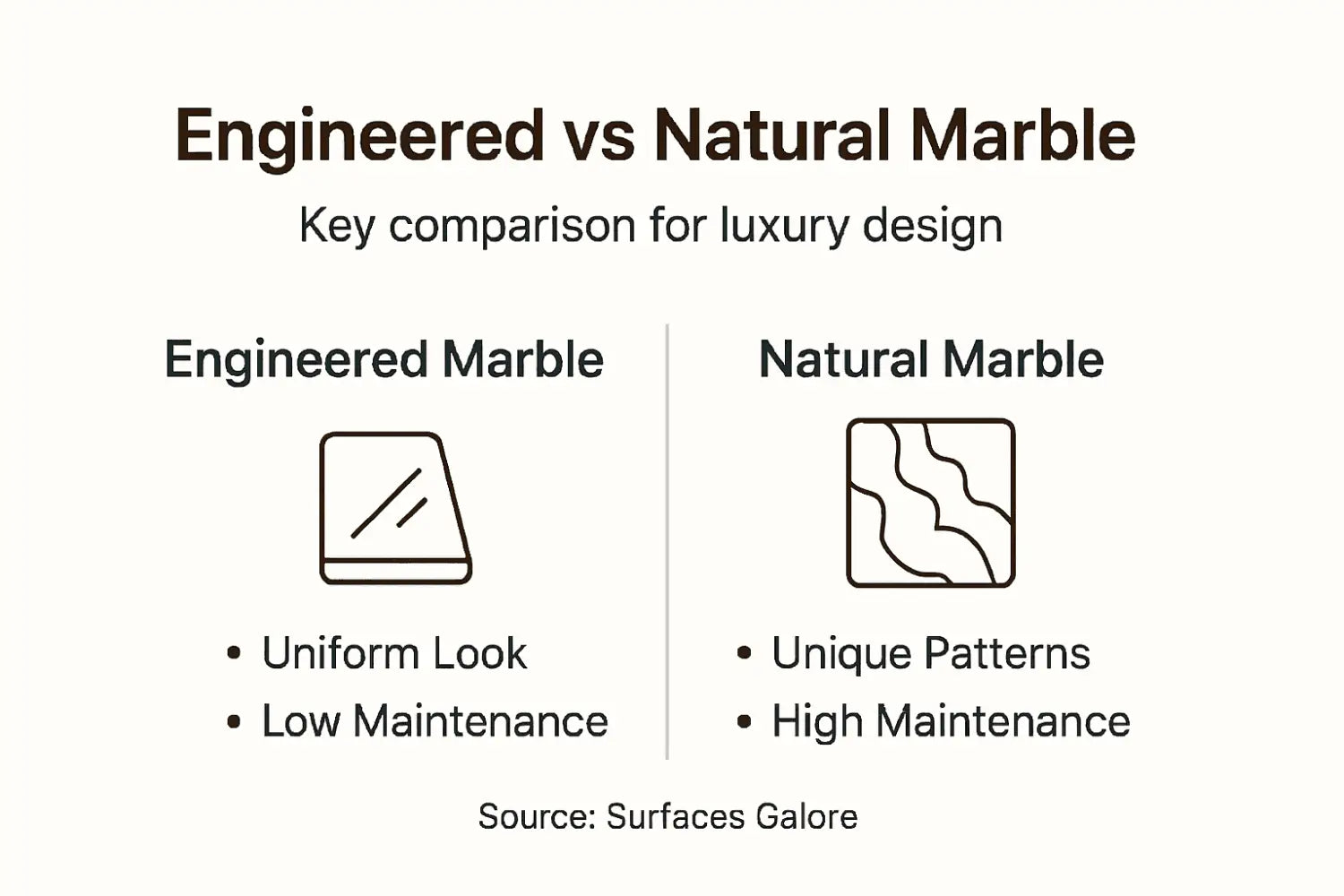
Long-term cost comparison favors engineered marble for most residential applications. While natural marble costs more initially, engineered marble’s maintenance-free existence saves clients hundreds annually in professional sealing and specialized cleaning. Over fifteen years, total cost of ownership often favors engineered marble despite lower upfront pricing.
For luxury design credibility, position natural marble as the authentic choice for clients prioritizing investment value and geological character. Marble maintenance protocols become part of your design story—a commitment to authentic luxury requiring mindful stewardship.
Position engineered marble for practical luxury clients wanting marble aesthetics without maintenance complexity. This positioning respects both material choices rather than framing engineered as a compromise.
Here’s a concise summary comparing engineered marble and natural marble for luxury design:
| Criteria | Engineered Marble | Natural Marble |
|---|---|---|
| Appearance | Uniform, consistent slabs | Unique color and veining |
| Durability | Highly resistant to scratches, low porosity | Prone to etching and stains |
| Maintenance | No sealing required, easy cleaning | Requires regular sealing, careful cleaning |
| Cost | Lower and predictable | Higher and variable |
| Heat Resistance | Sensitive to direct heat | Handles hot surfaces well |
| Best Uses | High-traffic, modern, budget projects | Luxury, bespoke, premium spaces |
Pro tip: Calculate total cost of ownership including sealing and maintenance over fifteen years when presenting marble options to clients—engineered marble often costs significantly less long-term despite higher natural marble initial pricing.
Discover Authentic Elegance Beyond Engineered Marble
The challenge many designers face when choosing materials is balancing durability and authentic beauty. As the article explains, engineered marble offers uniformity and low maintenance but lacks the rich character and unique veining of natural stone. If your goal is to deliver timeless luxury that captivates clients with genuine geological depth, then you understand the importance of selecting the right surface for your project.
At Surfaces Galore, we specialize in premium natural marble and travertine that transform luxury spaces with enduring elegance and unmatched authenticity. Our direct-import model from trusted quarries ensures you receive natural stone that tells a unique story on every slab paired with durability suitable for sophisticated California homes and commercial properties.
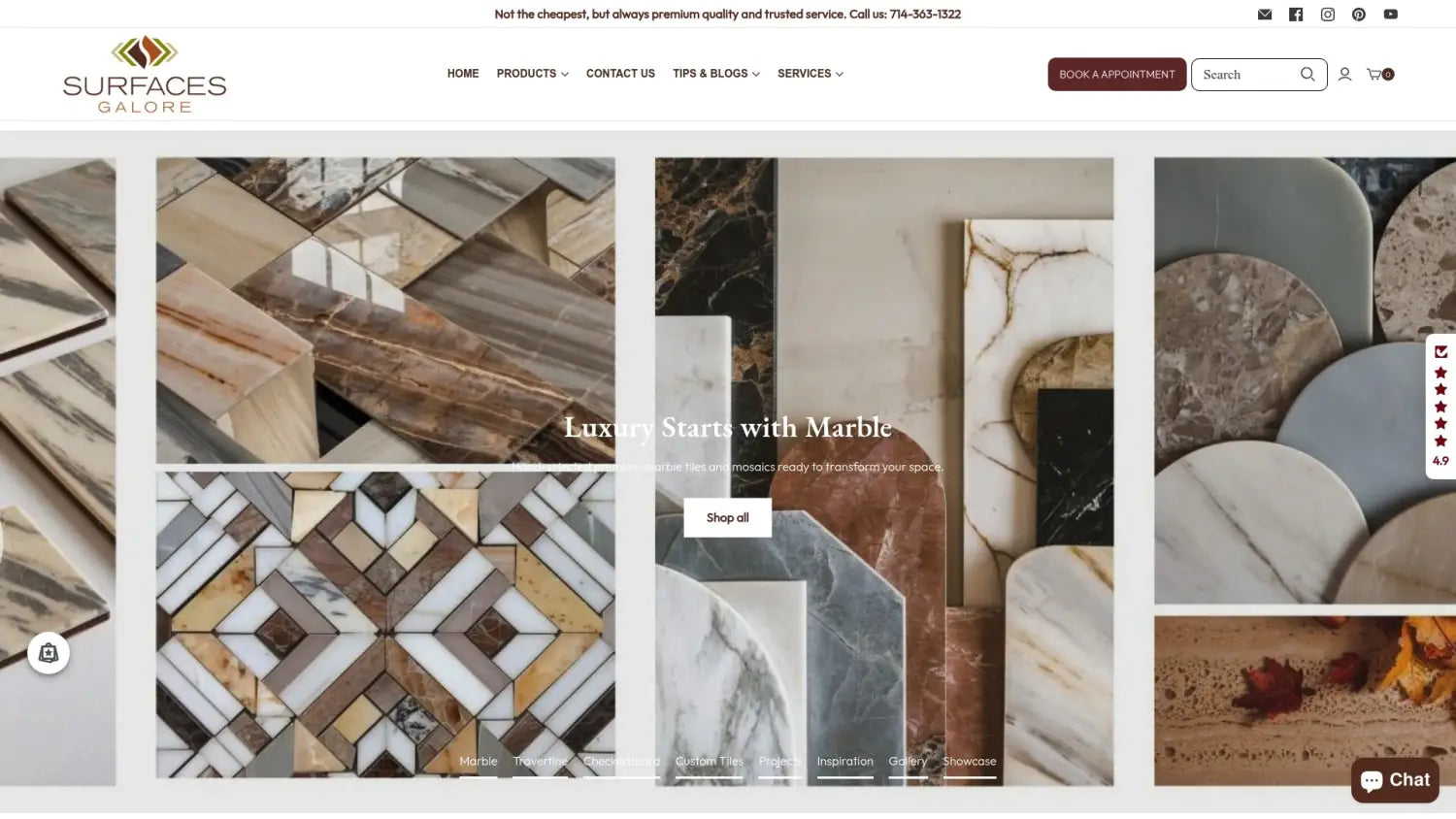
Elevate your design impact now by exploring our extensive collection of authentic natural stone options available nationwide. Visit Surfaces Galore to find exclusive marble tiles, mosaics, and decorative pieces crafted for discerning professionals. Experience the beauty of genuine stone paired with expert guidance so your projects exude authenticity and lasting value. Start crafting exceptional spaces today with premium natural stone tiles designed to surpass the compromises of engineered alternatives.
Frequently Asked Questions
What is engineered marble made of?
Engineered marble is a composite material consisting of about 90-93% crushed stone, typically quartz or marble fragments, bound together with 7-10% polyester resin. This composition creates a durable and consistent surface that mimics natural stone.
How does engineered marble compare to natural marble in terms of maintenance?
Engineered marble requires significantly less maintenance than natural marble. It does not need regular sealing and is more resistant to stains and scratches, making it easier to clean with mild non-abrasive products.
What are the advantages of using engineered marble in design projects?
The key advantages of engineered marble include uniformity in appearance, enhanced durability, lower cost, less porosity, and no need for sealing. These features make it ideal for high-traffic areas and budget-conscious projects while maintaining a modern aesthetic.
Can engineered marble be used in high-traffic areas?
Yes, engineered marble is well-suited for high-traffic areas due to its durability, low porosity, and scratch resistance. It can maintain its aesthetic appeal in environments like commercial spaces, kitchens, and bathrooms, where wear and tear are common.

Leave a comment