
What Is Honed Tile? A Practical Guide for Homeowners

TL;DR:
- Honed tile is a matte, non-reflective surface created by grinding natural stone to enhance slip resistance. It hides scratches and water spots better than polished finishes and requires sealing every 6-12 months. This finish is ideal for bathrooms, kitchens, outdoor areas, and spaces prioritizing safety and understated beauty.
Honed tile is defined as a smooth, matte surface finish produced by grinding natural stone or porcelain to a non-reflective, slip-resistant texture. The grinding process stops before the polishing stage, leaving the surface flat and soft to the touch without any gloss. This finish appears most often on marble, limestone, and travertine, though porcelain manufacturers also produce honed-look options. Sealing is a non-negotiable step for natural stone honed tiles, as the open surface absorbs stains far more readily than a polished counterpart. Surfacesgalore imports authentic honed marble, limestone, and travertine tiles that meet this standard, giving homeowners and designers a reliable starting point for any project.
What is honed tile, and how does it differ from other finishes?
Honed tile carries a matte, velvety appearance that reveals the natural color and grain of the stone without amplifying it through gloss. The surface absorbs light rather than reflecting it, which creates a calm, understated look in any room. Polished tile, by contrast, undergoes additional buffing stages that produce a mirror-like shine and intensify the stone’s color depth. The visual difference is significant: a polished marble floor reads as formal and luminous, while the same marble in a honed finish reads as relaxed and organic.
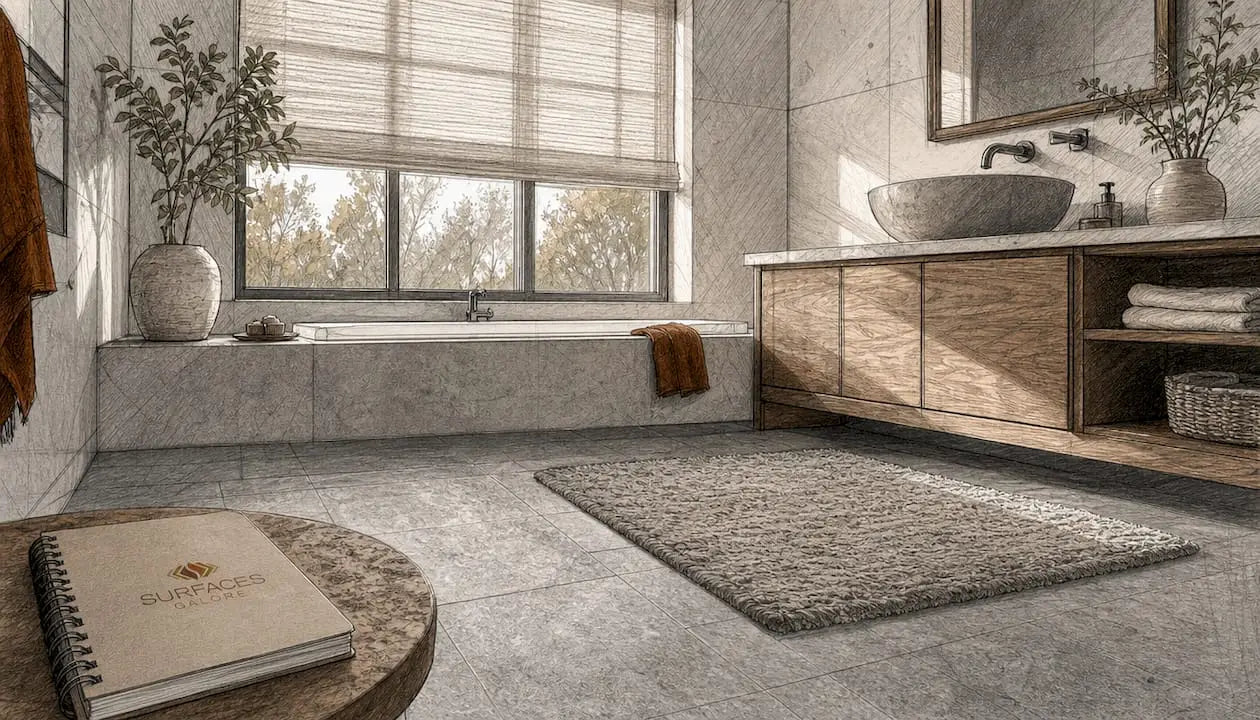
The tactile difference matters just as much as the visual one. Honed surfaces feel smooth but not slick, which is why designers specify them for bathroom floors, kitchen countertops, and any area where wet feet or spills are common. The matte texture also means that minor scratches and etch marks blend into the surface rather than catching the light and becoming obvious. That characteristic makes honed finishes particularly forgiving in households with children, pets, or heavy daily use.
The three stone types most commonly available in a honed finish are marble, limestone, and travertine. Each behaves slightly differently. Marble is denser and takes a crisp honed edge. Limestone has a more porous, earthy quality that deepens slightly when sealed. Travertine has natural voids that are typically filled before honing, producing a smooth, consistent face. Porcelain tiles can also replicate a honed look through digital printing and surface treatment, though they lack the natural variation that makes stone distinctive.
How is honed tile made? The honing process explained
The honing process uses progressively finer diamond abrasives to grind the stone surface down to a uniform, smooth plane. Each pass removes a thin layer of material, and the grit sequence determines the final texture. A coarser grit opens the surface and removes damage; finer grits refine the scratch pattern until the surface is smooth but still matte. The process stops before polishing, which would require even finer grits and a final buffing compound that creates gloss.
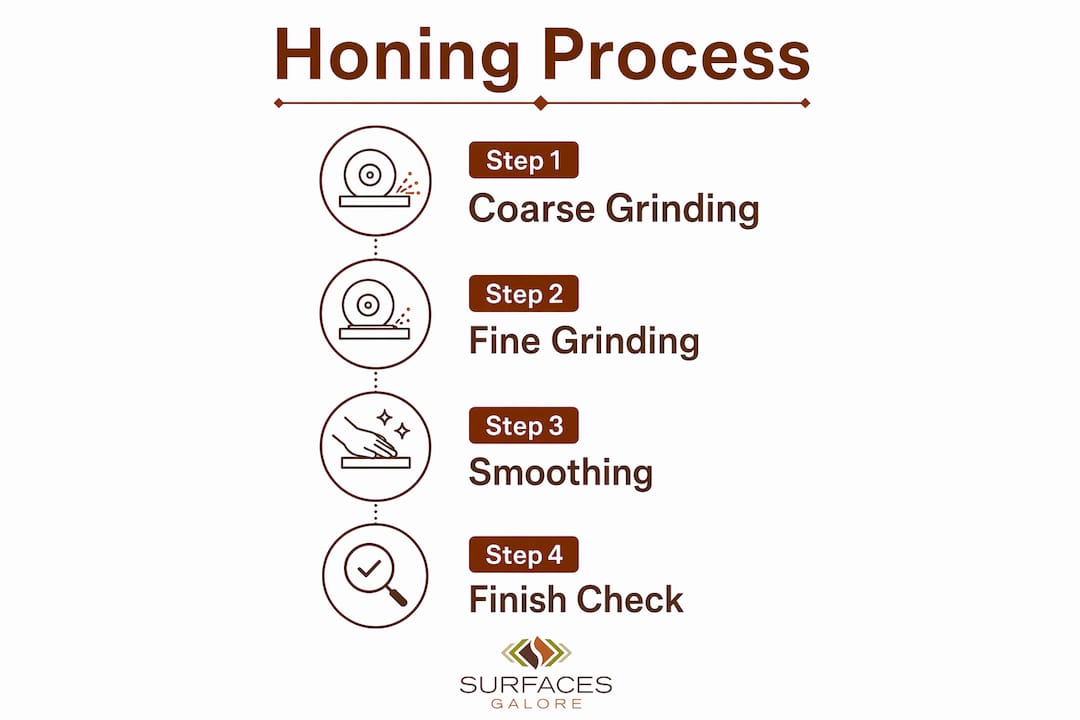
The step-by-step honing sequence
Professional fabricators follow a structured sequence to achieve a consistent honed finish:
- Surface assessment. The fabricator examines the stone for cracks, deep scratches, or existing finish irregularities before grinding begins.
- Coarse grinding. Diamond pads in the 50–120 grit range remove the top layer of stone, eliminating etching, scratches, and old finish.
- Medium grinding. Pads in the 200–400 grit range refine the surface and begin to produce a uniform scratch pattern.
- Fine grinding. Pads in the 800–1,500 grit range bring the surface to a smooth, matte plane. This is where the honing process ends.
- Cleaning and sealing. The stone is cleaned thoroughly, then sealed to close the pores before installation or grouting.
The critical decision is knowing when to stop. Continuing past the fine grinding stage into polishing compounds produces a semi-polished or “satin” finish, which is a distinct category. Improper technique at any stage can produce an uneven finish and reduce the stone’s long-term durability.
Pro Tip: Run your fingertip across a tile sample in direct light. An authentic honed finish feels smooth and shows no reflective glare. A matte-look porcelain tile will feel slightly different in texture and often shows a uniform, printed pattern rather than natural stone variation.
Factory-honed tiles from reputable importers like Surfacesgalore go through quality control checks to confirm grit consistency across the full tile face. That consistency matters when you are installing large-format tiles on a floor or countertop, because any variation in sheen becomes visible at an angle.
Honed vs polished tile: appearance, durability, and functionality
The choice between a honed and polished finish affects how a room looks, how safe the floor feels underfoot, and how much time you spend cleaning. Understanding the practical differences helps you make the right call before installation, not after.
Appearance and room ambiance
Polished tile intensifies color and creates visual depth through its reflective surface. A polished white marble floor makes a bathroom feel larger and brighter. A honed version of the same marble produces a softer, more muted palette that suits transitional and contemporary interiors. Neither finish is objectively better. The right choice depends on the mood you want the space to carry.
Slip resistance and safety
Honed tile is less slippery when wet, which makes it the safer choice for bathroom floors, pool surrounds, and kitchen areas near sinks. The matte surface provides more friction underfoot than a polished surface, which can become dangerously slick when wet. This is a functional advantage that goes beyond aesthetics, particularly in homes with older adults or young children.
Scratch and etch resistance
Honed finishes hide scratches and etch marks better than polished finishes because the matte surface already has a fine, consistent scratch pattern from the grinding process. A new scratch blends in. On a polished tile, even a light scratch catches the light and stands out against the mirror surface. Etching from acidic substances like vinegar or lemon juice is also less visible on honed stone, though it still occurs.
Maintenance comparison
| Feature | Honed tile | Polished tile |
|---|---|---|
| Gloss level | Matte, non-reflective | High gloss, mirror-like |
| Slip resistance | Higher, safer in wet areas | Lower, can be slick when wet |
| Scratch visibility | Low, blends into matte surface | High, scratches catch light |
| Etch mark visibility | Low to moderate | High, very visible |
| Smudge and water spot visibility | Low | High, requires frequent wiping |
| Sealing frequency | Every 6–12 months | Every 12–18 months |
| Cleaning effort | Moderate, requires stone-safe products | Moderate, requires frequent buffing |
Key practical differences between honed and polished tile:
- Honed tile hides smudges and water spots better than polished tile, reducing daily cleaning demands in busy households.
- Polished tile shows streaks immediately and requires frequent wiping to maintain its shine.
- Honed tile requires sealing more often because its more open surface absorbs liquids faster.
- Both finishes require pH-neutral, stone-safe cleaners. Acids and bleach damage both.
How to clean honed tile for lasting beauty
Honed tile maintenance follows a clear set of rules. Break them, and you risk permanent damage to a surface that is difficult and expensive to restore.
Daily and weekly cleaning
Use a pH-neutral stone cleaner for all routine cleaning. Dish soap, vinegar, lemon-based cleaners, and bleach all damage natural stone and degrade sealers over time. A damp microfiber mop or cloth removes dust, grit, and light soil without scratching the surface. For floors, sweep or vacuum before mopping to prevent abrasive particles from grinding into the stone.
Soap scum deserves special attention on honed surfaces. Soap scum buildup is more visible on honed stone because the scum creates a sheen that contrasts sharply against the matte background. Use a dedicated stone-safe soap scum remover rather than a standard bathroom spray, which almost always contains acids or bleach that will damage the surface.
Sealing schedule and the water droplet test
Sealing honed natural stone every 6–12 months is the expert standard, with the frequency depending on how heavily the surface is used. Kitchen countertops in active households need sealing every 6 months. Lower-traffic areas like a guest bathroom floor can go 12 months between applications.
The water droplet test is the most reliable way to know when resealing is needed. Place a few drops of water on the tile surface and wait 10–15 minutes. If the water beads up, the sealer is still effective. If the water soaks in and darkens the stone, it is time to reseal. Following a fixed calendar schedule is less accurate than this test because usage, cleaning products, and stone porosity all affect how quickly a sealer breaks down.
Pro Tip: Always seal honed natural stone before grouting. Sealing before grouting prevents grout haze from absorbing into the porous surface, which can cause permanent staining that requires professional restoration to fix.
Common mistakes to avoid
- Using acidic cleaners like vinegar, lemon juice, or citrus-based sprays on any natural stone surface.
- Skipping the pre-grout seal, which leaves the stone vulnerable to permanent grout staining.
- Assuming that sealing prevents acid etching. No sealer prevents etching on marble. Etching is a chemical reaction that dulls the surface and requires professional honing to restore.
- Using abrasive scrub pads that scratch the honed surface and create uneven texture.
- Letting spills sit. Blot liquids immediately, especially wine, coffee, and citrus juices.
Where to use honed tile: applications and design considerations
Honed tile performs best in spaces where safety, durability, and a refined aesthetic all matter. Its slip resistance and subdued surface make it safer and more practical than polished tile in wet and high-traffic areas, which is why it appears in some of the most demanding residential and commercial settings.
Best placements for honed tile
- Bathroom floors. The matte texture provides traction in wet conditions. Honed marble and limestone are classic choices for master bath floors.
- Kitchen countertops. Honed marble countertops are a staple of professional kitchen design. The matte surface hides daily wear better than polished stone, though sealing every 6 months is non-negotiable.
- Shower walls and floors. Honed travertine and limestone work well in showers because the finish handles moisture without becoming slippery.
- Entryway and hallway floors. High-traffic zones benefit from a finish that hides scratches and scuffs. Honed limestone or travertine holds up well under foot traffic.
- Outdoor patios and pool surrounds. Honed stone is a strong choice for exterior applications where wet conditions are constant. Check that the specific stone is rated for outdoor use and freeze-thaw cycles if applicable.
Design styles that suit honed finishes
Honed tile fits naturally into several design directions. Modern and minimalist interiors favor honed stone because the matte surface reads as quiet and architectural rather than decorative. Transitional kitchens and bathrooms use honed marble countertops and floors to balance traditional stone with a contemporary restraint. Classic Mediterranean and Tuscan-inspired spaces use honed travertine extensively on floors and walls, where the warm, earthy tones and matte texture reinforce the handcrafted aesthetic.
Light, color, and material pairing
| Design consideration | Honed tile behavior |
|---|---|
| Light reflection | Absorbs light, reduces glare, creates a calm atmosphere |
| Color appearance | Colors appear slightly lighter and more muted than polished versions |
| Room size perception | Makes large rooms feel grounded; smaller rooms feel less cavernous |
| Pairing with wood | Complements warm wood tones without competing for visual attention |
| Pairing with metal fixtures | Works with matte, brushed, and unlacquered brass finishes |
| Pairing with polished accents | Honed field tile with polished mosaic borders creates intentional contrast |
When selecting honed tile for a specific space, consider how natural light enters the room. North-facing rooms with limited sunlight benefit from lighter honed stones like white marble or cream limestone, which keep the space feeling open. South-facing rooms with strong light can handle darker honed stones like gray limestone without the space feeling heavy. Surfacesgalore carries honed marble, limestone, and travertine in a range of tones suited to both lighting conditions, and their team can help you match finishes across field tiles, mosaics, and trim pieces for a cohesive result. For guidance on picking floor tiles for kitchens and bathrooms, the Surfacesgalore blog covers selection criteria in detail.
Key Takeaways
Honed tile is the most practical natural stone finish for wet, high-traffic, and family-oriented spaces because it combines slip resistance, scratch tolerance, and understated beauty in a single surface.
| Point | Details |
|---|---|
| Honed tile definition | A matte, non-reflective finish created by grinding stone with diamond abrasives and stopping before polishing. |
| Safety advantage | Honed tile is less slippery when wet, making it the right choice for bathroom floors, showers, and kitchens. |
| Sealing is mandatory | Seal honed natural stone every 6–12 months and use the water droplet test to confirm when resealing is needed. |
| Maintenance rules | Use only pH-neutral, stone-safe cleaners. Acids, bleach, and abrasive pads all damage honed surfaces permanently. |
| Best applications | Bathroom floors, kitchen countertops, shower walls, entryways, and outdoor patios all suit honed tile well. |
Why I think honed tile gets undersold in most design conversations
Most design content treats honed tile as the “safe” or “understated” choice, as if choosing it means settling for less. That framing misses the point entirely. After years of working with natural stone and watching how homeowners actually live with their surfaces, I have come to believe that honed tile is the more demanding choice in the best possible sense. It asks you to be intentional about maintenance, and it rewards that attention with a surface that ages gracefully rather than showing every scratch and smudge.
The biggest misunderstanding I encounter is that honed stone is harder to maintain than polished stone. The opposite is true in daily use. Polished marble countertops show every fingerprint, water ring, and drip. Honed marble absorbs those same events into its matte surface and asks only for a quick wipe. The sealing requirement is real, but it takes less than an hour twice a year. That is a reasonable trade for a surface that does not demand constant attention between those sessions.
The other thing worth saying plainly: honed tile looks better in most residential settings than polished tile does. A polished floor in a family home often reads as high-maintenance and slightly out of place. A honed floor in the same space looks considered and livable. The polished versus honed debate is not really about aesthetics alone. It is about how you want to live with your surfaces every day. For most homeowners, honed wins that argument.
— cihan
Natural honed stone tiles from Surfacesgalore
Surfacesgalore sources authentic honed marble, limestone, and travertine tiles directly from quarries, which means you get genuine stone at prices that reflect direct importing rather than retail markup.

Whether you are planning a bathroom renovation, a kitchen countertop replacement, or a large-format floor installation, Surfacesgalore carries honed natural stone in formats, tones, and thicknesses suited to both residential and commercial projects. The collection includes field tiles, mosaics, and trim pieces that coordinate across finishes, so you can mix honed floors with polished accents or match stone tones across multiple rooms. Browse the honed natural stone collection at Surfacesgalore and request samples before committing to a full order. Nationwide shipping from Anaheim, California means your stone arrives ready for installation regardless of where your project is located.
FAQ
What is the honed tile definition in simple terms?
Honed tile is a natural stone or porcelain tile with a smooth, matte finish created by grinding the surface with diamond abrasives and stopping before the polishing stage. The result is a non-reflective, slip-resistant surface that reveals the stone’s natural color without gloss.
Is honed tile harder to maintain than polished tile?
Honed tile is not harder to maintain in daily use. It hides smudges, water spots, and minor scratches better than polished tile, though it requires sealing every 6–12 months and cleaning with pH-neutral, stone-safe products only.
How often should you seal honed natural stone?
Seal honed natural stone every 6–12 months depending on usage. Use the water droplet test: if water soaks into the stone rather than beading on the surface, it is time to reseal.
Can honed tile be used outdoors?
Honed tile works well in outdoor applications like patios and pool surrounds because the matte finish provides traction in wet conditions. Confirm that the specific stone is rated for outdoor use and, in colder climates, that it can withstand freeze-thaw cycles.
What is the difference between honed and polished tile?
Honed tile has a matte, non-reflective surface that is safer in wet areas and hides wear better. Polished tile has a high-gloss, mirror-like finish that intensifies color and visual depth but shows scratches, smudges, and water spots more readily.

Leave a comment