
Types of Decorative Stone: A 2026 Guide for Designers

TL;DR:
- Decorative stone categories include various natural and engineered materials used to enhance landscapes and interiors, with each type offering distinct aesthetic and performance qualities. The six primary natural stones—marble, granite, slate, travertine, quartzite, and limestone—differ in hardness, porosity, and suitability for specific applications, requiring careful selection based on project demands. In 2026, polished black pebbles and slate chips dominate landscaping trends, while natural stones demand knowledge of mineralogy, porosity, and durability to ensure long-term success.
Types of decorative stone refer to the natural and processed stones used to enhance the aesthetics and functionality of home and commercial landscapes and interiors. From polished marble countertops to river rock garden beds, the category spans dozens of materials with distinct hardness levels, color families, and maintenance demands. Choosing the wrong stone for your project does not just look off. It costs money to fix. This guide covers the major natural stone varieties, popular landscaping stone types, selection criteria, and the key differences between natural and engineered options so you can make a confident, informed decision.
What are the main types of decorative stone?
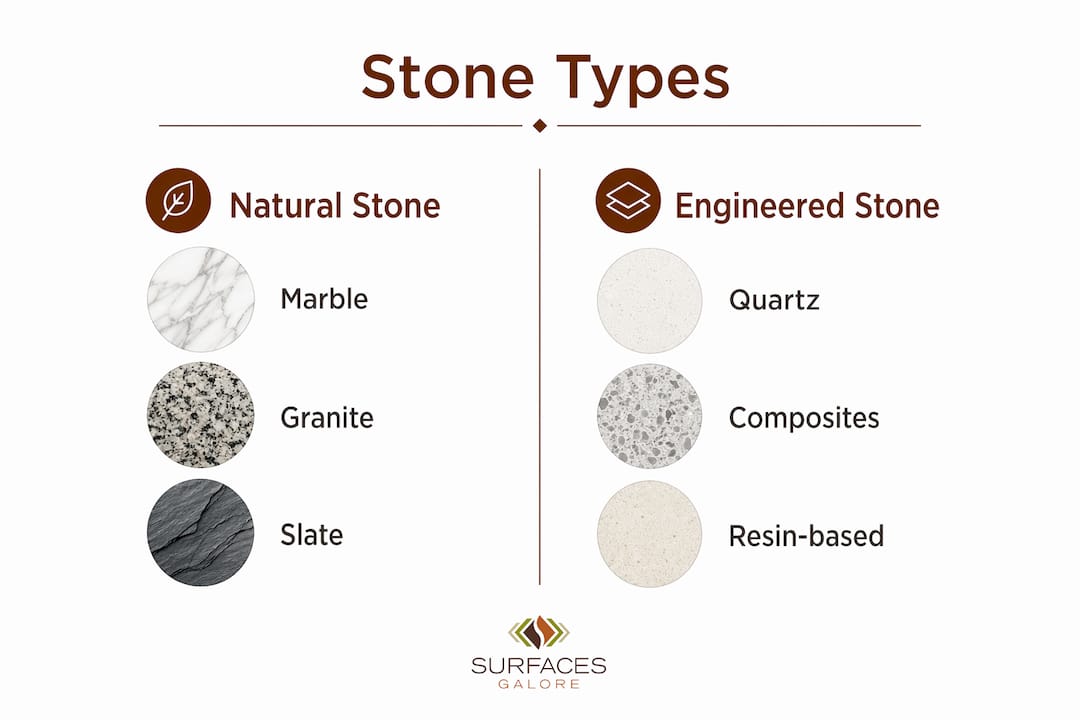
Decorative stone is the industry’s broad term for any quarried, processed, or naturally shaped stone used for visual or structural enhancement. The six most widely used natural stone varieties in residential and commercial projects are marble, granite, slate, travertine, quartzite, and limestone. Each has a distinct mineral composition that directly affects how it performs, how it looks, and how much care it needs.
Marble
Marble is a metamorphic rock composed primarily of recrystallized carbite minerals, giving it the flowing veins that designers prize. It scores between 3 and 4 on the Mohs hardness scale, which makes it softer than granite and more vulnerable to etching from acidic cleaners or spills. White Carrara and Calacatta marbles dominate interior applications like bathroom floors, shower walls, and fireplace surrounds. Marble requires sealing every 6 to 12 months to prevent staining, but its reflective surface and timeless appearance justify the maintenance for most high-end projects. You can explore current marble design trends to see how designers are using it in 2026 kitchens and bathrooms.
Granite
Granite is an igneous rock that scores between 6 and 7 on the Mohs scale, making it one of the hardest natural stones available for decorative use. Its density resists scratching, heat, and moisture better than marble, which is why it dominates kitchen countertops and outdoor applications. Granite appears in a wide range of colors including black, gray, white, gold, and pink, depending on its mineral content. Fabricators select tooling hardness based on stone mineral hardness, meaning black granites require different blade bonds than softer stones like soapstone. This technical reality matters when you are ordering custom cuts or commissioning fabrication work.
Slate
Slate is a fine-grained metamorphic rock that splits naturally into flat sheets, giving it a layered, textural appearance that works well for flooring, wall cladding, and garden paths. It scores between 2.5 and 4 on the Mohs scale and is naturally slip-resistant when left unpolished. Slate’s color range runs from charcoal black and deep gray to rusty red and green, depending on its mineral origin. Its flat cleavage makes it one of the most practical stones for DIY installation, since pieces stack and align predictably.
Travertine
Travertine is a sedimentary limestone formed by mineral springs, and its characteristic pitted surface gives it a warm, Old World aesthetic that suits Mediterranean and Tuscan-inspired interiors. It scores between 4 and 5 on the Mohs scale and is available in cream, ivory, walnut, and gold tones. Travertine tiles are commonly used for bathroom floors, pool surrounds, and exterior patios because they stay cool underfoot in warm climates. The natural pores in travertine require filling and sealing before installation to prevent moisture infiltration and staining.
Quartzite and limestone
Quartzite is a metamorphic rock derived from sandstone, scoring between 7 and 8 on the Mohs scale. It is harder than marble and granite, which makes it an excellent choice for high-traffic flooring and exterior cladding. Its appearance often mimics marble with white and gray veining, which leads to frequent misidentification at the point of sale. Limestone scores between 3 and 4 on the Mohs scale and shares travertine’s warm, earthy palette. It works well for flooring, wall panels, and garden stepping stones, but it requires consistent sealing because it is highly porous and reactive to acids. The types of natural stone available for design projects extend well beyond these six, but these form the foundation of most residential and commercial specifications.
Pro Tip: Fabricators and designers organize natural stones into broad color families such as black, gray, gold, and white rather than mineral names. Grouping by color family improves selection efficiency and helps predict how a stone will perform and age in a specific application.
Which landscaping stones are most popular in 2026?
Landscaping stone types serve both functional and decorative purposes outdoors. The best decorative stones for gardens, pathways, and xeriscaping balance visual impact with practical performance. Here are the five most widely used options in 2026 projects.
-
Polished black pebbles. Polished black pebbles are the most in-demand decorative stones for modern landscaping, available in sizes from half an inch to 4 inches. Their smooth, reflective surface works in contemporary garden beds, pool surrounds, and zen gardens where a clean, minimal aesthetic is the goal. They pair well with white gravel or light-colored pavers to create strong visual contrast.
-
Slate chips. Slate chips’ flat shape and dark gray to black color create stable, natural-looking borders and paths with less rolling underfoot compared to round pebbles. Sizes between 1 and 3 inches are recommended for walkways and borders. A 40 lb bag of slate chips provides adequate coverage for garden path borders and stable surfaces in typical DIY projects, making it a practical choice for homeowners working without a contractor.
-
Gravel and crushed stone. Gravel is an economical option that provides good drainage and a rustic look, suitable for driveways and pathways. It comes in varied colors and sizes, facilitates water drainage, and installs easily without specialized tools. Crushed limestone gravel is particularly popular in the Southwest and Southeast United States where it blends with regional soil tones.
-
River rock. River rock is smooth, rounded stone shaped by water erosion, available in sizes from half an inch to several inches in diameter. It works well for dry creek beds, drainage channels, and decorative ground cover around trees and shrubs. Its natural, organic appearance suits cottage, farmhouse, and naturalistic garden styles.
-
Lava rock. Lava rock is lightweight, porous, and ideal for xeriscaping, creating striking contrast against greenery while requiring minimal maintenance. Its porous texture aids water retention, which makes it a smart choice for drought-tolerant planting schemes in California, Arizona, and Texas. The deep red and black tones of lava rock add a bold, volcanic texture that few other landscaping stones can replicate.
Pro Tip: Marble chips brighten shady garden areas with their reflective surfaces, but they require more cleaning than darker stones because they show algae and debris more readily. Use them in high-visibility spots where you can maintain them seasonally.
Beach pebbles deserve a separate mention. Beach pebbles are expensive but chosen for their clean, luxurious aesthetic that balances organic and polished looks. Designers specify them for luxury residential projects where the premium cost is justified by the visual result. No other stone delivers the same combination of smooth texture, natural color variation, and refined appearance.
How to choose the right decorative stone for your project
Selecting decorative stone options for a specific project requires matching material properties to project demands. The wrong choice creates maintenance headaches, premature wear, or a visual mismatch that is expensive to correct.
Consider these factors before you commit to a stone:
- Project type and traffic level. High-traffic flooring in a kitchen or commercial lobby needs a stone that scores at least 6 on the Mohs scale. Quartzite, granite, and hard limestone are appropriate. Marble and travertine are better suited to lower-traffic areas like bathroom walls, fireplace surrounds, and decorative accents.
- Exposure to moisture and weather. Outdoor applications require stones with low porosity or consistent sealing schedules. Granite and quartzite perform well outdoors without intensive maintenance. Marble and limestone need sealing twice a year in wet climates to prevent water infiltration and freeze-thaw damage.
- Color family and visual intent. Ignoring mineralogy when choosing by color can cause problems. Chipping in rare blue granite can be far more costly to repair than chipping in common beige granite because the material is harder to source and match. Always confirm the mineral composition of a stone before selecting it based on color alone.
- Maintenance commitment. Polished marble and travertine require regular sealing and careful cleaning with pH-neutral products. Granite, slate, and quartzite are more forgiving. If you are specifying stone for a client who wants minimal upkeep, steer toward harder, denser options.
- Budget and availability. Beach pebbles and rare granites carry premium price tags. Gravel, slate chips, and standard limestone are cost-effective without sacrificing visual quality. Order samples before committing to a full quantity, and verify that the batch color matches your sample since natural stone varies between quarry pulls.
Pro Tip: When ordering stone for a large project, request samples from the specific batch you plan to purchase. Natural stone color varies between quarry pulls, and a sample from a different batch may not match your final delivery. Surfacesgalore ships samples nationwide so you can validate color and texture before placing a full order.
For interior applications, the natural stone selection process involves evaluating finish options as well. A honed finish on marble reads softer and more matte than a polished finish, which affects both the aesthetic and the maintenance routine.
Natural stone vs. engineered stone: which should you choose?
The comparison between natural and engineered decorative stone options is one of the most common decisions designers and homeowners face. Both categories have genuine strengths, and the right choice depends on the specific application.
| Feature | Natural stone (marble, granite, quartzite) | Engineered stone (quartz composites) |
|---|---|---|
| Appearance | Unique veining and color variation per slab | Consistent pattern and color across batches |
| Porosity | Varies by stone type; most require sealing | Non-porous; no sealing required |
| Hardness | 3 to 8 on Mohs scale depending on type | Typically 7 on Mohs scale |
| Maintenance | Sealing every 6 to 12 months for porous types | Wipe-clean surface; no sealing needed |
| Heat resistance | High for granite and quartzite; moderate for marble | Moderate; can discolor under sustained heat |
| Cost | Wide range; rare stones carry premium pricing | Mid-range; consistent pricing across batches |
| Authenticity | Unique, one-of-a-kind material from the earth | Factory-manufactured composite product |
Engineered white quartz is consistent, non-porous, and maintenance-friendly, with fabrication behaviors that differ from natural stone. This predictability makes it attractive for commercial projects where consistency across multiple slabs is critical. However, engineered quartz cannot replicate the depth, movement, and uniqueness of a natural marble or granite slab. Each natural stone slab is geologically unique, which is precisely what makes it valuable in high-end residential and hospitality design.
The practical rule is straightforward. Choose engineered stone when consistency, low maintenance, and budget predictability are the top priorities. Choose natural stone when authenticity, visual depth, and long-term value matter more. A natural stone backsplash in a kitchen, for example, creates a focal point that no engineered product can replicate at the same level of visual impact.
Key takeaways
The most effective approach to selecting decorative stone is to match mineral hardness, porosity, and color family to the specific demands of your project before purchasing.
| Point | Details |
|---|---|
| Match hardness to traffic | Use stones scoring 6 or higher on the Mohs scale for high-traffic floors and outdoor surfaces. |
| Understand color families | Fabricators group stones by color family to predict performance and simplify slab matching across a project. |
| Landscaping stone selection | Polished black pebbles and slate chips lead 2026 landscaping trends for modern and naturalistic gardens. |
| Natural vs. engineered | Natural stone offers unique aesthetics and long-term value; engineered quartz delivers consistency and low maintenance. |
| Mineralogy matters | Ignoring a stone’s mineral composition when choosing by color alone leads to costly repair and replacement errors. |
Why stone selection is more technical than most people expect
The most common mistake I see homeowners and even experienced designers make is treating stone selection as a purely visual decision. You find a color you love, you order it, and then six months later you are dealing with etching on a marble kitchen counter or crumbling edges on a limestone patio that was never meant for freeze-thaw conditions. The visual appeal of natural stone is real and earned. But the material science underneath it is what determines whether a project ages beautifully or becomes a maintenance problem.
What I have learned from working with natural stone across dozens of projects is that the Mohs hardness scale is your first filter, not your last. Before you fall in love with a slab, know its number. Marble at 3 to 4 is a bathroom and fireplace stone. Quartzite at 7 to 8 is a kitchen and exterior stone. Granite sits in between and handles almost everything. Getting this wrong is not a stylistic error. It is a structural one.
The second thing most people underestimate is the cost of rarity. Chips in rare blue granites can lead to major costly callbacks because matching the material for repair is nearly impossible. If you are specifying an unusual stone for a client, make sure you order 10 to 15 percent extra material for future repairs. Rare stones go out of production, and a chip two years after installation with no matching material on hand is a serious problem.
My honest recommendation is to source from a supplier who understands the mineralogy of what they sell, not just the aesthetics. Surfacesgalore imports directly from quarries and can speak to the composition, finish options, and maintenance requirements of every stone in their catalog. That level of knowledge protects your project from the kinds of errors that look fine on day one and become expensive by year three.
— cihan
Discover premium natural stone at Surfacesgalore
Surfacesgalore is a direct importer of premium natural stone based in Anaheim, California, specializing in marble, limestone, and travertine tiles, mosaics, and decorative pieces. Every stone in the catalog is sourced for authenticity, durability, and visual quality, with nationwide shipping to designers, architects, contractors, and homeowners.
Whether you are planning a marble bathroom, a travertine patio, a limestone feature wall, or a custom mosaic accent, Surfacesgalore carries the materials and the expertise to support your project from selection to installation. Browse the natural stone collections to find tiles, mosaics, and custom cuts that match your design vision. Samples ship nationwide so you can validate color and texture before committing to a full order.
FAQ
What are the most durable types of decorative stone?
Quartzite, granite, and hard limestone are the most durable decorative stone options for high-traffic and outdoor applications, scoring between 6 and 8 on the Mohs hardness scale. These stones resist scratching, heat, and moisture better than marble or travertine.
What decorative stones work best for landscaping?
Polished black pebbles, slate chips, gravel, river rock, and lava rock are the most popular landscaping stone types in 2026. Slate chips and polished pebbles lead for modern garden aesthetics, while lava rock excels in xeriscaping and drought-tolerant designs.
How do I choose between natural and engineered stone?
Choose natural stone when visual uniqueness, authenticity, and long-term value are priorities. Choose engineered quartz when you need consistent color across multiple slabs, a non-porous surface, and minimal maintenance requirements.
Does decorative stone require sealing?
Most natural stones require sealing, but the frequency depends on porosity. Marble and limestone need sealing every 6 to 12 months. Granite and quartzite need less frequent sealing. Engineered quartz requires no sealing at all.
Why does stone mineralogy matter when choosing by color?
Choosing stone by color without understanding its mineral composition can lead to costly errors. For example, chipping in a rare blue granite is far more expensive to repair than chipping in a common beige granite because the material is harder to source and match for repairs.

Comments on this post (1)
Decorative stone continues to be a major design trend because it adds texture, authenticity, and lasting visual appeal to both interior and exterior spaces. From limestone and quartzite to slate, each stone brings its own character and architectural presence. Among the standout options for contemporary designs is VALONGO BLACK™ from Porto Slate Importers, which showcases the rich tones and natural elegance of genuine black slate. Its versatility and timeless aesthetic make it an excellent choice for designers seeking materials that combine sophistication with long-term performance.
— Jay Tauber