

How natural stone is cut for precise installations

Contrary to popular belief, natural stone cutting is not a wasteful or imprecise process. Modern techniques achieve material yields exceeding 97% while maintaining tolerances within ±0.2 mm. This guide walks you through the complete workflow, from quarry extraction to finished slabs, explaining the machinery, tooling choices, and best practices that ensure quality installations. Whether you’re specifying marble for a luxury residential project or travertine for a commercial lobby, understanding these processes helps you make informed decisions that balance cost, precision, and sustainability.
Table of Contents
- Key takeaways
- Understanding natural stone cutting: from quarrying to finishing
- Comparing stone cutting technologies: precision, cost, and yield
- Matching cutting tools to stone characteristics for optimal results
- Sustainability and efficiency considerations in natural stone cutting
- Explore premium natural stone solutions with SurfacesGalore
- How natural stone is cut: frequently asked questions
Key Takeaways
| Point | Details |
|---|---|
| Two stage workflow | Natural stone cutting occurs in two stages: quarry extraction and subsequent processing into finished slabs using gang saws, multi-wire saws, bridge saws, and polishing equipment. |
| Multi wire yield advantage | Multi-wire saws deliver higher material yields up to 97 percent, compared with 85 to 90 percent from gang saws. |
| Test cuts | Test cuts help prevent fractures and ensure finished slabs meet design expectations. |
| Tooling hardness | Tooling must be matched to stone hardness for optimal results and to maximize usable yield. |
| Cost sustainability balance | Modern methods balance upfront costs with project requirements and sustainability goals. |
Understanding natural stone cutting: from quarrying to finishing
Natural stone cutting unfolds in two distinct phases, each requiring specialized equipment and expertise. The primary extraction phase happens at the quarry, where massive blocks are separated from bedrock using drilling, wire saws, and controlled explosives. Workers create strategic cut lines, insert wedges, and employ diamond wire saws to free blocks weighing several tons. This stage prioritizes block integrity over precision, focusing on minimizing internal fractures that could compromise later processing.
The secondary processing phase transforms rough quarry blocks into finished slabs ready for installation. This stage employs gang saws, multi-wire saws, bridge saws, and polishing equipment to achieve the exact dimensions and surface finishes your projects demand. Gang saws use multiple parallel blades to slice blocks into slabs simultaneously, while bridge saws handle precise cuts for custom shapes and edge profiles. Grinders and polishing pads create the final surface texture, from honed matte finishes to high-gloss polished surfaces.
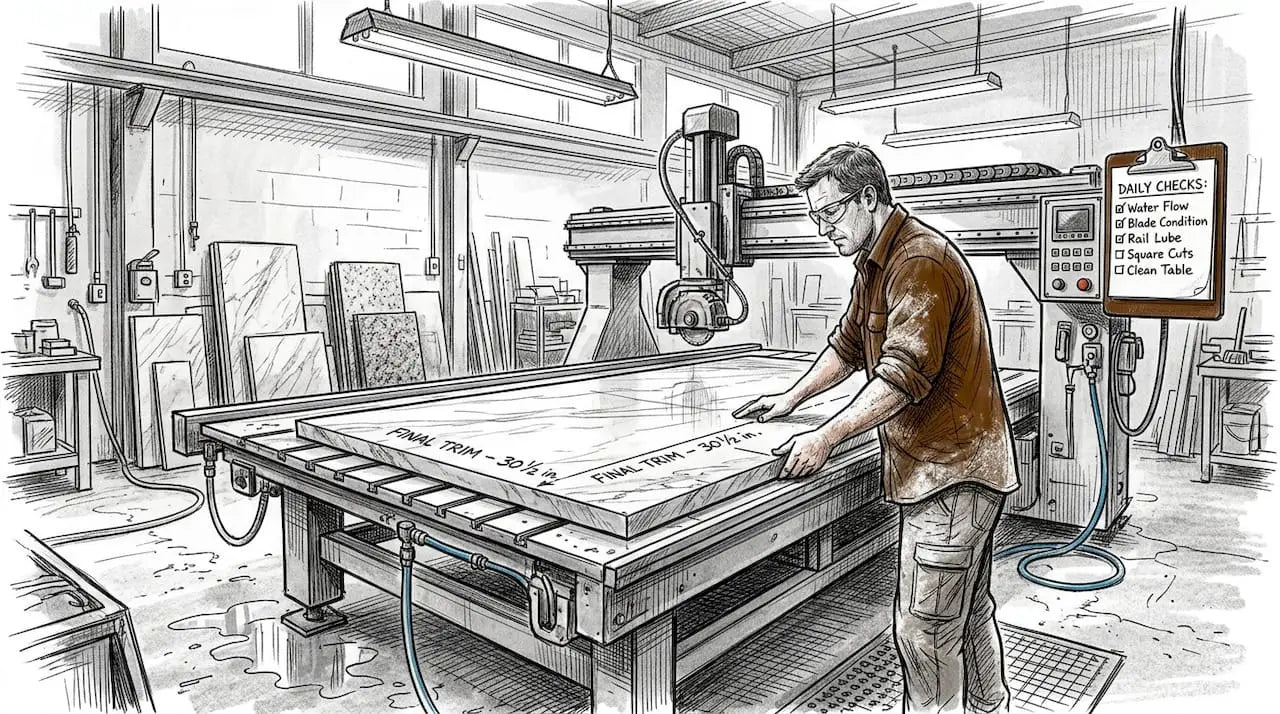
Machinery selection directly impacts material yield, surface quality, and project economics. A gang saw might process 20-30 slabs from a single block, but a multi-wire saw can extract 25-35 slabs from the same block due to thinner cutting widths. This difference translates to thousands of dollars in material savings on large commercial projects. Understanding these phases helps you refine specifications and communicate effectively with fabricators when ordering natural stone for your projects.
The transition from quarry to fabrication shop involves careful handling and inspection. Blocks are evaluated for structural integrity, vein patterns, and color consistency before processing begins. This quality control step prevents wasted effort on compromised material and ensures the slabs you receive meet design expectations. Professional fabricators document block characteristics and adjust cutting plans accordingly, maximizing the usable yield from each piece.
Comparing stone cutting technologies: precision, cost, and yield
Three primary technologies dominate commercial stone cutting, each offering distinct advantages for different project scales and quality requirements. Gang saws represent the traditional approach, with initial equipment costs ranging from $100,000 to $190,000. These machines use tensioned steel blades with abrasive slurry to cut through stone blocks, processing them over 24-48 hours depending on block size and stone hardness. While gang saws deliver reliable results, they produce wider kerfs (cutting widths) that increase material waste.
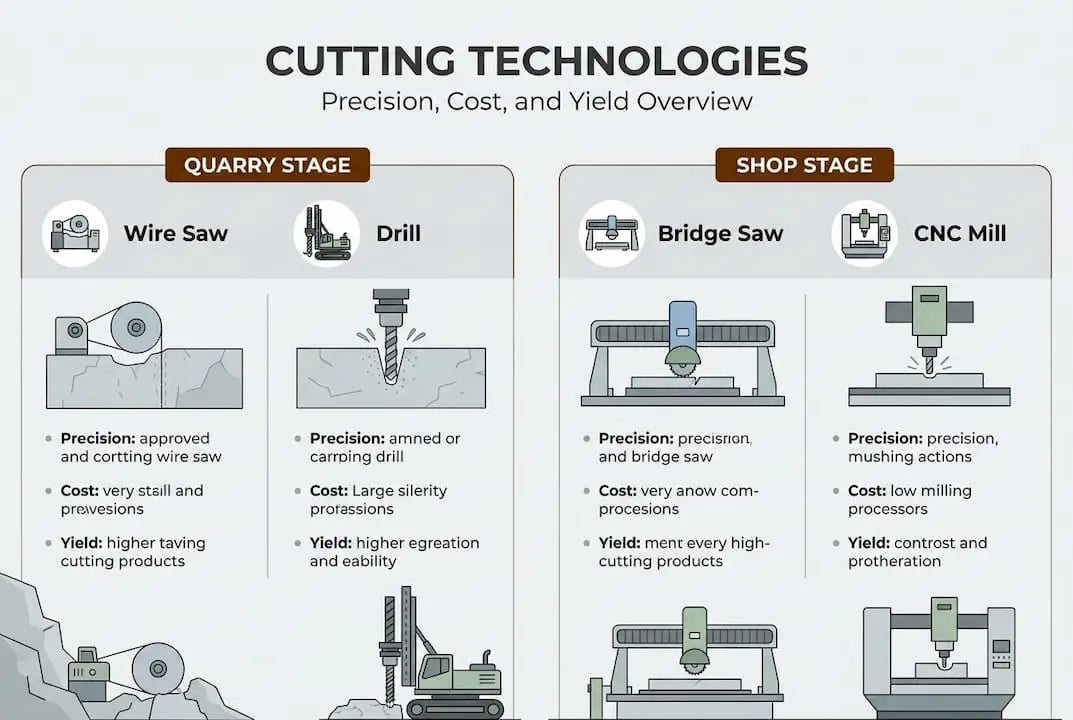
Multi-wire saws cost $145,000 to $300,000 but deliver superior material efficiency, achieving yields up to 97% compared to gang saws at 85-90%. These machines use diamond-embedded wires that cut thinner profiles, extracting more slabs per block. For Carrara marble, multi-wire saws can yield 55 m² per cubic meter versus 47 m² with gang saws, representing a 17% improvement. This efficiency gain quickly offsets the higher equipment cost on medium to large projects, making multi-wire technology increasingly popular among quality-focused fabricators.
Bridge saws and CNC systems provide the precision required for premium installations, maintaining tolerances within ±0.2 mm. These machines handle detailed cuts for countertops, wall cladding, and custom architectural elements. CNC bridge saws can execute complex curves, miters, and edge profiles automatically, reducing labor costs while ensuring consistency across multiple pieces. For projects demanding exact dimensions and tight seams, this technology is indispensable.
| Technology | Initial Cost | Material Yield | Typical Tolerance | Best Application |
|---|---|---|---|---|
| Gang Saw | $100k-$190k | 85-90% | ±1-2 mm | High-volume standard slabs |
| Multi-Wire Saw | $145k-$300k | 95-97% | ±0.5 mm | Premium slabs, efficiency focus |
| Bridge/CNC Saw | $80k-$250k | Variable | ±0.2 mm | Custom cuts, architectural details |
Pro Tip: When specifying stone for large commercial projects, request slabs cut with multi-wire technology to maximize material consistency and reduce waste-related costs that might otherwise be passed to your client.
The choice between technologies depends on project scale, budget constraints, and finish quality requirements. Residential projects with modest square footage might not justify premium cutting methods, while luxury commercial installations benefit significantly from the precision and yield of advanced equipment. When choosing marble slabs for your design, ask fabricators about their cutting technology to ensure alignment with your quality standards.
Matching cutting tools to stone characteristics for optimal results
Stone hardness determines which cutting tools will deliver clean results without excessive wear or material damage. Granite and other hard igneous stones require sintered diamond wires that bond diamond particles into a metal matrix, creating durable cutting edges that withstand high temperatures and abrasion. These wires maintain cutting efficiency through thousands of linear meters, making them cost-effective despite higher initial prices. For softer stones like marble and limestone, electroplated diamond wires offer faster cutting speeds at lower cost, as the reduced hardness causes less tool wear.
Quartzite presents unique challenges due to its crystalline structure and extreme hardness. Cutting quartzite demands high-diamond-concentration segmented blades that can handle the material’s abrasive nature without premature wear. Standard marble blades will dull rapidly on quartzite, leading to rough cuts and potential chipping along edges. Always verify that your fabricator uses appropriate tooling for your specified stone type to avoid quality issues during installation.
Test cuts on sample pieces or offcuts represent essential quality control before processing full slabs. These trial runs reveal how the stone responds to specific cutting parameters, including blade speed, feed rate, and cooling water flow. Veining patterns become visible during test cuts, allowing fabricators to adjust cutting plans to showcase desirable features or avoid problematic areas. For stones with pronounced veining or layered structures, test cuts prevent costly fractures that could ruin entire slabs.
- Evaluate stone hardness using Mohs scale ratings to select appropriate diamond tooling and cutting speeds
- Perform test cuts on offcuts to identify optimal feed rates and reveal internal vein patterns before processing valuable slabs
- Use wet cutting methods with continuous water flow to prevent thermal stress and reduce airborne silica dust
- Adjust blade depth and multiple-pass techniques for brittle stones to minimize edge chipping and internal fractures
- Monitor blade wear indicators and replace tooling proactively to maintain cut quality and prevent damage to stone surfaces
Stacked stone and thin veneer products require specialized wet saws that prevent chipping on edges and faces. These saws use fine-grit diamond blades with reduced cutting speeds, prioritizing surface integrity over processing speed. The continuous water stream lubricates the cut and carries away debris that could scratch polished surfaces. When cutting marble tiles for installation, professionals rely on these techniques to deliver clean edges that require minimal finishing.
Cross-joints and natural bedding planes in sedimentary stones like sandstone influence how material fractures under cutting stress. Fabricators orient cuts parallel to these planes whenever possible, reducing the risk of unexpected splits. Understanding your stone’s geological characteristics helps you work with fabricators to plan cuts that respect the material’s natural structure, resulting in stronger, more stable finished pieces.
Pro Tip: Request that your fabricator perform test cuts in your presence when working with rare or expensive stone varieties, allowing you to approve vein orientation and surface quality before full processing begins.
Sustainability and efficiency considerations in natural stone cutting
Material efficiency directly impacts both project economics and environmental footprint. Multi-wire saws reduce waste by 10-25% compared to gang saws, translating to significant material savings on large projects. A 100 m³ stone order processed with multi-wire technology yields approximately 5,500 m² of usable slabs versus 4,700 m² with gang saws. This 800 m² difference represents substantial cost savings and reduced quarrying impact. Energy consumption also drops by roughly 30% with multi-wire systems, as thinner cutting widths require less power to process equivalent volumes.
Operational costs extend beyond equipment depreciation to include consumable tooling expenses. Gang saw blade sets cost approximately $12,000 and require replacement after processing 500-800 m² of stone, depending on hardness. Diamond wire for multi-wire saws runs about $1,000 per 30 kilometers of cutting length, typically processing 1,000-1,500 m² before replacement. While wire costs appear lower per unit, the higher equipment investment must be amortized across sufficient volume to realize savings. For fabricators processing 10,000+ m² annually, multi-wire technology delivers clear economic advantages.
| Cost Factor | Gang Saw | Multi-Wire Saw | Annual Savings (10,000 m²) |
|---|---|---|---|
| Blade/Wire Replacement | $240,000 | $100,000 | $140,000 |
| Energy Consumption | $45,000 | $31,500 | $13,500 |
| Material Waste (5% vs 15%) | $75,000 | $25,000 | $50,000 |
| Total Operating Cost | $360,000 | $156,500 | $203,500 |
Dust management and water usage represent critical environmental considerations in stone fabrication. Traditional dry cutting generates hazardous silica dust that poses serious health risks to workers and requires expensive ventilation systems. Diamond wire technology with continuous water cooling eliminates airborne dust while lubricating cuts for superior surface quality. The water becomes a slurry containing stone particles and must be filtered and recycled through closed-loop systems to prevent environmental contamination. Modern fabrication facilities recycle 90-95% of process water, dramatically reducing consumption.
Emerging performance optimization models use artificial intelligence to monitor cutting parameters in real time, adjusting speeds and pressures to minimize energy use and equipment wear. These systems analyze vibration patterns, power draw, and acoustic signatures to detect developing problems before they cause damage. Predictive maintenance schedules based on actual usage patterns replace arbitrary time-based servicing, reducing downtime and extending equipment life. As these technologies mature, they promise further efficiency gains across the stone fabrication industry.
“Sustainable stone cutting isn’t just about reducing waste. It’s about optimizing every aspect of the process, from energy consumption to water recycling, to deliver quality products while minimizing environmental impact. The technology exists; the challenge is implementation across the industry.” — Dr. Maria Chen, Materials Engineering Research Institute
Sustainable practices in modern stone fabrication include:
- Implementing closed-loop water recycling systems that filter and reuse process water, reducing consumption by 90%
- Repurposing cutting waste as aggregate for concrete, landscaping materials, or terrazzo applications
- Scheduling production runs to maximize equipment utilization and minimize idle energy consumption
- Selecting locally quarried stone when feasible to reduce transportation emissions and support regional economies
- Investing in high-efficiency cutting technologies that reduce both material waste and energy use per square meter processed
When evaluating fabricators for your projects, inquire about their sustainability practices and equipment capabilities. Facilities using modern multi-wire saws and closed-loop water systems demonstrate commitment to both quality and environmental responsibility. These operational choices directly impact the sustainability profile of marble and natural stone in your completed projects, supporting green building certifications and client sustainability goals.
Explore premium natural stone solutions with SurfacesGalore
Understanding how natural stone is cut empowers you to make informed decisions, but sourcing quality material from trusted suppliers completes the equation. SurfacesGalore imports premium marble, travertine, and decorative stone directly from quarries, ensuring you receive material cut with modern precision techniques. Our Anaheim facility stocks an extensive collection of tiles, mosaics, and slabs suitable for residential and commercial projects across the country.

Our team provides expert guidance on stone selection, ordering processes, and installation best practices, helping you navigate specifications and ensure project success. Whether you’re designing a luxury bathroom, commercial lobby, or outdoor living space, we connect you with materials cut to exacting standards. Visit SurfacesGalore to explore our collections and access resources that simplify selecting natural stone for timeless spaces.
How natural stone is cut: frequently asked questions
What is the difference between primary and secondary stone cutting?
Primary cutting extracts large blocks from quarries using drilling, wire saws, and controlled splitting techniques focused on freeing intact material. Secondary cutting transforms these rough blocks into finished slabs at fabrication facilities using precision saws, grinders, and polishing equipment that achieve exact dimensions and surface finishes.
How do I choose the right saw type for my stone project?
Select equipment based on project scale, required precision, and budget constraints. Gang saws suit high-volume standard slabs with moderate quality requirements, while multi-wire saws deliver superior yield and consistency for premium projects. Bridge and CNC saws handle custom architectural details requiring tight tolerances and complex shapes.
What practices reduce stone waste during cutting?
Using multi-wire saws with thinner cutting widths increases slab yield per block by 10-25%. Performing test cuts identifies optimal parameters and prevents fractures. Planning cuts to respect natural veining and bedding planes minimizes breakage. Repurposing offcuts as smaller tiles, mosaics, or aggregate prevents landfill disposal and recovers material value.
Why are test cuts essential before processing full slabs?
Test cuts reveal how specific stone responds to cutting parameters, exposing internal vein patterns and structural characteristics invisible from exterior inspection. They allow fabricators to optimize blade speeds, feed rates, and cooling water flow before committing valuable material. This practice prevents costly fractures and ensures finished slabs meet quality expectations. Learn more about cutting marble tiles cleanly for installation success.
How can I prevent chipping when cutting natural stone?
Use wet cutting with continuous water flow to reduce thermal stress and lubricate the blade. Select fine-grit diamond blades appropriate for stone hardness and employ slower feed rates for brittle materials. Make multiple shallow passes rather than single deep cuts, and support material fully to prevent vibration. Always cut from the finished face when possible to minimize visible edge damage.
Leave a comment