

Step-by-step tile demo for natural stone: DIY guide

TL;DR:
- Installing natural stone tile requires careful planning, proper surface preparation, and precise execution to prevent costly mistakes.
- Using the right tools, following industry standards, and exercising patience during layout ensure a professional, long-lasting finish.
Natural stone tile transforms a bathroom or kitchen in ways that no other material can match, but the installation process intimidates even experienced DIYers. The weight, fragility, and unique surface characteristics of marble, travertine, and limestone demand a different approach than standard ceramic or porcelain work. This guide walks you through every stage of a successful stone tile demo, from gathering the right tools to verifying your finished work, with practical tips grounded in TCNA/ANSI standards that professional tile setters follow on every job.
Table of Contents
- Gathering your tools and materials
- Surface preparation: Set up for success
- Step-by-step tile installation demo
- Common pitfalls and troubleshooting
- Verifying your results and long-term care
- The truth about DIY tile success: What the manuals don’t explain
- Ready to tackle your tile project?
- Frequently asked questions
Key Takeaways
| Point | Details |
|---|---|
| Prepare thoroughly | A flawless stone tile job starts with careful planning, correct tools, and a properly prepped surface. |
| Follow industry standards | Use TCNA and ANSI guidelines for things like mortar coverage and handling large tiles to prevent water damage and failure. |
| Back-butter large tiles | For large stone tiles, always apply mortar to the tile back as well, ensuring full adhesion and durability. |
| Check your work | Inspect each phase of the installation, from surface prep to final clean-up, to catch problems early. |
| Maintain stone tiles | Regular cleaning and scheduled resealing will help your stone tile surfaces look beautiful for years. |
Gathering your tools and materials
Before you cut a single tile or mix a single batch of mortar, you need the right equipment on hand. Natural stone is not forgiving. Unlike porcelain, which is manufactured to precise, uniform dimensions and density, natural stone requires specialized handling because each piece varies in thickness, porosity, and weight. Running out to a hardware store mid-project because you grabbed the wrong trowel wastes time and risks leaving mortar to skin over before you finish a section.
For a deeper look at how travertine specifically behaves during installation, the travertine tiling DIY guide from Surfaces Galore breaks down the stone’s unique open-pore structure and how it affects your approach.
Tools you need
| Tool | Purpose | Stone-specific note |
|---|---|---|
| Notched trowel (1/2" x 1/2" square notch) | Applying mortar to substrate | Larger notch ensures full coverage for heavy stone |
| Wet saw with diamond blade | Cutting tiles | Essential for clean cuts without chipping stone edges |
| Rubber mallet | Seating tiles | Gentler than a standard hammer; prevents cracking |
| Tile spacers (1/8" or 3/16") | Maintaining grout joint width | Consistent joints matter more with irregular natural stone |
| 4-foot level and straightedge | Checking flatness | Stone amplifies lippage (height differences between tiles) |
| Mixing drill and paddle | Blending mortar | Ensures consistent mortar texture without air pockets |
| Grout float | Applying grout | Use a hard rubber float for stone surfaces |
| Sponges and buckets | Cleanup | Keep multiple clean sponges on hand |
Materials checklist
- Natural stone tiles: Order 10% extra to account for cuts and breakage
- Large-format tile mortar: Use a polymer-modified, non-sag mortar rated for stone
- Unsanded or sanded grout: Unsanded for joints under 1/8 inch; sanded for wider joints
- Stone sealer: Penetrating sealer applied before grouting and again after curing
- Cement backer board or uncoupling membrane: For floors and wet walls
- Waterproofing membrane: Required for showers and wet areas
- Safety equipment: Safety glasses, dust mask rated N95 or better, knee pads, gloves
One thing many DIYers skip is the sealer applied before grouting. Stone is porous. Without that first sealer coat, grout pigment can stain the tile face permanently during application. It takes 20 minutes and saves hours of frustration.
Surface preparation: Set up for success
With tools and materials on hand, the next priority is creating the right foundation for your tiles. Poor surface prep is the number one reason tile installations fail, and it is an especially costly mistake with natural stone because the material itself is expensive and difficult to remove cleanly once set.
Assessing your substrate
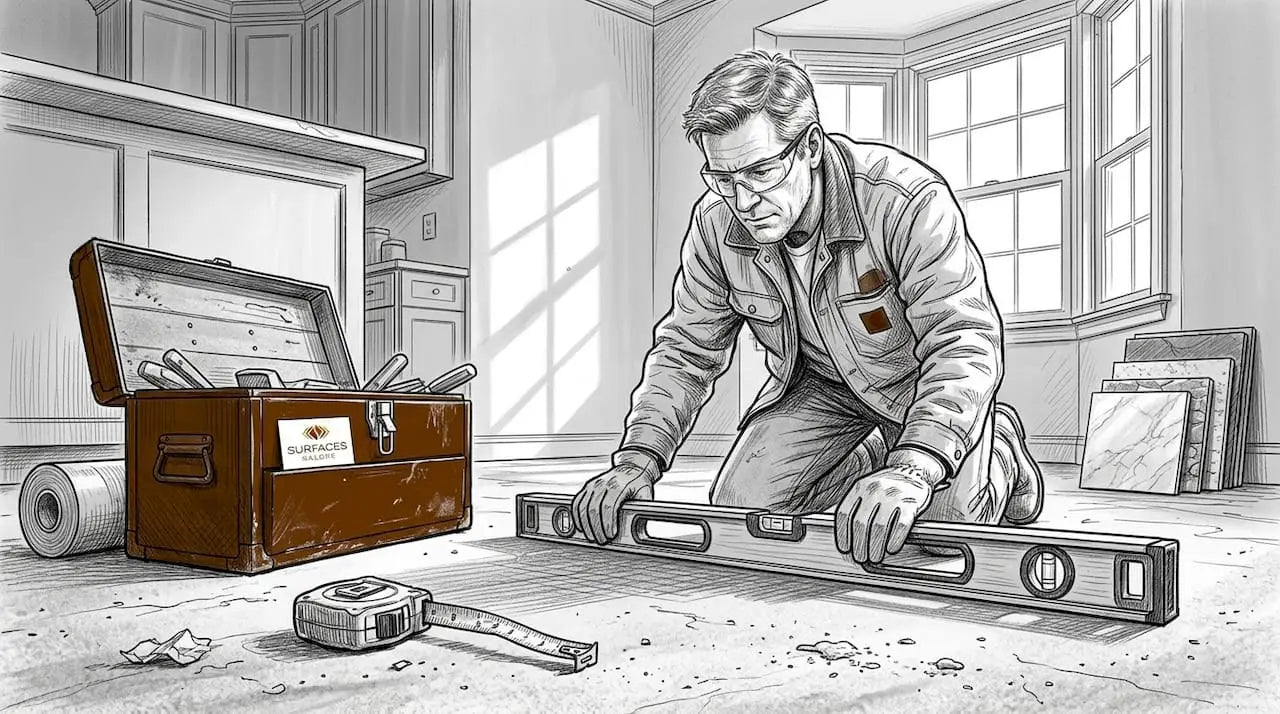
Start by checking three things: flatness, firmness, and moisture. For floors, the TCNA/ANSI standard requires no more than 3/16 of an inch variation over a 10-foot span, and no more than 1/16 of an inch variation over a 12-inch span. Drag your level across the floor in multiple directions and mark any high or low spots with chalk.
For walls, check that the substrate is structurally sound. Press firmly across the surface. Any flex, soft spots, or hollow sounds indicate a problem that must be fixed before tiling. You can use our measuring tile accurately guide to plan your layout once the surface passes inspection.
Step-by-step surface prep
- Remove existing flooring or wall coverings: Scrape adhesive residue completely. Any bump left behind telegraphs through stone.
- Repair the subfloor or wall: Fill low spots with floor-leveling compound. Grind down high spots. Let the compound cure fully before proceeding.
- Install cement backer board if needed: Screw it down every 6 inches along edges and every 8 inches in the field. Tape seams with alkali-resistant mesh tape and thinset.
- Apply waterproofing membrane in wet areas: Brush or roll it on according to manufacturer instructions. Pay extra attention to corners and seams.
- Conduct a moisture test: Tape a plastic sheet to the floor for 24 hours. Condensation under the sheet means moisture is migrating up, which will destroy your mortar bond over time.
- Clean the surface: Vacuum, then damp-mop to remove dust and debris. Let it dry completely before tiling.
“A properly prepared surface is invisible once the tile is down, but a poorly prepared surface shows through every single tile for the life of the installation.”
Pro Tip: If you are working in a bathroom, review our tile renovation guide before finalizing your substrate choice. Shower floors and walls have specific requirements that differ from dry areas.
Wear your PPE throughout prep work. Grinding concrete and cutting backer board creates fine silica dust that is a serious respiratory hazard. An N95 mask is the minimum; a P100 respirator is better for extended work.
Step-by-step tile installation demo
Once your base is ready, it’s time to tackle the main event: precisely laying out and installing your natural stone tiles. This is where patience pays off. Rushing through the installation steps is the fastest way to end up with a floor or wall you are not proud of.
1. Plan your dry layout
Before mixing any mortar, lay out your tiles dry across the entire surface. Start from the center of the room or wall and work outward. This ensures cut tiles at the edges are symmetrical and that you avoid ending up with a tiny sliver of tile in a visible corner. Snap chalk lines to mark your center point and your working grid.
2. Mix your mortar
Follow the manufacturer’s water-to-mortar ratio exactly. Under-watered mortar is crumbly and won’t bond. Over-watered mortar shrinks and weakens. Mix to a peanut butter consistency, let it slake (rest) for 10 minutes, then mix briefly again. This activates the polymers in the mortar.
3. Apply mortar to the substrate
Use the flat side of your trowel to spread a thin bond coat, then comb through it with the notched side at a consistent 45-degree angle. Work in sections no larger than you can tile in 20 to 30 minutes. Mortar that skins over won’t bond properly to the tile back.
4. Back-butter every large tile
This step is non-negotiable for stone tiles over 15 inches. Back-buttering large tiles means spreading a thin layer of mortar on the back of each tile before pressing it into the combed mortar bed. This fills any voids and ensures you hit the required coverage. For a practical visual on how this looks in a shower setting, the marble tile shower workflow is a great reference.
5. Set and level each tile
Press the tile firmly into the mortar with a slight twisting motion, then use your rubber mallet to tap it level. Check with your level after every two or three tiles. Use tile spacers consistently.
6. Verify mortar coverage
Periodically lift a freshly set tile and inspect the back. You should see mortar contact across the full surface with no bare spots. In wet areas, 95% coverage is required by industry standards. If you see voids, add more mortar before resetting.
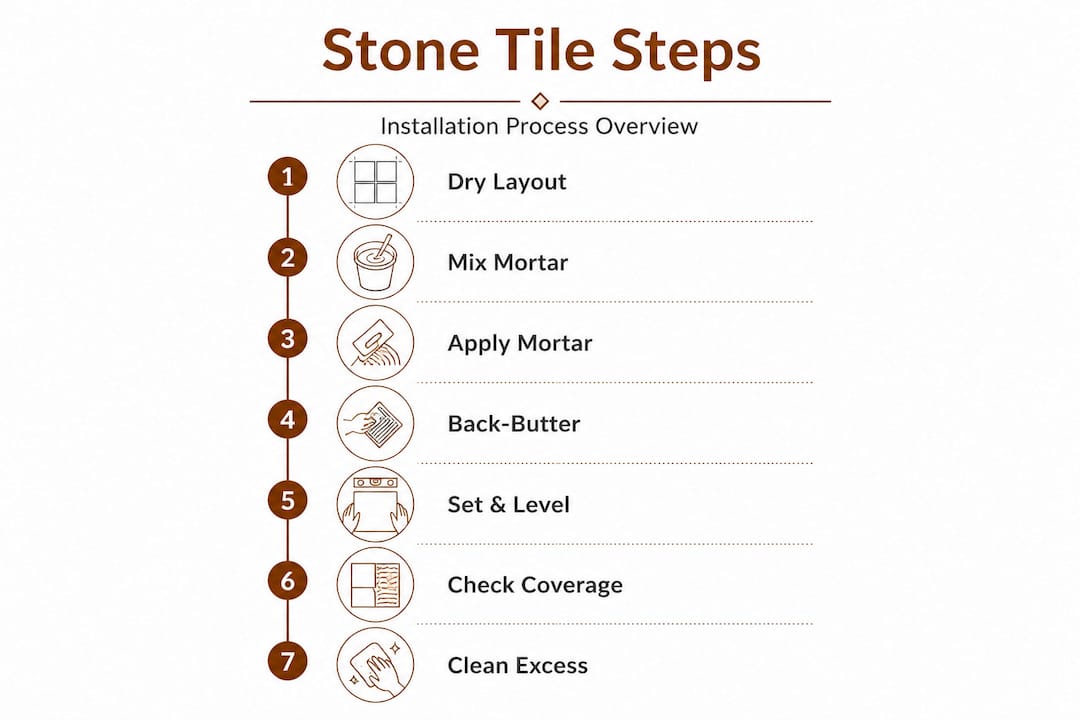
7. Clean excess mortar immediately
Wipe mortar off the tile face with a damp sponge before it hardens. Dried mortar on stone can be very difficult to remove without scratching the surface.
Natural stone vs. porcelain: Key installation differences
| Factor | Natural stone | Porcelain |
|---|---|---|
| Back-buttering | Required for tiles over 15 inches | Recommended but less critical |
| Mortar type | Polymer-modified, non-sag | Standard thinset acceptable |
| Cutting method | Wet saw only | Wet saw or snap cutter |
| Pre-sealing | Required before grouting | Not needed |
| Weight per sq. ft. | Heavier; substrate must be rated | Generally lighter |
| Lippage sensitivity | High; small variations are visible | More forgiving |
Pro Tip: For a detailed breakdown of how the bathroom tile design workflow differs between stone types, plan your layout before purchasing. The wrong tile size for a small bathroom can make the space feel even smaller.
The travertine tiling process is particularly worth studying if you are working with filled travertine, because the open pores require a specific mortar application technique to avoid voids under the tile.
Common pitfalls and troubleshooting
Even with careful planning, mistakes can happen. Here’s how to spot and fix them early, before they become costly.
Top issues and how to handle them
-
Lippage: Tile edges that sit higher or lower than their neighbors. Caused by uneven substrate or inconsistent mortar application. Fix by grinding down high edges with a hand grinder before the mortar fully cures. Prevention is far easier than correction.
-
Uneven grout joints: Usually caused by skipping spacers or rushing the layout. If joints are off by more than 1/16 of an inch, the only real fix is to remove and reset the affected tiles before the mortar cures.
-
Cracked tiles: Can result from a soft spot in the substrate, dropping a heavy tile, or using a snap cutter instead of a wet saw. Always use a wet saw for stone. Check the substrate for flex before tiling.
-
Poor adhesion: Tiles that sound hollow when tapped indicate voids under the tile. This is a serious problem in wet areas because water can migrate under the tile and destroy the bond over time. Tiles with hollow spots must be removed and reset.
-
Inadequate mortar coverage: The TCNA/ANSI guidance is clear that insufficient coverage leads to cracking, especially in freeze-thaw climates or high-traffic areas. Lift test tiles regularly during installation to confirm coverage.
-
Water infiltration: Grout is not waterproof. In wet areas, the waterproofing membrane behind the tile does the real work. If you skipped or compromised the membrane, you will see efflorescence (white mineral deposits) appearing through grout lines within months.
Pro Tip: If you are comparing stone options for a project and want to understand how marble vs ceramic tile behaves differently in high-moisture environments, that comparison can help you choose the right material before you commit.
For mosaic work, the stone mosaic installation guide covers the specific challenges of mesh-mounted stone pieces, which behave very differently from large-format tiles.
When to start over
If more than 10% of your tiles have hollow spots, or if you discover the substrate was not properly waterproofed in a wet area, starting over is the right call. It is a painful decision, but far less painful than water damage behind the wall six months later.
Verifying your results and long-term care
After the tiles are set, a few careful checks and ongoing upkeep will ensure lasting performance and beauty.
Post-installation inspection checklist
- Check levelness: Walk across the floor or run your hand across the wall. Any tile that rocks or feels high needs attention before the mortar fully cures (usually within 24 hours).
- Inspect grout lines: Lines should be consistent in width and depth. Shallow grout is weak grout.
- Look for edge chipping: Examine tile edges closely. Chips that occurred during installation should be noted and addressed with color-matched grout or epoxy filler.
- Confirm full cure before use: Mortar needs at least 24 to 48 hours before light foot traffic, and 72 hours before heavy use. Grout needs 72 hours minimum before exposure to water.
- Clean the surface: Once grout has cured, clean the entire surface with a pH-neutral stone cleaner. Never use vinegar, bleach, or ammonia-based products on natural stone.
Sealing and ongoing maintenance
Apply a penetrating stone sealer after grouting and after the grout has fully cured. This is your second sealer application (the first was before grouting). The TCNA/ANSI framework emphasizes that natural stone’s porous nature makes sealing a maintenance requirement, not a one-time step.
Pro Tip: Test your sealer’s effectiveness by dropping a few water droplets on the tile surface. If the water beads up, the sealer is working. If it soaks in and darkens the stone, it is time to reseal.
- Cleaning frequency: Sweep or vacuum weekly to prevent grit from scratching the surface. Mop with a pH-neutral cleaner monthly.
- Resealing schedule: High-traffic floors need resealing every 12 months. Low-traffic areas or walls may only need it every 2 years.
- Early signs of water damage: Watch for grout discoloration, efflorescence, or tiles that feel loose. These are early warnings that moisture is getting where it should not.
For floors in living areas, the living room tile workflow covers long-term care strategies that apply equally well to kitchen and bathroom stone floors.
The truth about DIY tile success: What the manuals don’t explain
Here is something the TCNA handbook will not tell you: following every specification to the letter is necessary, but it is not enough on its own. We have seen installations where every box was checked and the result was still mediocre, and we have seen careful, patient DIYers produce work that looked genuinely professional. The difference was not the rulebook. It was the mindset.
Stone tile is unforgiving in a way that porcelain simply is not. Porcelain hides small errors. Stone amplifies them. A 1/16-inch lippage that you might not notice in a ceramic floor becomes immediately obvious in a marble or travertine surface because the polished or honed finish catches light at every angle. This is not a reason to avoid stone. It is a reason to slow down.
The single most valuable thing you can do on any stone tile project is to spend more time on the dry layout than you think is necessary. Most DIYers rush this step because it feels like nothing is getting done. But a dry layout is where you catch problems before they are permanent. You discover that the natural variation in your travertine pieces means certain tiles need to be rotated for a better color match. You realize that your center point puts a tiny cut tile right at the shower entrance. You find that two tiles in the batch have a thickness difference that will create lippage no matter how carefully you set them.
The travertine tiling advice we share consistently reinforces this point: the prep and planning phase is not the boring part before the real work. It is the real work.
There is also an honest conversation to have about cleanup. Mortar and grout cleanup on stone is more demanding than on glazed tile because the surface is not sealed from the factory. If you let grout haze dry on an unpolished travertine surface, you will spend hours removing it. Keep your sponges clean, change your water constantly, and clean as you go. It is not glamorous advice, but it is the advice that separates a beautiful finished floor from a frustrating one.
Finally, give yourself permission to redo a section. Many DIYers set a tile that is clearly off and leave it because pulling it up feels like admitting failure. It is not. It is good craftsmanship. Stone rewards patience and punishes shortcuts every single time.
Ready to tackle your tile project?
You now have a complete picture of what it takes to install natural stone tile with confidence and precision. The next step is getting your hands on materials that are actually worth the effort you are about to put in.

At Surfaces Galore, we import premium marble, travertine, and limestone tiles directly, which means you get authentic natural stone at prices that make sense for a homeowner budget. Every piece we carry is selected for quality, consistency, and beauty. Browse our full collection of natural stone tiles, mosaics, and decorative pieces online, and if you need help choosing the right stone for your specific project, our team is ready to guide you. We ship nationwide, so your dream renovation is closer than you think.
Frequently asked questions
What is the minimum mortar coverage required for natural stone tiles in wet areas?
Industry standards require 95% mortar coverage for natural stone tiles in wet areas to prevent water penetration and tile failure. This is why back-buttering and proper trowel technique are non-negotiable in showers and around tubs.
Do I need to back-butter large natural stone tiles?
Yes. Large-format tiles over 15 inches require back-buttering to ensure proper adhesion and full mortar coverage across the entire tile back. Skipping this step almost always results in hollow spots and eventual failure.
What’s the most common mistake DIYers make with stone tile?
Improper surface preparation and inadequate mortar coverage are the most common causes of failures in natural stone tile installations. Stone does not tolerate voids or an uneven substrate the way more forgiving materials do.
How do you clean up excess mortar or grout from stone tiles without damage?
Clean excess mortar or grout with a damp sponge immediately after application, and avoid any harsh chemicals or acidic cleaners that can etch or discolor the stone’s natural finish. Rinse your sponge frequently and change your water often to avoid spreading grout haze back onto the surface.
How often should natural stone tiles be sealed?
Natural stone tiles generally need resealing every 1 to 2 years depending on foot traffic, usage, and the specific stone type. High-traffic floors like kitchen entries need annual resealing, while bathroom walls may go two years between applications.
Recommended
- Step-by-step travertine tiling: A DIY guide for homeowners– SurfacesGalore
- Home Tile Renovation Guide 2026: 30% Less Edge Chipping– SurfacesGalore
- How to grout stone tiles: marble & travertine guide– SurfacesGalore
- How to Match Tile Patterns for Flawless Design Results– SurfacesGalore
- Waterproofing Under Tiles: 3-Day Cure Prevents Leaks
Leave a comment