
What is split face marble? 75% safer with textured elegance

Many designers mistakenly assume split face marble is fragile compared to polished finishes, but this textured stone offers comparable structural integrity with significantly enhanced safety features. This guide clarifies what split face marble actually is, how it’s produced, and why its unique characteristics make it ideal for both residential and commercial projects. You’ll learn about its texture, durability advantages, maintenance requirements, and practical applications to confidently specify this versatile material.
Table of Contents
- Introduction To Split Face Marble
- Visual And Textural Characteristics
- Advantages And Limitations Of Split Face Marble
- Common Misconceptions About Split Face Marble
- Comparing Split Face Marble With Other Marble Finishes
- Design Applications And Use Cases
- Practical Sourcing And Specification Tips
- Conclusion And Next Steps
- Discover Premium Split Face Marble And Expert Guidance
- FAQs About Split Face Marble
Key takeaways
| Point | Details |
|---|---|
| Split face marble is created by mechanically splitting marble blocks along natural grain lines, revealing raw texture | This production method creates a rough, three-dimensional surface distinct from polished or honed finishes |
| The textured finish provides up to 75% better slip resistance than polished marble | Enhanced safety makes it ideal for commercial flooring and high-traffic areas |
| Despite its rugged appearance, split face marble maintains structural strength comparable to polished stone | The splitting process doesn’t compromise the marble’s inherent durability |
| The porous, rough surface requires more frequent cleaning and consistent sealing protocols | Higher maintenance needs compared to smooth finishes but rewards with long-lasting beauty |
| Versatile applications span accent walls, facades, fireplaces, and commercial flooring | Works exceptionally well combined with smooth marble, wood, or metal for layered design palettes |
Introduction to split face marble
Split face marble is created through a mechanical process that splits large marble blocks along their natural grain lines, exposing the stone’s raw internal structure. This production method contrasts sharply with polished finishes that achieve high gloss through grinding and buffing, or honed finishes that create smooth matte surfaces. The splitting reveals inherent mineral variations, fissures, and color depth without any surface treatment.
The rough, dimensional texture defines split face marble’s character. Unlike polished marble’s mirror-like reflection or honed marble’s uniform smoothness, split face showcases the stone’s geological history through its irregular surface. This authenticity appeals to designers seeking natural, tactile materials that connect spaces to their organic origins.
Key distinguishing characteristics include:
- Raw, jagged surface texture with visible mineral stratification
- Three-dimensional depth ranging from subtle to dramatic relief
- Matte appearance with minimal light reflection
- Enhanced tactile engagement inviting touch and close inspection
- Variable surface plane creating shadow play and visual interest
The mechanical splitting process preserves the marble’s structural integrity while revealing its natural beauty. This production method allows each piece to display unique characteristics, ensuring no two installations look identical. Understanding this foundation helps you evaluate how split face marble might serve your design intentions.
Visual and textural characteristics
The rough, irregular surface of split face marble creates dramatic visual depth absent in smooth finishes. Visible mineral grains, natural fissures, and color variations become pronounced features rather than subtle details. This texture invites tactile interaction, encouraging occupants to engage physically with architectural surfaces in ways polished stone cannot achieve.
Light interacts differently with split face marble’s dimensional surface. Rather than creating mirror-like reflections, the rough texture scatters light, producing soft shadows and highlighting the stone’s natural contours. This low reflectivity reduces glare in commercial spaces while emphasizing the material’s organic patterns and geological character.
Pro Tip: Combine split face with polished marble elements to create striking architectural contrast. Use split face for vertical accent walls and polished stone for horizontal surfaces to balance visual weight while showcasing marble texture options within a single space.
The matte appearance delivers sophisticated elegance without the high maintenance demands of maintaining polished shine. Natural wear patterns blend seamlessly into the textured surface, making split face marble particularly forgiving in high-traffic environments. Color variations become more pronounced, with darker and lighter mineral deposits creating organic patterns that shift with viewing angles.
Key visual elements include:
- Pronounced three-dimensional relief creating depth perception
- Matte surface reducing light reflection and glare
- Enhanced color variation visibility
- Natural shadow patterns changing throughout the day
- Rugged aesthetic conveying authenticity and permanence
This combination of visual and tactile qualities positions split face marble as an ideal choice for spaces requiring both aesthetic impact and functional performance. The texture becomes a design feature rather than simply a surface treatment.
Advantages and limitations of split face marble
Split face marble delivers significant practical advantages that extend beyond aesthetics. The rough texture provides superior slip resistance, with studies showing up to 75% better traction compared to polished surfaces. This safety benefit makes it particularly valuable for commercial lobbies, bathroom floors, and exterior walkways where wet conditions pose risks.
Durability matches polished marble because the splitting process doesn’t compromise the stone’s structural integrity. The marble’s inherent strength depends on its geological composition and density, not surface treatment. Split face finishes actually help mask minor scratches and wear patterns that would be obvious on smooth surfaces, extending the perceived lifespan of the installation.
Pro Tip: Develop detailed maintenance schedules during the design phase and educate clients about sealing requirements. Regular sealing every 12 to 18 months protects the porous surface while preserving its natural appearance and maximizing longevity.
However, the textured surface presents maintenance challenges. Greater porosity compared to polished finishes means the stone absorbs liquids more readily, increasing staining risks. The irregular surface traps dust, debris, and moisture in crevices, requiring more frequent cleaning. Proper marble maintenance protocols become essential for preserving appearance and performance.
Key advantages include:
- Enhanced slip resistance ideal for safety-critical applications
- Structural strength comparable to polished finishes
- Natural wear pattern masking extending aesthetic lifespan
- Reduced glare beneficial in commercial environments
- Authentic texture creating memorable spatial experiences
Primary limitations involve:
- Higher porosity demanding consistent sealing schedules
- Increased cleaning frequency to prevent buildup
- More complex installation requiring experienced fabricators
- Potential for debris accumulation in surface crevices
- Initial client education needs regarding maintenance expectations
Balancing these factors during specification ensures successful project outcomes. Understanding both benefits and trade-offs allows you to match material characteristics to project requirements and client capabilities.
Common misconceptions about split face marble
Many designers believe split face marble is inherently fragile due to its rough appearance, but this assumption conflates aesthetics with structural performance. The stone’s strength depends on its geological composition, density, and mineral structure, not surface treatment. A properly selected split face marble from dense quarries performs as reliably as polished versions of the same stone type.
Another frequent misconception suggests maintenance requirements match polished marble. In reality, the textured surface demands more intensive care protocols. The rough texture traps contaminants that smooth surfaces shed easily, requiring specialized cleaning approaches and more frequent attention to prevent buildup and staining.
Some professionals restrict split face marble to exterior applications only, missing significant interior opportunities. While the finish excels in outdoor facades due to its weather resistance and slip properties, it equally serves interior accent walls, fireplaces, and feature elements. Commercial designers increasingly specify split face for lobby walls, retail displays, and hospitality spaces where tactile engagement enhances brand experience.
Key myths clarified:
- Myth: Rough texture indicates weakness — Truth: Surface finish doesn’t determine structural integrity
- Myth: Maintenance matches polished stone — Truth: Textured surfaces require specialized care and more frequent sealing
- Myth: Only suitable outdoors — Truth: Equally effective for interior accent walls, fireplaces, and commercial features
- Myth: Installation is straightforward — Truth: Requires experienced fabricators familiar with textured stone handling
- Myth: Limited design versatility — Truth: Combines effectively with multiple materials for layered aesthetics
Correcting these misconceptions empowers confident specification decisions. Understanding the material’s actual characteristics rather than assumed limitations expands design possibilities and prevents unnecessary project restrictions.
Comparing split face marble with other marble finishes
Different marble finishes serve distinct functional and aesthetic purposes. This comparison helps you evaluate which surface treatment best matches your project requirements, maintenance capacity, and design vision.
| Characteristic | Split Face | Polished | Honed |
|---|---|---|---|
| Surface Texture | Rough, jagged, three-dimensional relief | Smooth, mirror-like, highly reflective | Smooth, matte, minimal reflection |
| Slip Resistance | High (75% better than polished) | Low, especially when wet | Moderate, better than polished |
| Maintenance Level | High (frequent sealing, detailed cleaning) | Moderate (periodic polishing, regular cleaning) | Moderate (regular sealing, routine cleaning) |
| Light Reflection | Minimal, creates shadow patterns | Maximum, mirror-like shine | Low, soft matte appearance |
| Scratch Visibility | Low (texture masks minor damage) | High (scratches highly visible) | Moderate (less obvious than polished) |
| Installation Complexity | High (experienced fabricators needed) | Moderate (standard techniques) | Moderate (standard techniques) |
| Staining Risk | Higher due to porosity | Lower with proper sealing | Moderate with proper sealing |
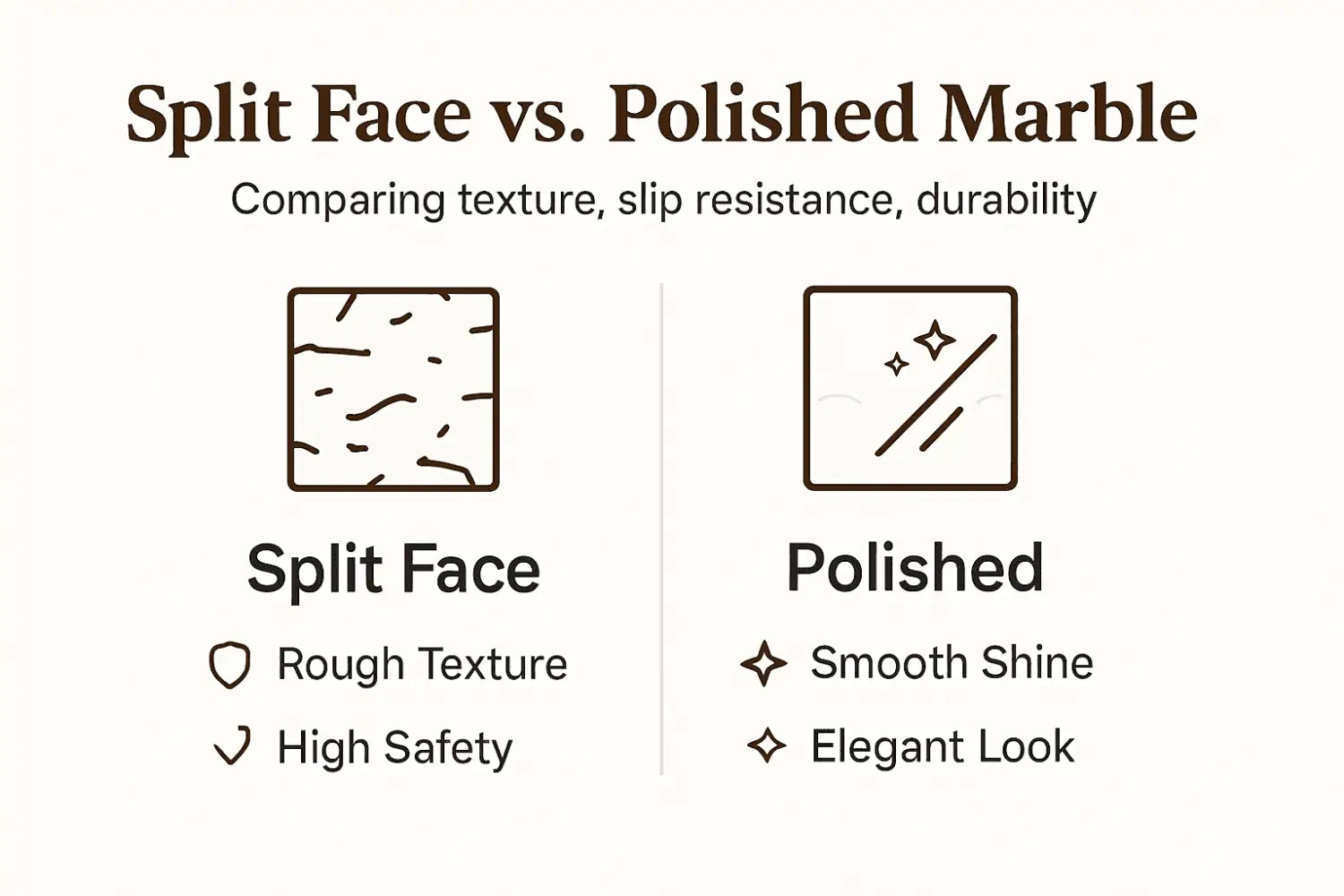
Polished marble finishes deliver maximum elegance and reflectivity, ideal for formal spaces where visual impact matters most. The smooth surface simplifies cleaning but shows every scratch and requires regular maintenance to preserve shine. Polished stone works best in controlled environments with lower foot traffic.
Honed finishes offer middle ground versatility. The smooth matte surface provides easier maintenance than split face while delivering better slip resistance than polished stone. Honed marble suits diverse applications from kitchen countertops to commercial flooring where balanced performance matters.
Split face marble excels when texture, slip resistance, and authentic character take priority over reflectivity. Understanding these marble surface finish differences allows you to specify the right treatment for each project element, potentially combining multiple finishes to achieve layered design narratives.
Choosing depends on:
- Functional requirements including safety and durability needs
- Aesthetic vision balancing texture with reflection
- Maintenance capacity and client expectations
- Budget considerations for installation and ongoing care
- Environmental factors like moisture exposure and traffic patterns
This data-driven comparison supports informed material selection aligned with project success criteria.
Design applications and use cases
Split face marble creates powerful focal points in both residential and commercial environments. The dimensional texture naturally draws attention, making it ideal for accent walls that define spaces without requiring additional ornamentation. Interior designers frequently specify split face for living room feature walls, where its tactile quality invites interaction and conversation.

Commercial applications leverage the finish’s superior slip resistance and durability. Hotel lobbies, corporate entrances, and retail spaces use split face marble flooring to balance safety requirements with luxury aesthetics. The texture’s ability to mask wear patterns maintains professional appearance longer than polished alternatives in high-traffic environments.
Residential fireplaces and surrounds showcase split face marble’s ability to convey warmth and authenticity. The rough texture complements flames’ organic movement while providing fire-resistant durability. Bathroom accent walls benefit from increased slip resistance when wet, combining safety with spa-like ambiance.
Exterior facades demonstrate split face marble’s weather resistance and architectural presence. The texture creates depth and shadow play that changes throughout the day, adding dynamic visual interest to building exteriors. Commercial developments increasingly specify split face for ground-floor facades where pedestrian interaction and durability matter most.
Popular applications include:
- Interior accent walls creating tactile focal points in living areas
- Commercial flooring where slip resistance and durability are critical
- Fireplace surrounds combining aesthetic warmth with practical fire resistance
- Building facades providing weather-resistant architectural character
- Lobby feature walls establishing memorable brand experiences
- Bathroom accent walls balancing safety with luxury aesthetics
The finish combines exceptionally well with contrasting materials. Pairing split face marble with smooth wood creates organic material narratives. Metal accents against textured stone emphasize modern-traditional fusion. Glass and polished marble in interior applications provide reflective contrast to split face’s matte absorption.
Successful integration requires considering how occupants will interact with the surface. Position split face at touchable heights in residential settings where tactile engagement enhances experience. In commercial spaces, use split face for vertical surfaces while reserving smoother finishes for horizontal surfaces requiring easier cleaning.
Practical sourcing and specification tips
Reliable sourcing begins with selecting certified suppliers who provide detailed authenticity documentation. Request quarry certifications, mineral composition reports, and finish consistency guarantees before committing to large orders. Reputable suppliers readily share this information and welcome specification questions.
Verify the geographic origin of marble to assess quality characteristics. Italian Carrara delivers different properties than Turkish or Greek marble, even with identical split face finishes. Origin affects color consistency, density, and long-term performance, making it a critical specification factor.
Request physical samples showing the full range of texture and color variation. Digital images cannot accurately convey split face marble’s three-dimensional qualities or tactile characteristics. Examine samples under various lighting conditions to understand how the texture will perform in your specific application.
Coordinate early with fabricators experienced in split face installations. The textured finish requires specialized cutting techniques and handling procedures different from smooth marble. Experienced fabricators prevent installation issues that could compromise appearance or structural performance.
Develop comprehensive maintenance specifications within project documentation. Include detailed sealing schedules, recommended cleaning products, and maintenance frequency guidelines. Educating clients about care requirements during the design phase prevents disappointment and ensures long-term satisfaction.
Key sourcing steps include:
- Partner with certified suppliers offering authenticity verification
- Verify quarry origin to assess inherent quality characteristics
- Request substantial physical samples showing variation ranges
- Confirm fabricator experience with textured stone installations
- Specify detailed maintenance protocols in project documentation
- Plan sealing schedules before installation completion
- Establish realistic client expectations regarding care requirements
Pro Tip: Order 10 to 15 percent more material than calculated needs to accommodate natural variation and potential replacement needs. Split face marble’s unique texture makes exact matching difficult if additional material is needed later.
Building relationships with knowledgeable suppliers pays dividends across multiple projects. Suppliers familiar with design professional needs provide technical support, sample coordination, and specification assistance that streamlines the selection process. Prioritize suppliers who understand both material properties and design applications.
Conclusion and next steps
Split face marble uniquely combines rugged texture with reliable structural strength, delivering both aesthetic impact and functional performance. The 75% improved slip resistance over polished finishes makes it invaluable for safety-critical applications without sacrificing luxury appeal. While maintenance demands exceed smooth finishes, proper care protocols ensure decades of natural beauty.
The textured finish serves diverse applications from residential accent walls to commercial flooring, adapting to varied design visions while maintaining authentic character. Understanding production methods, maintenance requirements, and sourcing best practices empowers confident specification decisions that meet client needs and project goals.
Successful integration requires balancing aesthetic desires with practical considerations. Partner with certified suppliers, verify material origins, and coordinate with experienced fabricators to ensure quality outcomes. Develop comprehensive maintenance plans that set realistic expectations and protect long-term investments.
Explore trusted suppliers offering authenticated split face marble to begin incorporating this versatile material into your upcoming projects. The combination of tactile engagement, safety benefits, and timeless elegance positions split face marble as a valuable addition to any design professional’s material palette.
Discover premium split face marble and expert guidance
After exploring split face marble’s unique characteristics and applications, sourcing authentic, certified material becomes your next priority. Surfaces Galore offers curated selections of premium split face marble with complete authenticity documentation and origin verification. Our direct import model ensures competitive pricing without compromising quality or reliability.
Access comprehensive educational resources including detailed natural stone guides and types of natural stone comparisons tailored for design professionals. Our expert team provides specification support, sample coordination, and technical guidance to simplify your material selection process.
Explore our complete collection and connect with knowledgeable specialists at Surfaces Galore to find the perfect split face marble for your next residential or commercial project. We ship nationwide from our Anaheim, California facility, delivering premium natural stone directly to your project site.
FAQs about split face marble
Is split face marble suitable for bathroom floors?
Yes, the enhanced slip resistance makes split face marble safer for bathroom floors than polished alternatives, especially when wet. However, consistent sealing every 12 to 18 months is essential to prevent water staining and maintain the stone’s protective barrier. The porous texture absorbs moisture more readily than smooth finishes, requiring diligent maintenance protocols.
How does the cost of split face marble compare to polished marble?
Pricing is generally comparable, though split face may cost slightly more due to labor-intensive mechanical splitting processes. Final costs vary significantly based on marble origin, quality grade, and supplier relationships. Installation expenses may exceed polished marble due to specialized fabrication requirements and experienced labor needs.
Can split face marble be used outdoors?
Yes, split face marble excels in exterior applications including building facades, walkways, and landscaping features. The rugged texture provides excellent slip resistance for outdoor pedestrian surfaces while weathering naturally over time. Proper sealing and periodic maintenance extend outdoor performance, though expect gradual patina development that many designers view as enhancing authentic character.
What maintenance does split face marble require compared to polished marble?
Split face marble demands more frequent cleaning to remove debris trapped in surface crevices and consistent sealing every 12 to 18 months to protect against staining. Polished marble requires less intensive cleaning due to its smooth surface but shows scratches and etching more prominently. Both finishes benefit from pH-neutral cleaners, but split face needs specialized tools to reach textured areas effectively.

Leave a comment